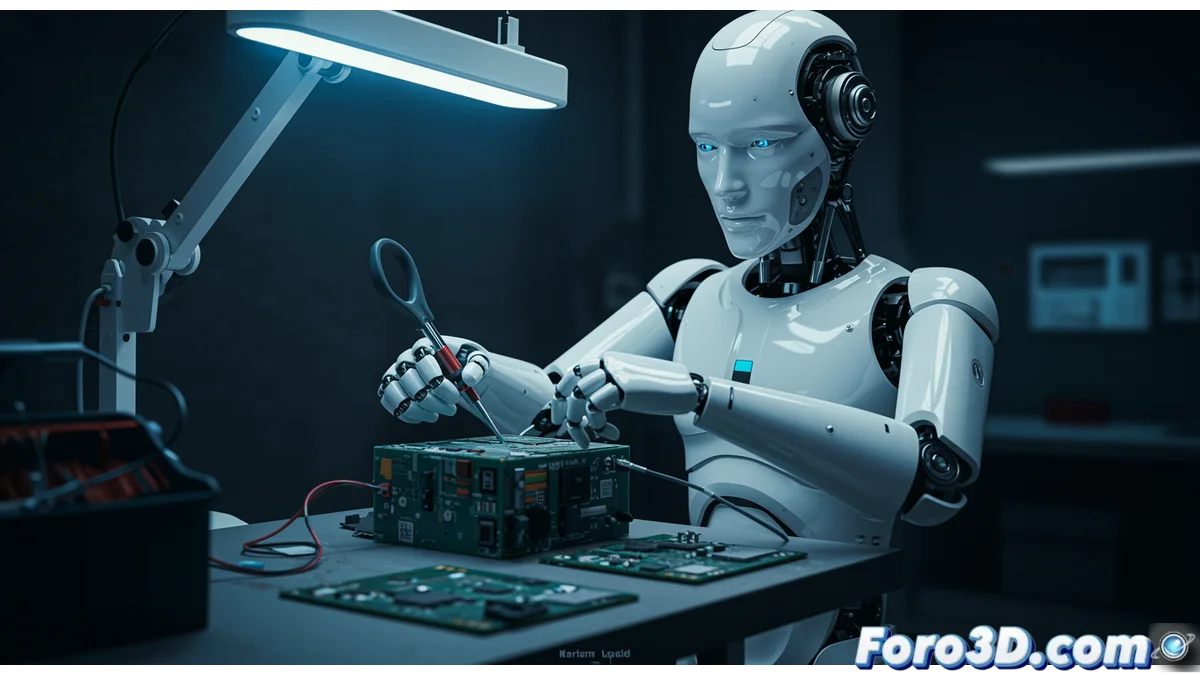
Xiaomi Director Reveals Timeline for Mass Arrival of Humanoid Robots in Factories
In an announcement that marks a turning point in its manufacturing strategy, Lei Jun, founder and CEO of Xiaomi, has publicly detailed the timelines for incorporating humanoid robots into its production lines. During a corporate event, the executive confirmed that the first experimental deployments on assembly lines will begin in the second half of this year, with the ambition to achieve large-scale implementation in all its manufacturing plants within a horizon of one to two years. 🤖
The Industrial Vision Behind the CyberOne Project
This ambitious timeline is not an improvised statement, but the materialization of a long-gestating internal project. Xiaomi presented its first functional prototype in 2022, the bipedal robot CyberOne, which at the time surprised with its environmental perception capabilities and even emotion recognition. Although many saw it as a mere technological image exercise, Lei Jun's vision always had a clear practical and industrial application. The company plans phased integration, starting with basic logistical tasks such as internal component transportation, and later addressing complex assembly operations that require the dexterity of its articulated hands.
Key Phases of Implementation:- Experimental Phase (2024): Initial deployment in controlled factory environments for logistical and transportation tasks.
- Scaling Phase (2025-2026): Expansion to more plants and start of assembly tasks requiring precise manipulation.
- Maturity Phase (2026 onward): Full and collaborative integration into main production lines, working side by side with human operators.
"The bet on the human form is not a design whim. These robots are designed to operate in spaces already built for people, without the need for costly and disruptive remodeling of existing factories." – Strategic reflection from the company.
Reconfiguring the Global Manufacturing Landscape
Xiaomi's decision decisively accelerates the global race for industrial humanoid robotics, positioning itself in direct competition with flagship projects like Tesla's Optimus and specialized Chinese firms like Fourier Intelligence. This move exerts considerable competitive pressure on other consumer electronics giants, who may be forced to accelerate their own advanced automation plans. The next decade could witness a radical transformation in assembly workshops, where collaboration between humans and humanoids will cease to be science fiction to become an everyday operational reality. ⚙️
Main Players in the Industrial Humanoids Race:- Tesla (Optimus): The most high-profile project, with the stated goal of creating a general-purpose and affordable humanoid robot.
- Fourier Intelligence: Chinese company specialized in rehabilitation robotics and exoskeletons, which has diversified into humanoids for logistics.
- Xiaomi (CyberOne): Practical and scalable focus, prioritizing immediate integration into its own supply and production chains.
A Future of Collaboration on the Production Line
While engineers finalize the details for the first day of work of these new automaton employees, the factory ecosystem prepares for an unprecedented coexistence. Human workers will not only have to get used to their presence, but also adapt some safety and space organization protocols, such as ensuring there are no obstacles in the aisles. This Xiaomi milestone is not just a technological advance for the company; it is a harbinger of the future of manufacturing, a future where efficiency and flexibility will come hand in hand (literally) from machines with a human form. 🏭