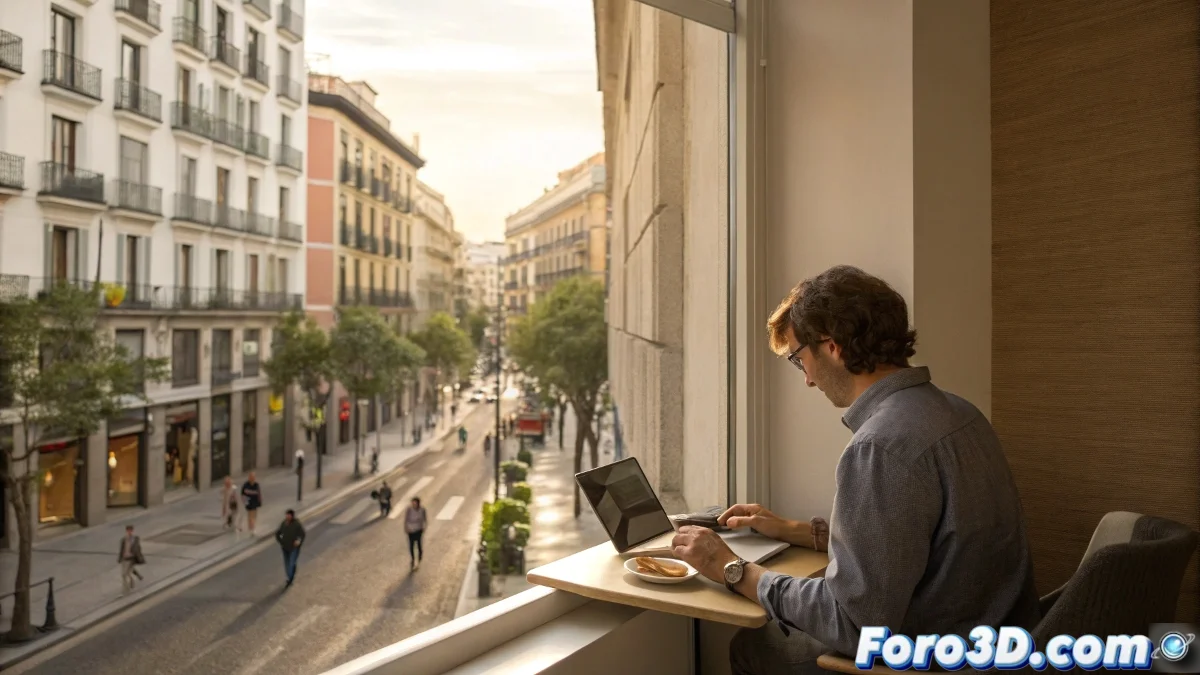
The Perfect Equation: Train + Suburbs = Massive Savings
A residential phenomenon is gaining strength among professionals who work in Madrid but seek alternatives to the stratospheric housing prices in the capital. The formula is simple: towns located just 30 minutes by train from Atocha or Chamartín offer apartments with price differences that can reach 300,000 euros compared to similar properties in central Madrid districts. This price gap is redrawing mobility patterns in the community.
The paradigmatic case is led by municipalities like Guadalajara, Alcalá de Henares, or El Escorial, where professionals from technology, finance, and creative sectors are investing housing savings in a higher quality of life. While a 90 square meter apartment in Chamberí can exceed 600,000 euros, in these towns they are found for around 300,000 euros, allowing more sustainable mortgages and even the possibility of acquiring larger homes with the same budget.
The commuter train has become the best housing savings tool
Urban Comparison Project Setup
To visually represent this phenomenon in Cinema 4D, we began by creating a scene that compares two contrasting urban environments: dense central Madrid and a well-connected peripheral town. The composition is structured around the fundamental connecting element: train tracks and stations. We set up the scene with real units and precise scales to convey verisimilitude in the comparison.
We establish a camera system that allows smooth transitions between both scenarios, highlighting differences in building density, green spaces, and urban atmosphere. The lighting is configured to show both environments under the same hourly conditions, enabling objective comparisons without lighting biases.
- Scene setup with real metric units
- Camera system setup for transitions
- Definition of differentiated color palette by zones
- Preparation of visual comparison elements
Modeling the Madrid Urban Environment
Central Madrid is represented by blocks of characteristic buildings from districts like Salamanca, Chamberí, or Argüelles. Using procedural modeling techniques, we create facades with traditional Madrid architectural typology: average height of 5-6 floors, continuous balconies, and ornamental details. The materials replicate the characteristic limestone and brick.
The scene includes identifying urban elements: narrow streets, scarce vegetation, high density of shops, and moderate traffic. Housing prices are represented by emerging graphs showing the value per square meter, placing the viewer in the premium location context that justifies the high prices.
- Modeling of characteristic Madrid center blocks
- Texturing of facades with realistic architectural materials
- Inclusion of identifying urban elements
- Implementation of particle systems for traffic and pedestrians
Creation of the Connected Periurban Environment
The peripheral town is modeled with a different architectural typology: lower height buildings, greater presence of green areas, and interspersed single-family homes. The atmosphere conveys greater tranquility and open spaces, with wider streets and lower construction density. The materials use lighter tones and less urban textures.
The key element is the train station, modeled in detail and positioned as the neuralgic center of the composition. The tracks converge towards Madrid, visually establishing the connection that makes this residential option viable. Travel times are indicated by numerical displays integrated into the scene.
Visual Price Comparison System
The core of the animation lies in the direct price comparison. We developed a system of three-dimensional bar graphs that grow from the ground showing the 300,000 euro difference. These bars use different materials according to the represented value: gold for Madrid, silver for the peripheral town.
The animation shows how the savings could be allocated to other aspects: an additional bar represents extra square meters available for the same price, while floating icons show better quality of life, lower noise pollution, and greater access to natural spaces. Each element is carefully timed to create narrative impact.
- Animation of comparative bar graphs
- Visual representation of savings and its potential use
- Indicators of quality of life and extra square meters
- Animated informative label system
Train Journey Animation
A key sequence shows the train journey between both points, represented by a motion path connecting the two locations. The train car is modeled in detail and animated following the route curve, while the environment gradually changes from dense urban to more open periurban.
During the journey, a display shows the elapsed time, highlighting that in just 30 minutes a radically different housing price environment is reached. The train windows function as screens showing comparative data during the trip, educating the viewer while virtually traveling.
Materials and Shaders for Economic Narrative
We developed specific materials that reinforce the central message. Madrid buildings use shaders with metallic reflections suggesting premium and high value, while peripheral constructions employ more matte and organic materials. The particle system for monetary circulation shows money flows redistributed from housing to other aspects of life.
Data elements use controlled emission to stand out at key animation moments. Numerical values appear with HUD-like effects reminiscent of financial interfaces, reinforcing the concept of smart economic decision-making.
- Development of shaders differentiated by economic value
- Particle system for monetary flow visualization
- Interface materials for economic data
- Glow and emission effects for highlighted elements
Integration of Real Data and Context Elements
The scene incorporates real estate data through animated texts showing prices per square meter, historical evolution, and district comparisons. Pie charts show how the budget is distributed in each scenario: higher mortgage percentage in Madrid versus more balanced distribution in the periphery.
Context elements like quality of life statistics, commuting times, and available services are integrated into informative panels that appear strategically during the animation. This information layer turns the visual piece into an analysis tool as well as an aesthetic experience.
Render and Post-Production for Communicative Impact
The final render optimizes message clarity through careful composition and post-production effects. We use separate render passes for independent control of architectural elements, numerical data, and special effects. Color grading reinforces the contrast between both residential environments.
The final version includes animated infographic elements that summarize the key findings, making the piece suitable for media and social media dissemination. The result is a powerful visualization that transforms abstract data into an understandable and visually appealing narrative.
It seems that the most profitable train station is not the metro one, but the commuter train towards a sustainable mortgage 🚆