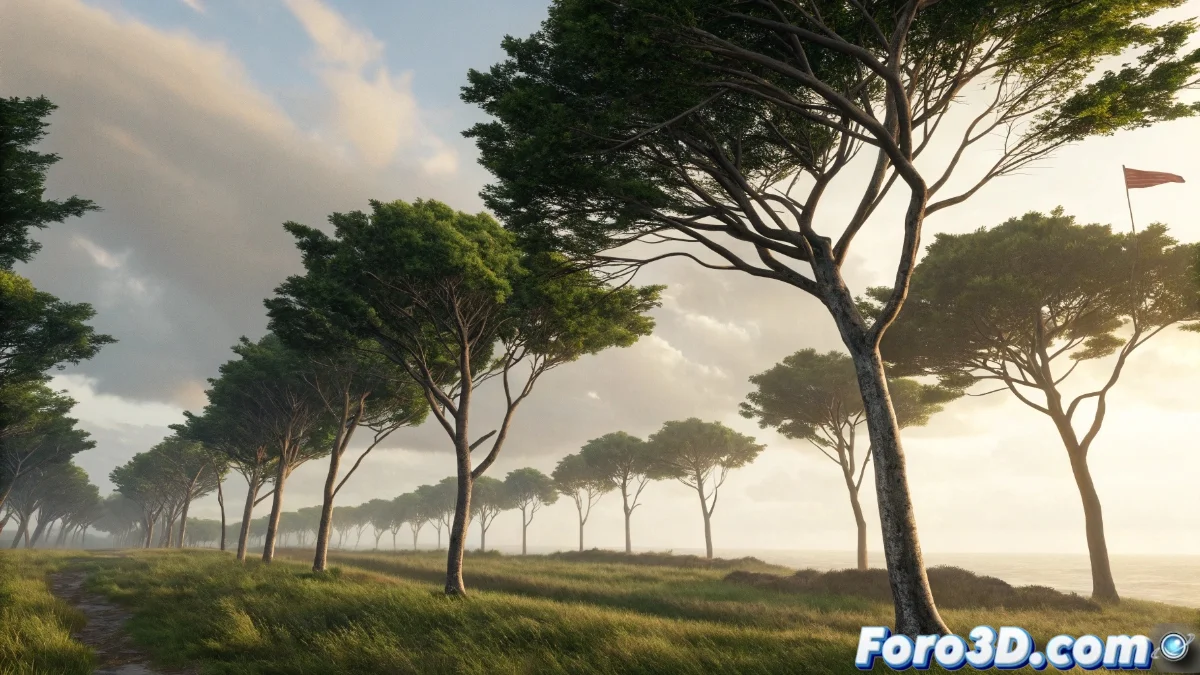
Wind Effect in Unreal Engine 5: Dynamic Wind Simulation for Interactive Environments
The Wind Effect integrated into Unreal Engine 5 revolutionizes the way developers simulate atmospheric interactions, applying directional forces that deform mesh vertices in real time. This tool is perfect for elements like trees, flags, or any flexible object, providing detailed control without relying on external code 🌬️.
Initial Wind System Setup
To implement the effect, a wind component is added to the corresponding actor within the editor. Key settings include intensity, turbulence, and direction, which are modified in the details panel to adapt to the project's scale. Defining the target geometry, such as a mesh skeleton for vegetation, ensures that deformations are natural and consistent.
Essential Parameters:- Wind Intensity: Controls the base wind force, from light breezes to powerful gusts
- Oscillation: Adds variability and organic movement, mimicking real wind patterns
- Directional Force: Sets the angle and impact vector to align with the visual environment
The native integration with systems like Nanite and Lumen ensures that wind effects are not only visually impressive but also resource-efficient.
Optimization and Practical Applications
In high-performance projects, it is vital to restrict the wind's scope to visible objects and use levels of detail (LOD) to minimize computational cost. Common scenarios include open worlds with interactive foliage or adventures where weather influences gameplay. Combining Wind Effect with particles and audio enriches immersion while maintaining a smooth experience.
Highlighted Use Cases:- Natural Environments: Forests and meadows where vegetation reacts to weather in real time
- Dynamic Elements: Flags, fabrics, and flexible structures that respond to environmental conditions
- Weather Events: Storms or blizzards that affect the player visually and audibly
Final Thoughts on the Tool
The Wind Effect demonstrates how Unreal Engine 5 simplifies the creation of dynamic environments, offering predictable yet organic simulation. Unlike real wind, this virtual system doesn't mess up digital hairstyles, but it does elevate realism and interactivity in graphically demanding projects 💨.