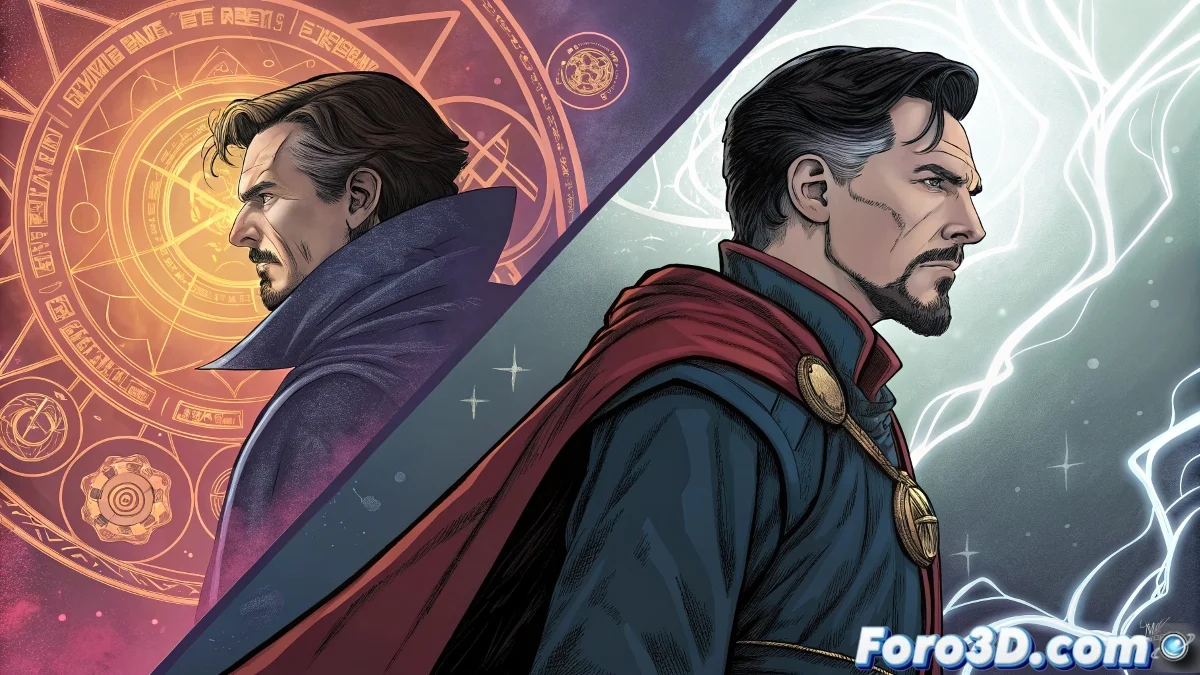
When Doctor Strange Loses His Magic
If you're a fan of Doctor Strange comics, you've probably already noticed that things aren't going down the best path. In this fifth volume, that feeling of a lost series is more present than ever. After the departure of Steve Ditko, who gave identity and atmosphere to the early adventures, what we have left now seems more like an attempt to keep the character in circulation than a project with genuine creative intent.
A Succession of Soulless Stories
We open the volume right where the previous one ended, with a confrontation between Stephen Strange and the Living Tribunal. The mission: to rescue Victoria Bentley, a character who tries to be a regular companion to the Doctor but never quite takes off. The plot continues with the typical duel against Baron Mordo and the appearance of Nebulos, an extradimensional creature that also leaves no mark. And as if that weren't enough, a new villain is introduced, Yandroth. Imagine the scientific reverse of the Sorcerer Supreme... but pitting him against a robot, in a story that would fit better in an Iron Man series than in that of the Master of the Mystic Arts.
From the Mystical to the Routine
What were once dreamlike journeys through impossible dimensions is now reduced to physical fights and almost textbook conflict resolution. Doctor Strange no longer explores alternate realities or philosophical concepts, but instead limits himself to casting spells like someone throwing combos in a video game. Magic, instead of feeling like a mysterious force, seems like just another combat tool, like Captain America's shield or Spider-Man's webs.
A Transition Waiting for Better Times
In this volume, we also see the editorial change that Marvel underwent in the late 60s. Strange Tales transforms into Doctor Strange's own series, while Nick Fury goes his own way. And to inaugurate this new stage... we return to the character's origin, told once again by Roy Thomas and Dan Adkins, but without the spark or impact of Ditko's original version.
This volume is like applying a flat shader to a 3D model that previously had textures, lighting, and lovingly done post-processing. It works, but it lacks soul. If Ditko gave Doctor Strange an emotional ray tracing render, here we're left with a viewport in wireframe mode. And of course... that's no way to feel the magic 🎩.