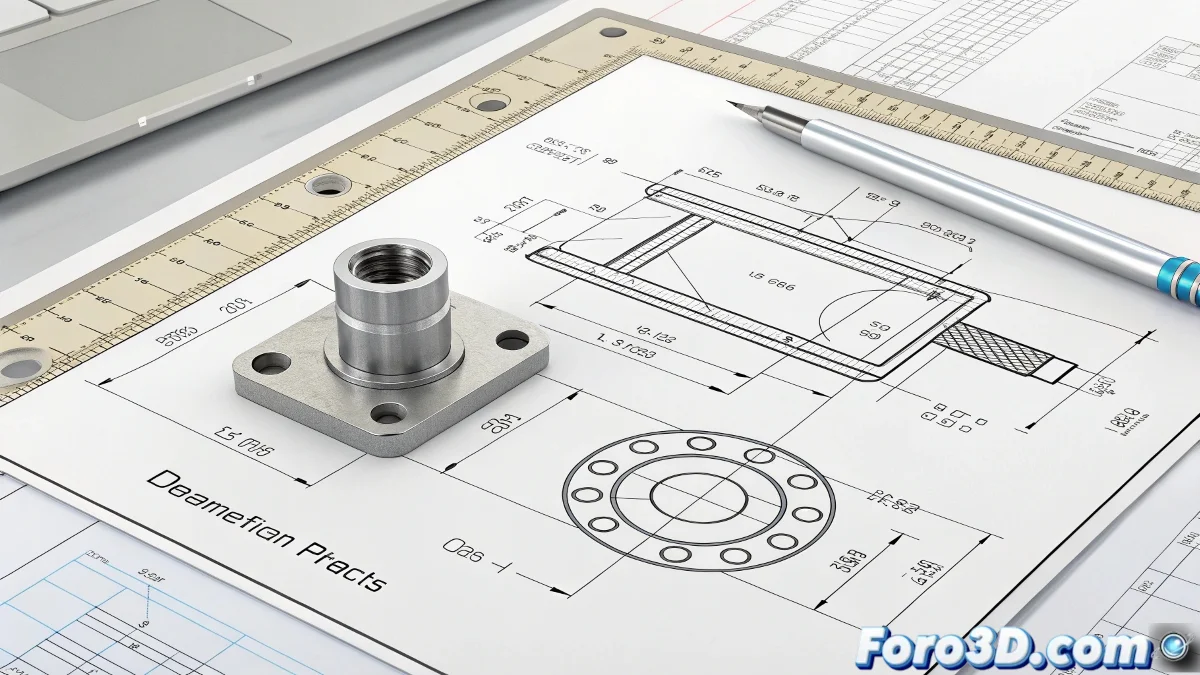
What is SolveSpace and What is it Used For: Intelligent Minimalism in CAD
In a world of increasingly complex and heavy CAD software, SolveSpace emerges as that refreshingly simple yet surprisingly powerful alternative. This parametric 2D/3D modeling software, developed as an open source project, demonstrates that power doesn't have to come with complexity. With an executable of just a few megabytes and an interface that prioritizes functionality over ornamentation, SolveSpace is that tool that respects your intelligence while elegantly and efficiently solving real design problems. 🎯
Work Philosophy: Constraints Over Commands
The heart of SolveSpace beats in its constraint-based geometric approach. Unlike systems that rely on a historical tree of operations, here you define relationships between elements: parallelism, perpendicularity, tangency, coincidence. The system solves these constraints in real time, allowing you to explore design variations simply by modifying dimensions. This approach is intuitive for those who think in terms of geometric relationships rather than command sequences. The learning curve is notably smooth for basic concepts, although mastering advanced constraints requires practice. 📐
Available Constraint Types:- geometric constraints: horizontal, vertical, parallel
- dimensional constraints: distances, angles, radii
- reference constraints: points, axes, planes
- assembly constraints: alignments and contacts
Integrated 2D to 3D Workflow
SolveSpace naturally handles the transition between 2D drawing and 3D modeling. You can create a fully constrained 2D sketch, then extrude, revolve, or sweep it to generate 3D solids. The most valuable feature is that 2D constraints remain active in 3D, allowing you to modify the original sketch and see the 3D model update automatically. This unified workflow eliminates the typical disconnection between 2D and 3D environments that plagues many CAD systems. 🔄
SolveSpace makes trivial things difficult, but impossible things possible in other systems
Practical Applications: Where it Really Shines
SolveSpace finds its maximum value in specific scenarios. It is ideal for designing simple mechanisms, creating parts for 3D printing, developing fixtures and tools, and basic mechanical engineering projects. The ability to analyze mechanism kinematics directly from constraints makes it invaluable for verifying movements and detecting interferences before manufacturing. For makers, students, and professionals who need to solve concrete design problems without unnecessary overhead, SolveSpace is often the most efficient tool. 🛠️ Ideal Use Cases:
- design of simple parts for 3D printing
- development of mechanisms and kinematic analysis
- mechanical engineering educational projects
- design of fixtures, templates, and tools
Advantages of Lightweight and Portable Software
With a size of just 10-15 MB, SolveSpace can run from a USB drive without installation, load in seconds, and run smoothly on old hardware. This lightness does not mean limited capabilities; the software includes advanced tools like geometric tolerances, automatic dimensioning, and export to standard formats. Its portability makes it ideal for working on different machines, taking to workshops, or using in situations where traditional software would be impractical. 💾
Limitations and When to Seek Alternatives
SolveSpace does not pretend to be a complete CAD solution for all scenarios. Very complex assemblies, organic surface modeling, and projects requiring enterprise collaboration are beyond its scope. Large-scale document management, standard component libraries, and integration with PLM systems are areas where commercial solutions maintain clear advantages. The choice depends on the project: for well-defined design problems, SolveSpace can be more efficient; for complex product development, more complete tools are needed. ⚖️
Supported Formats:- export: STEP, STL, DXF, PDF, SVG
- import: STEP, STL, DXF, SVG
- native formats: .slvs
- exchange: raster images (PNG, JPG)
SolveSpace represents that rare combination of simplicity and power that challenges the notion that professional software must be complex and expensive. It's not for everyone, but for those who understand and appreciate its philosophy, it becomes an indispensable tool in their digital toolbox. It demonstrates that sometimes, less is more: fewer megabytes, fewer menus, less complication, but more direct control over geometry and more focus on solving the real design problem. In a world of oversized software, SolveSpace is a breath of elegant efficiency. 🌟