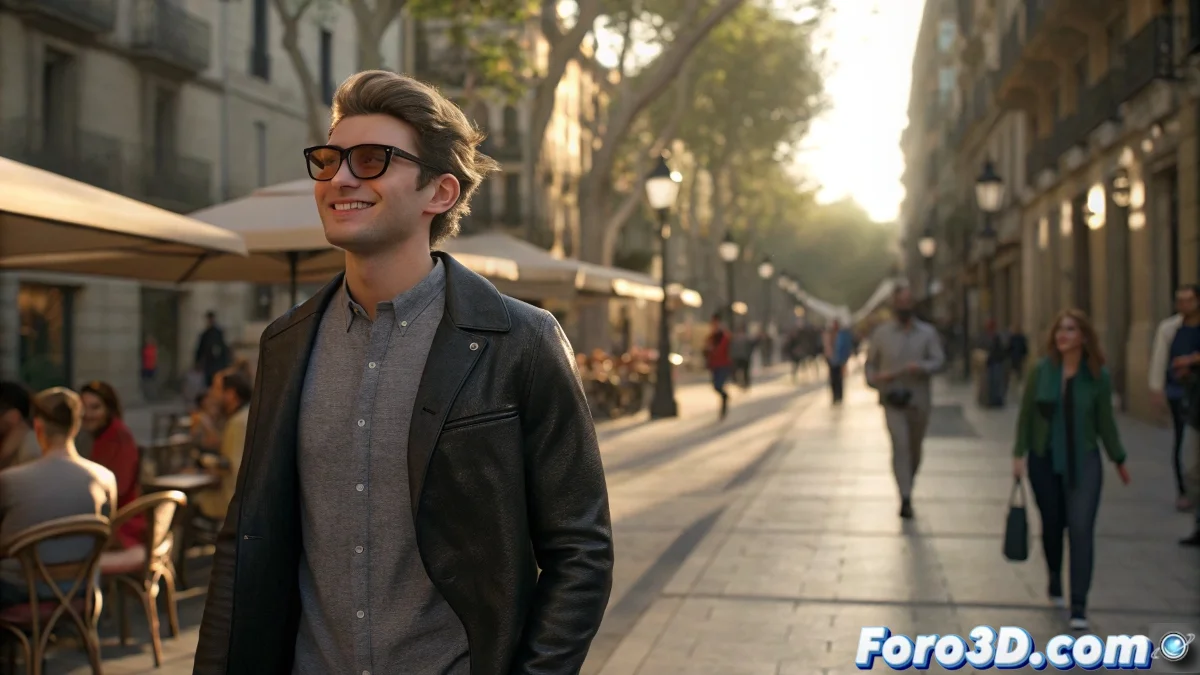
When Sunglasses Become Pocket Spies
Wearable technology has taken an unsettling leap into covert surveillance that would have delighted any 1960s secret agent. Smart glasses have evolved from futuristic concepts into practically undetectable recording tools that camouflage as everyday fashion accessories. Barcelona has become the stage for a pioneering case where these devices transcend their original purpose to venture into deeply murky legal and ethical territories. The line between technological innovation and privacy violation has never been as thin as the lens of a pair of Ray-Bans. 👓
The modus operandi is as simple as it is disturbing: seemingly casual conversations with unsuspecting tourists transform into marketable content without the slightest trace of consent. This strategy represents a sophisticated evolution of traditional covert recording techniques, leveraging the social and trusting nature of travelers exploring new cities with an open and receptive attitude.
The Era of Invisible Surveillance
Current devices have overcome the technical limitations that characterized their predecessors. While early generations of camera glasses were evident and bulky, contemporary models integrate perfectly into classic designs that raise no suspicion whatsoever. Recording quality reaches professional standards with resolutions that capture every facial detail and every nuance of expression, creating a complete digital file of private interactions. 🕵️
The elimination of the luminous indicator using techniques as simple as a piece of adhesive tape demonstrates how vulnerable the protection system implemented by manufacturers is. This rudimentary modification transforms a supposedly transparent device into a completely covert surveillance tool.
The Dark Business Behind Fake Smiles
The monetization of content obtained without consent has created a parasitic business model that exploits both the recorded victims and the buyers of the resulting material. Overpriced seduction courses promise infallible techniques based on real interactions, without revealing that those conversations were captured through deception and violation of privacy.
- High-definition recordings that capture genuine expressions and reactions
- Customized content targeted at specific audiences on social networks
- In-person courses that combine theory and non-consensual practical examples
Digital platforms become showcases where this material is displayed as legitimate educational content, leveraging the naturalness of unauthorized recorded interactions to create an illusion of authenticity that attracts potential buyers.

When Artificial Intelligence Amplifies the Harm
The real danger transcends the initial recording to venture into even more sinister territories. Captured images can serve as raw material for facial synthesis technologies that create compromising content without limits. Generative artificial intelligence allows manipulating real faces in fabricated contexts, perpetuating the harm far beyond the original encounter. This technological evolution turns every non-consensual recording into a potential permanent threat to the dignity of the victims. 🤖
The convergence between invisible hardware and generative software is redefining the boundaries of personal privacy in public spaces, creating vulnerabilities that current legislation does not adequately address.
3D and digital visualization professionals have begun developing educational tools that demonstrate these risks through controlled simulations. Using software like Blender for modeling, Substance Painter for realistic texturing, and rendering engines like Cycles or V-Ray, they create scenarios that illustrate how technology can be used maliciously without exposing real victims.
In the end, it is profoundly ironic that someone would devote so much effort to hiding a microscopic LED light to teach authenticity in human relationships. I suppose the real lesson here is that the world's most advanced technology cannot disguise a lack of basic ethics, no matter how many filters you put on it. 🎭