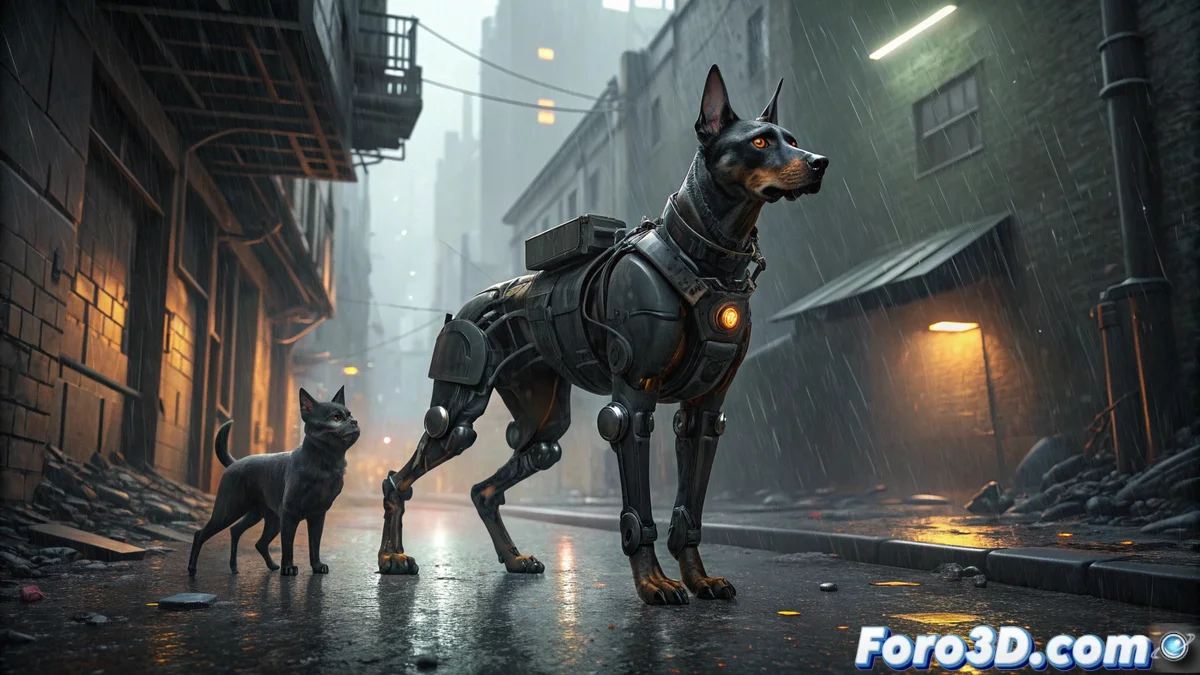
We3: three pets turned into weapons seek their home
In the comic universe, Grant Morrison and Frank Quitely join their talents to create We3, a science fiction work that confronts military technology with the most basic nature. The plot follows a dog, a cat, and a rabbit, transformed by a secret program into lethal cybernetic soldiers. When the project is canceled and they are marked for dismantling, their survival instinct triggers an epic and violent escape. Their only goal is to return to a place they barely remember: home 🏠.
A graphic style that breaks down movement
Frank Quitely defines the visual rhythm of We3 with a bold technique. Instead of large panels, he uses a multitude of small and irregularly shaped panels, especially in action scenes. This method allows breaking down each jump, shot, and charge into a succession of frozen instants. The reader perceives the extreme speed and chaos of combat in a visceral way. Contrast is key: the detailed drawing of animal anatomy and implant mechanics is juxtaposed with environments drawn in raw realism. This stylistic choice not only shows action but conveys the fragmented perception of the world that the protagonists have ⚡.
Key features of Quitely's art:- Sequences with numerous and asymmetrical panels to simulate speed.
- High level of detail in organic and technological elements.
- Composition that generates a frenetic and chaotic reading rhythm.
"Sometimes, the deadliest weapon is not a laser, but the instinct of a cat that decides it has had enough of humans."
Narrative: beyond the escape, a search for identity
Grant Morrison builds a story that transcends the simple chase narrative. Despite their radical modifications and programming as weapons, the animals retain emotional impulses and memories from their previous life. Their communication, represented through pictograms and simple language, reveals their distinctive personalities: Bandit the dog acts out of loyalty, Tinker the cat out of distrust, and Pirate the rabbit out of fear. The work questions the ethical limits of turning living beings into tools and explores the concept of artificial consciousness implanted over an instinctive base. The physical journey becomes a metaphorical search for autonomy and belonging 🧠.
Central elements of Morrison's plot:- The protagonists retain their animal essence under layers of technology.
- Use of a simplified visual language to express complex thoughts.
- The military pursuit serves as a framework to explore nature vs. artificial creation.
Conclusion: a comic that redefines the genre
We3 establishes itself as a reference work by fusioning a powerful science fiction premise with innovative graphic execution. It is not just a story about animals with armor, but a deep reflection on freedom, identity, and the cost of the instrumentalization of life. The collaboration between Morrison and Quitely achieves a comic where the visual form serves the narrative directly, inviting the reader to experience the confusion, fear, and hope of its protagonists. It is a testament that even the most artificial creations can long for a place to call home 🐾.