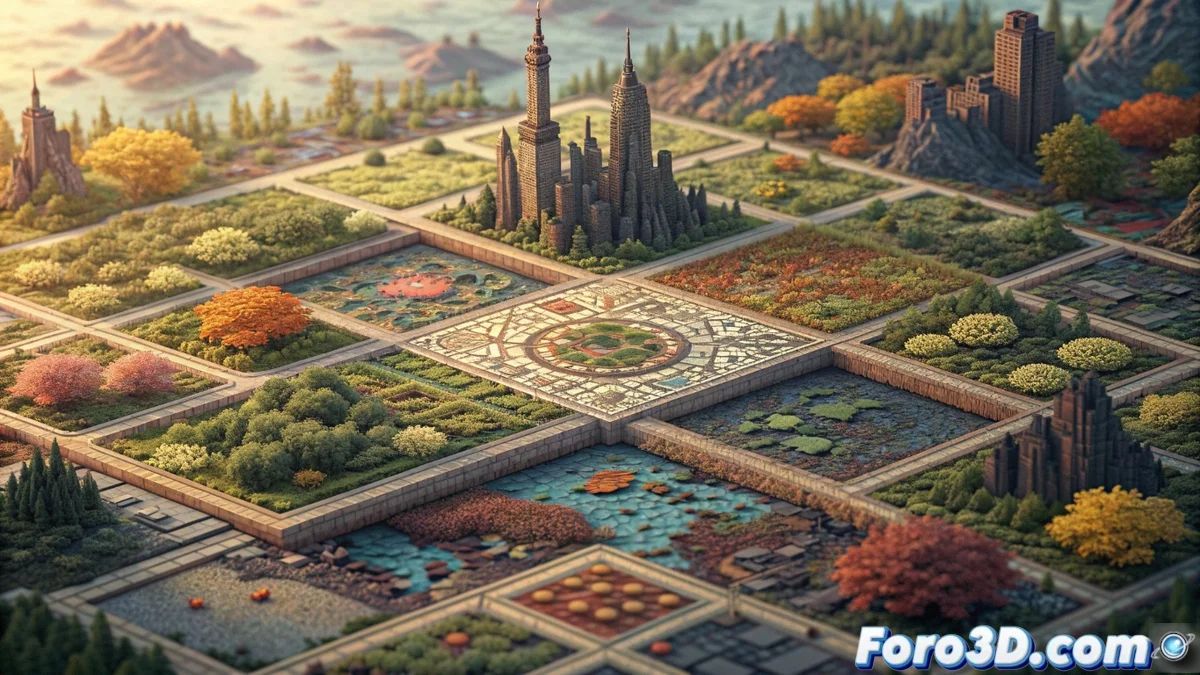
Wave function collapse: the procedural generation algorithm inspired by quantum physics
In the field of digital content creation, the Wave Function Collapse (WFC) algorithm stands out for its unique approach. Instead of relying on explicit construction rules, this method starts from a reference sample, such as a set of modules or "tiles," and deduces their connection patterns. The process abstractly emulates the wave function collapse from quantum physics, where a state among multiple possibilities materializes. 🌀
Fundamental mechanics of the algorithm
The core of WFC is an iterative cycle of choice and constraint propagation. It begins by randomly placing a tile on the grid. Then, it analyzes which options are viable for adjacent cells, discarding those that would be incompatible with the one already placed. This elimination process propagates throughout the mesh, progressively reducing possibilities until each cell is resolved with a single tile. The result is a new and extensive creation that, however, faithfully maintains the aesthetics and logical relationships of the initial example.
Key advantages in production:- Stylistic coherence: Generates results that appear handcrafted, preserving the visual style of the source material.
- Creative efficiency: From a small and manageable input, it is capable of producing a vast amount of complex and structurally valid variations.
- Application versatility: Its use goes beyond the visual, adaptable for creating sound patterns or musical structures.
WFC doesn't understand aesthetics; it only follows the rules you gave it. A chaotic example will generate gloriously procedural chaos.
Practical applications in video game development
Its power makes it an invaluable tool for procedural design, especially in the video game industry. It is ideal for automating the creation of open-world maps, street layouts in cities, dungeon interior designs, or the generation of organic textures for materials. Developers value it because it allows offering unique gaming experiences in every playthrough, without the need for an artist to manually model every possible scenario. This greatly streamlines the workflow and enhances replayability. 🎮
Considerations and limits to keep in mind:- Risk of contradictions: The algorithm can fail and encounter irresolvable states, especially if the input rules are too restrictive or the solution space is very limited, which may require restarting the process.
- Input dependency: The quality of the generated output is a direct reflection of the quality and coherence of the example tile set. Poor or ambiguous input design will produce problematic results.
- Computational cost: For very large grids, the implementation can become costly in terms of processing. A common solution is to use it modularly, generating the world in sections, or combine it with other optimization techniques.
Final evaluation of the method
Wave Function Collapse is a powerful tool but with nuances. It is not a magical solution that always works autonomously. Its success depends on a careful definition of adjacency rules and a well-designed input example. When configured correctly, it is capable of unleashing enormous procedural creativity, generating varied and coherent content that expands the limits of manual design. However, it is crucial to remember that its logic is purely mechanical: it executes constraints, not artistic value judgments. 🧩