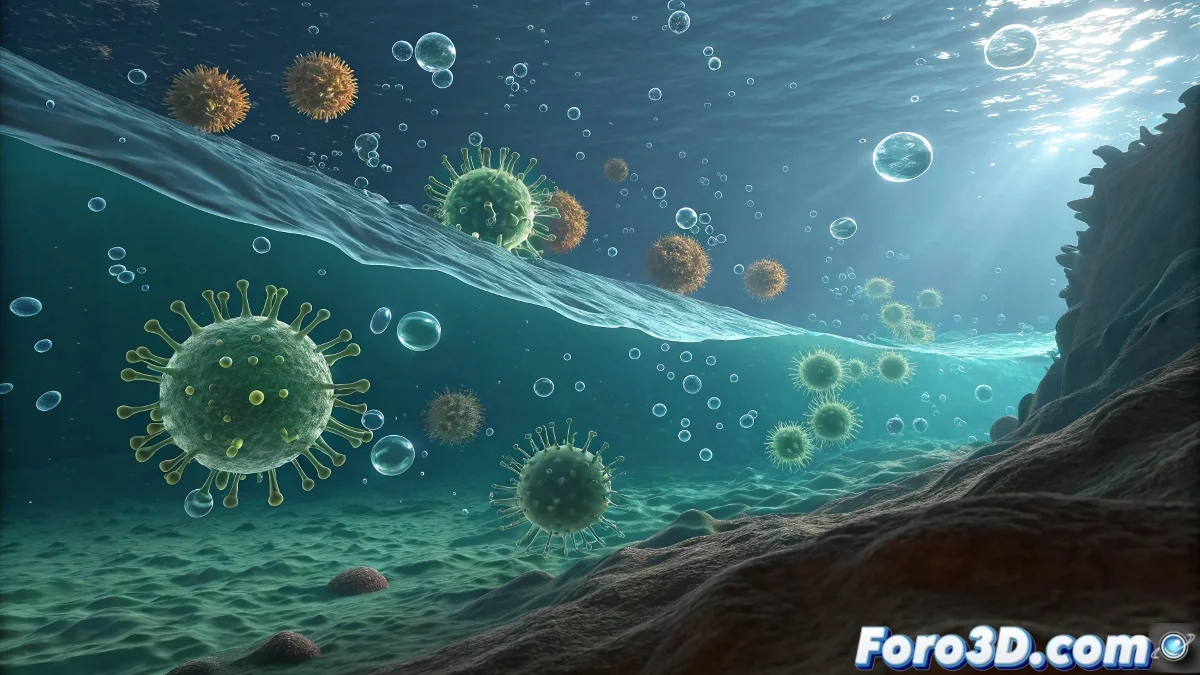
When nature works magic... and we render it
Nature has just given us a lesson: while we complicate filtration systems, invisible microbes clean water without an instruction manual 🦠. Now the challenge is to simulate in Blender what evolution perfected over millennia... and make sure the particle system doesn't crash.
Techniques for simulating small giants
Turning biological data into visualizations requires:
- Organic particle systems: Set up behaviors that mimic real microbial movement, not that random dance that looks like a Windows screensaver.
- Magical Dynamic Paint: Make "contaminated" areas change color/texture when microbes pass by, like a biological eraser.
- Strategic fluids: Simulate contaminants with controlled density fields, because even in 3D, pollution must have limits. 💧
A well-configured particle system is like a microbial colony: when it works in harmony, it transforms chaos into beauty. And when it doesn't, better not to ask.
Secrets for a believable simulation
To fool the human eye (which is more skeptical than a scientist with renders):
- Use Noise Textures to vary the size and movement of particle-microbes
- Add vorticity forces for those organic twists that everyone loves
- Try instancing to show individual microbes within the swarm
And the master touch: animate a "rebel" microbe that goes against the current. For biological realism... and because in every colony there's always a nonconformist.
The irony of rendering
While these real organisms work silently 24/7, our simulated ones demand hours of baking, parameter tweaks, and the occasional Blender restart. Nature is efficient; our computers, not so much. But hey, at least we can speed up time... if the RAM holds up. 🖥️
So go ahead: simulate that ecological miracle in 3D. And if the final render resembles even 1% of nature's elegance, consider it a success. After all, evolution had millions of years of advantage... and didn't use integrated graphics.