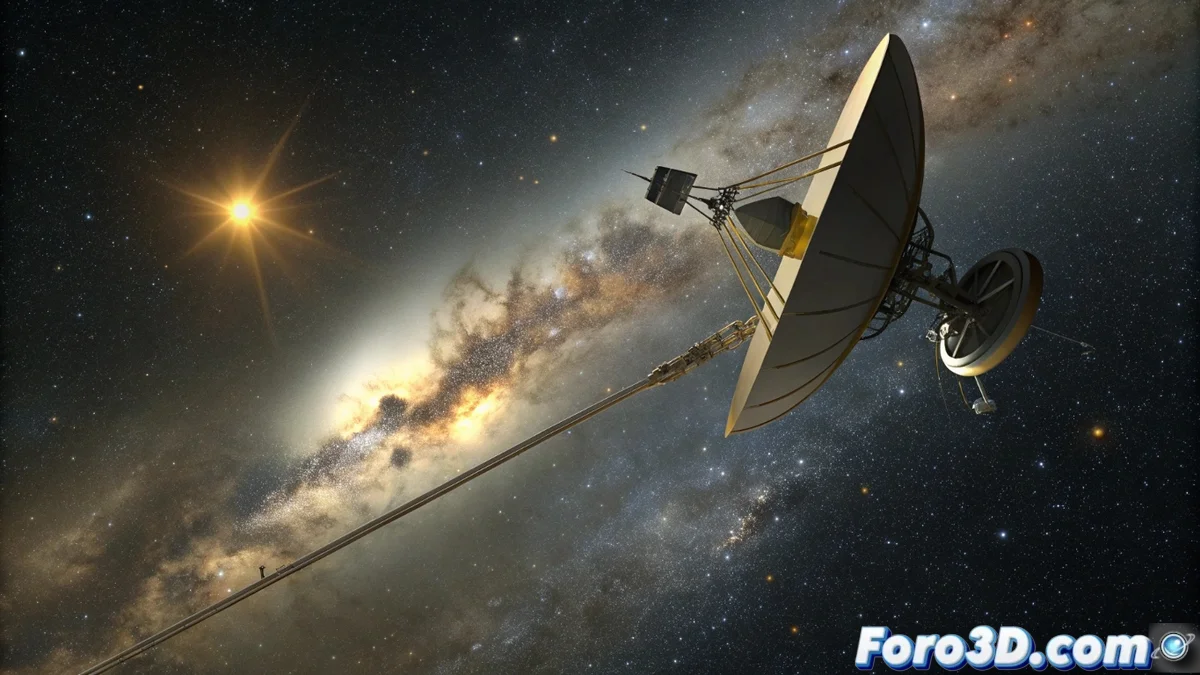
Voyager 1 and 2: NASA's Eternal Probes
In 1977, NASA launched two robotic ambassadors with a primary mission of just four years. Today, Voyager 1 and Voyager 2 are the farthest and longest-operating human artifacts, writing one of the most astonishing epics of space exploration. Their journey led them to make revolutionary discoveries on Jupiter, Saturn, Uranus, and Neptune, revealing worlds of active volcanoes and complex atmospheres, before venturing into the darkness of the interstellar void. Despite the inconceivable distance—more than 20 billion kilometers—their faint signal still reaches Earth, defying all expectations of longevity. 🚀
The Technological Heart of a Legend
The extraordinary resilience of the Voyagers is supported by a robust design and meticulous engineering. Their life source is the radioisotope thermoelectric generators, which convert the heat from the decay of plutonium-238 into electricity. Although this power decreases gradually, it still powers crucial scientific instruments. Their computers, with processing capacity minuscule by current standards, have demonstrated unparalleled reliability. Maintaining contact is a challenge in itself: the Deep Space Network uses gigantic antennas to capture signals that, traveling at the speed of light, take more than 22 hours to reach us.
Pillars of Their Success:- Nuclear Power Source: The RTGs provide constant and reliable energy, independent of sunlight, essential for missions in the darkness of deep space.
- Simple and Robust Computing: Systems with less memory than a modern digital watch, but with efficient programming and exceptionally durable hardware.
- Precision Communication: A telecommunications system designed to transmit data across interstellar distances, using high-gain antennas and error-correction protocols.
"The Voyagers are like a message in a bottle thrown into the cosmic ocean. Every bit of data is a word from that message, telling us about places where humanity has never been."
Beyond the Solar Bubble
A historic milestone was reached when both probes crossed the heliopause, the boundary where the solar wind's influence ends and true interstellar space begins. Voyager 1 crossed it in 2012 and Voyager 2 in 2018. From this new realm, their instruments send pioneering measurements: they analyze the plasma density, the intensity of galactic cosmic rays, and the orientation of magnetic fields in an environment never before directly probed. Each packet of information is a scientific treasure that redefines our understanding of the galactic environment surrounding our solar system.
Discoveries from the Interstellar Frontier:- Plasma Measurement: They confirmed a sharp increase in plasma density upon exiting the heliosphere, a key signature of the interstellar medium.
- Shield Against Cosmic Rays: They provide data on how the heliosphere protects us from high-energy cosmic radiation from the galaxy.
- Intelligent Energy Management: NASA strategically turns off heating systems and secondary instruments to maximize the life of key scientific sensors.
A Lasting Legacy
The irony is profound: these machines, with computing power inferior to that of an electronic greeting card, continue sending postcards from the interstellar abyss, while infinitely more powerful devices fail at basic connections. Their journey is a testament to human ingenuity, demonstrating that with robustness, simplicity, and a long-term vision, the impossible can be achieved. The Voyagers not only explore space; they have become eternal symbols of our curiosity and our tenacious will to go farther. Their signal, though increasingly faint, will continue to be a beacon of knowledge in the darkness for years to come. ✨