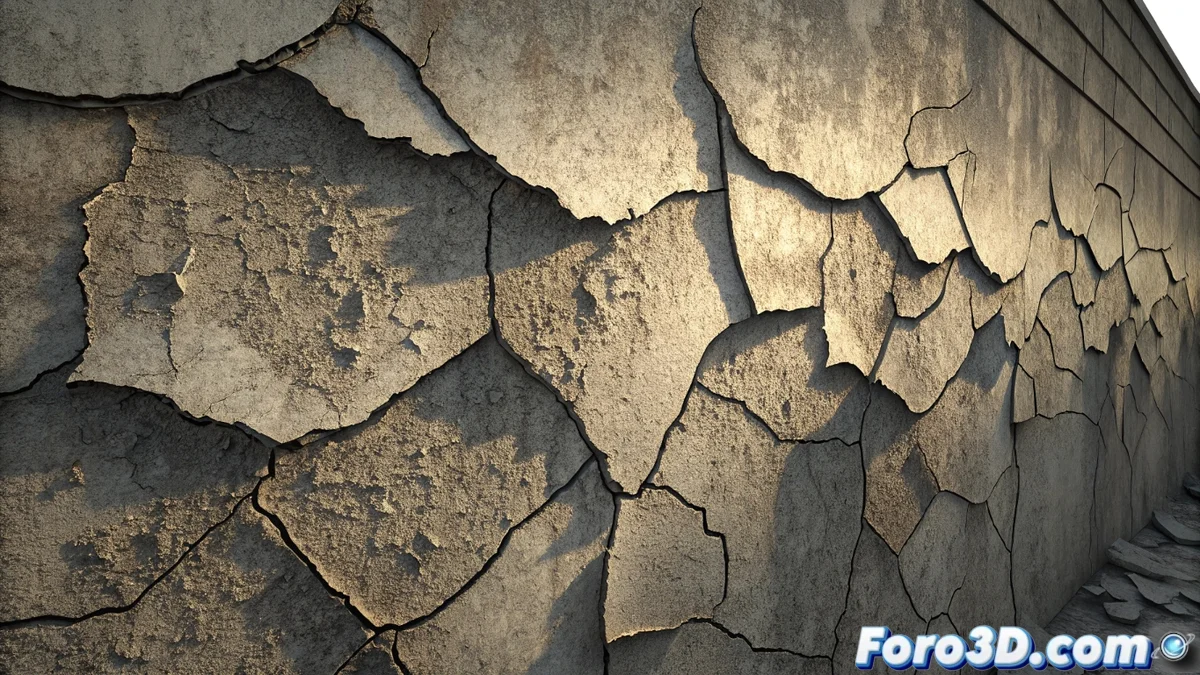
Voronoi Chipping: shading technique for realistic chipping
In the fascinating world of procedural shading, one technique stands out for its ability to add convincing age and wear: Voronoi Chipping. 🧱 Unlike other uses of the Voronoi pattern, such as creating cracks, this methodology specializes in simulating the detachment of small fragments, generating that irregular and believable profile we see in eroded materials. Its magic lies in transforming the cells of the diagram into zones of structural weakness, where the material appears to have chipped, adding a crucial layer of realism for immersive scenarios.
Technical foundations of the chipping effect
The technical process begins with a Voronoi map, whose cells delimit potential fracture areas. 🧩 Through mapping operations and threshold adjustments, the edge or interior of these cells is selectively isolated to generate a control mask. This mask is the brain of the operation, subsequently directing transparency or height within a shader, allowing material to be "subtracted" in an organic and random way. To avoid dreaded repetition and an artificial appearance, it is common to apply texture coordinate distortion and combine the node with other types of noise, which varies the size and density of the chipping, ensuring that each break is unique.
Key components in generating the effect:- Voronoi map as base: Defines the cellular structure that simulates zones of weakness and initial fracture.
- Control mask: Derived from the cells and precisely determines where and how the virtual material is "removed."
- Complementary noise nodes: Add variation in scale and distribution, breaking predictable patterns for a natural result.
Voronoi Chipping is the controlled chaos that turns a perfect digital surface into a credible testament to the passage of time and wear.
Practical implementation in graphics engines
Integrating this technique into a modern workflow is quite straightforward in engines like Blender (Cycles/Eevee) or Unreal Engine. 🚀 Its main application lies within the material or shader editor, where the generated mask is used to modulate various channels. The most common is the opacity channel in "cutout" or "masked" type materials, allowing geometric trimming of the chip shape. However, its power multiplies when it also influences the normal and roughness maps, thus simulating not only the shape of the hole, but also the textural difference between the freshly exposed interior and the worn exterior surface.
Applications in production pipelines:- Optimization of detailed assets: Allows adding high-level geometric complexity without the computational cost of manual sculpting, ideal for deteriorated architectural environments or post-apocalyptic scenarios.
- Multichannel detail layers: A single pattern controls opacity, relief (normals), and surface properties (roughness), creating a sense of cohesion and depth.
- Fast and non-destructive iteration: The pattern parameters (scale, distortion, threshold) can be adjusted in real time, allowing fine artistic control over the degree of deterioration.
The final touch of organic realism
This technique is, in essence, the elegant solution to a common problem: making a concrete wall look like it has lost a fragment due to a chance impact, and not due to a perfect and suspicious digital cut. 🔨 Voronoi Chipping provides that degree of random imperfection that brings life, or rather history, to virtual objects. It is a powerful reminder that in digital creation, it is often the careful introduction of disorder and decay that finally convinces the eye and elevates the realism of a scene, filling it with narrative and visual authenticity.