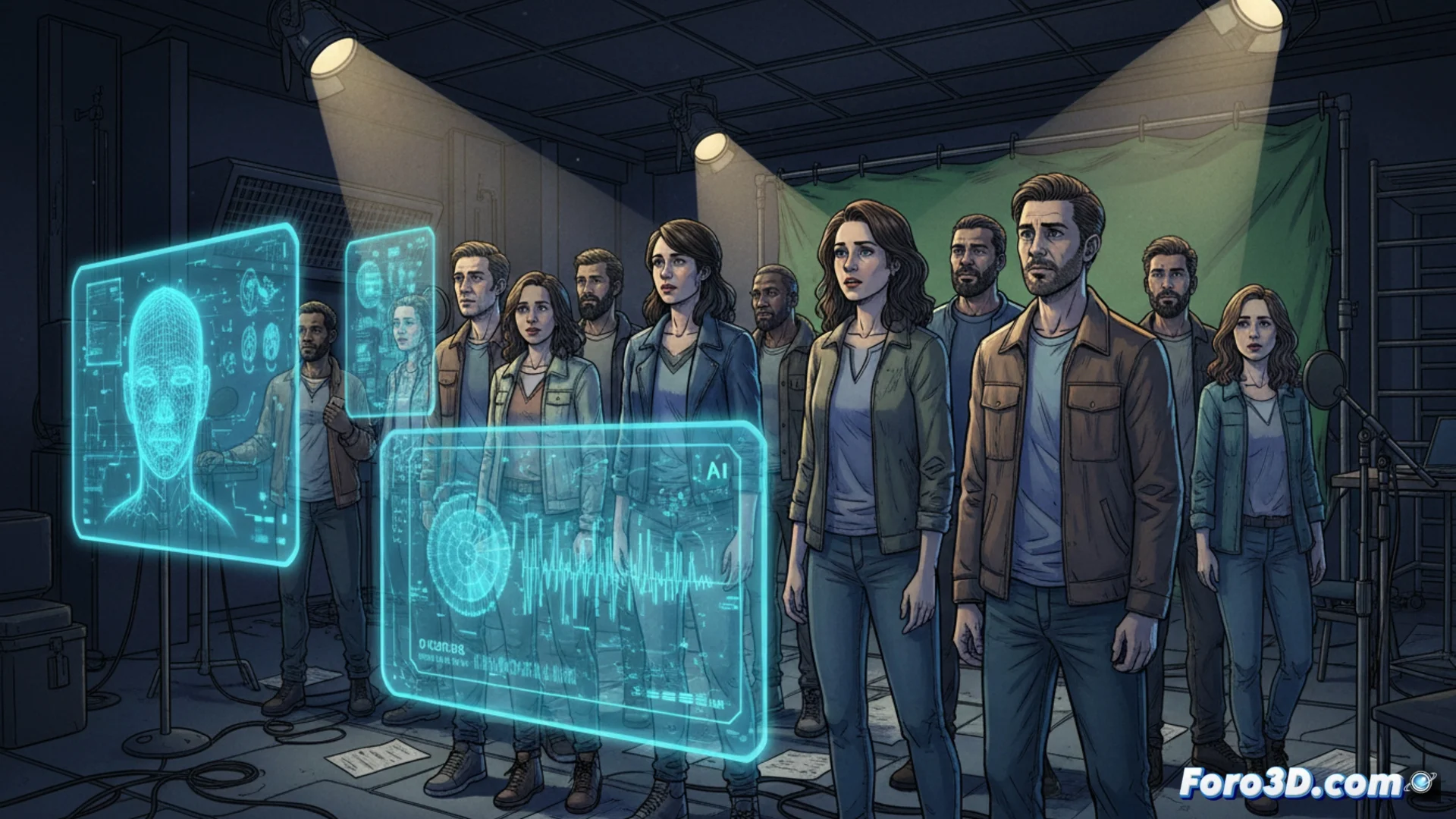
Dubbing Actors and Extras Demand Protection in the Artist's Statute Against AI
Professionals who lend their voice and physical presence to audiovisual productions in Spain are raising their voices. Their main demand is to be explicitly included in the future Artist's Statute law, a legal framework they consider vital for their professional survival in the digital era. They argue that without this coverage, they are totally exposed to the abuses that artificial intelligence technology could enable. 🎭
Artificial Intelligence as a Labor and Identity Risk
The sector points with alarm to the current capabilities of generative AI. These tools can replicate a human voice with precision or create a digital double from a person's images. This advancement not only threatens to make them lose their jobs but also facilitates unauthorized use of their most intimate identity: their voice tone or gestures. Without regulations to protect them, they fear that their past work will be the raw material for generating new content without their authorization and without receiving fair economic compensation.
Main threats identified:- Cloning voices for use in projects without hiring the original actor.
- Generating digital replicas or deepfakes of extras for new scenes.
- Exploiting previous recordings or images to train AI algorithms without paying rights.
Without a specific legal framework, our greatest legacy could be to become training data for machines.
The Crucial Role of the Artist's Statute
The Artist's Statute proposal seeks to unify and improve the conditions of all culture workers. For dubbers and extras, being recognized within this law would mean officially validating their artistic contribution and, most importantly, obtaining concrete legal tools for negotiation. This would translate into being able to decide how their voice recordings or synthetic image are used, being able to establish contracts with clear licenses and remunerations for these uses.
Benefits they expect to obtain with their inclusion:- Legal recognition as artists with full rights.
- Ability to control and license the use of their voice or AI-generated image.
- Access to a common framework that improves their collective negotiation with producers and platforms.
A Race Against the Algorithm
While artificial intelligence systems perfect their capacity to imitate even the smallest human detail, many artists face a disturbing question. They wonder if, in the future, their main value will not lie in having provided sufficiently authentic and organic biological data to feed these algorithms, rather than in their talent and professional trajectory. Inclusion in the statute is perceived as the only way to protect their essence and ensure that their work has a dignified and regulated future. 🤖