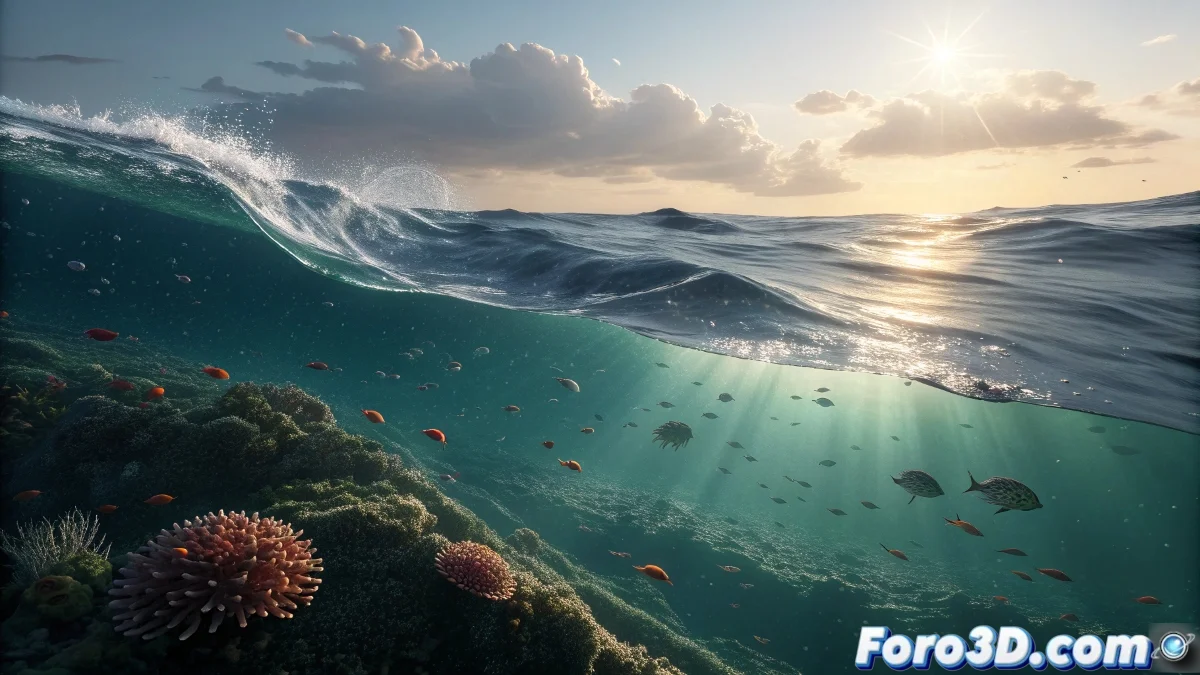
Visualizing the Ocean's Invisible Crisis with Terragen 🌊
A recent study from the University of Washington warns about how the increase in ocean temperatures affects microorganisms fundamental to the marine ecosystem. These small life forms sustain the food chain and play an essential role in carbon absorption and oceanic balance. Terragen presents itself as the ideal tool to visualize this critical phenomenon, allowing the creation of visually striking representations that show thermal changes and their effects on the marine microscopic world.
Oceanic Environment Setup
The process begins by creating a realistic oceanic scenario in Terragen using the Water Shader system. Parameters are adjusted for:
- Wave height and frequency for a semi-calm sea
- Base color of the water with gradients ranging from deep blues to warm greens
- Transparency and refraction to simulate light penetration
- Surface reflections that respond to the sun's position
These adjustments allow visualizing how heat distributes and accumulates in different oceanic layers. 🌡️
Representation of Temperature Increase
To visually show the warming:
- Color gradients from cold blue to warm green-yellow
- Subtle thermal maps on the surface using texture layers
- Thermal distortion in the water with mild heat haze effects
- Progressive color animation to show temporal change
These combined elements create an intuitive representation of thermal stress.
Visualizing ocean warming is making the invisible visible and the abstract tangible.
Environmental Effects and Microscopic Particles
Elements are added to represent microscopic life:
- Particle systems to simulate plankton and microorganisms
- Variable density that decreases in warmer areas
- Light effects that highlight organism concentrations
- Submarine haze with volumetrics for ambient depth
- Light rays that penetrate the water illuminating suspended particles
These details communicate the critical presence of invisible life.
Lighting and Atmosphere
The lighting setup reinforces the message:
- Zenith sunlight that creates intense reflections on the surface
- Light penetration adjusted to show different depths
- Soft shadows that suggest movement and depth
- Atmosphere with light haze that unifies the scene
The balance between light and shadow accentuates the ecosystem's fragility.
Composition and Visual Narrative
The scene is composed to maximize emotional impact:
- Low angle that shows surface and depth simultaneously
- Close frames in thermal transition areas
- Smooth camera movement that explores different layers
- Scale elements that reference microscopic size
These decisions guide the viewer's attention to key elements.
Rendering and Post-Production
The final render is optimized for:
- High resolution to show subtle color and texture details
- Formats suitable for scientific and educational outreach
- Minimal post-production to maintain scientific accuracy
- Metadata including technical information on parameters used
The result is a powerful visual tool for environmental awareness.
While scientists document rising temperatures, we document how to prevent our software from overheating the CPU during long renders. In the end, the only heat we can control is that of our equipment... for now. 😅