When Ecology Meets 3D Animation
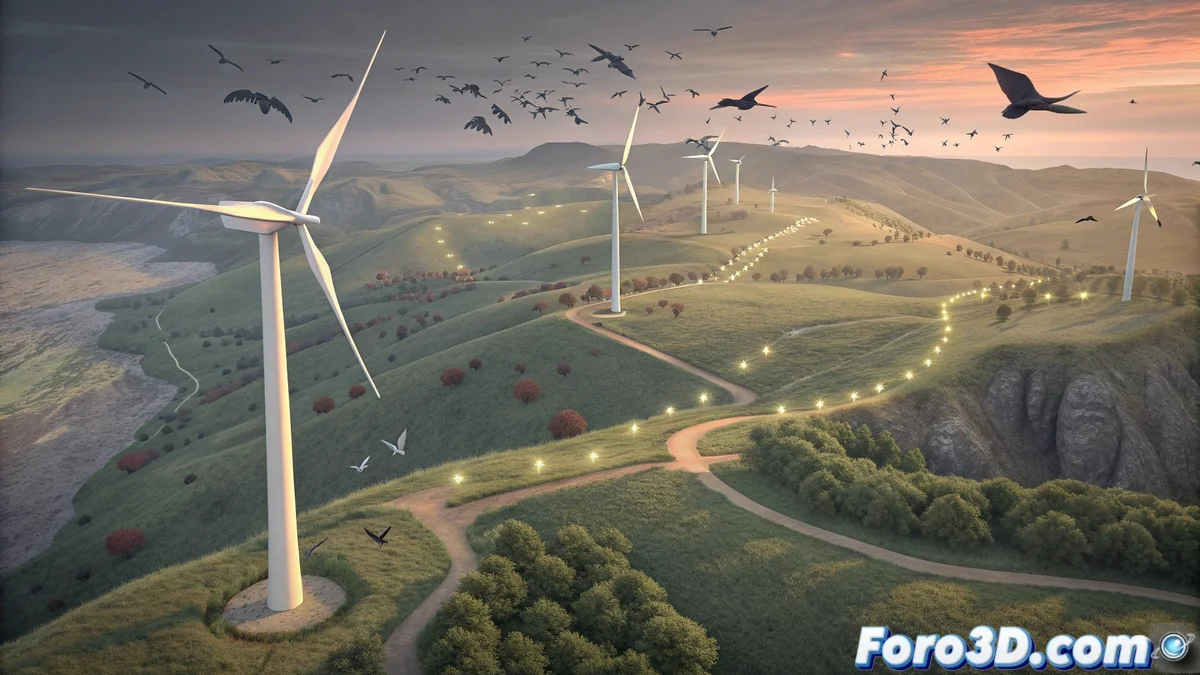
The environmental rejection of the Corus wind project in Cantabria represents a paradigmatic case of conflict between renewable energies and conservation. 🌄⚡ With ten 112-meter wind turbines that would affect eight municipalities, this project shows how the ecological transition requires balancing multiple factors. In MotionBuilder, we can visualize this delicate balance, creating animations that show both the projected infrastructure and its potential impacts on the natural and cultural environment.
Initial Project Setup
Upon opening MotionBuilder, a new file is created by setting units to meters to work at real scale. Scene organization is fundamental: Terrain, Wind Turbines, Fauna, Protected_Areas, and Cameras must be structured in separate layers. Saving the project as parque_eolico_corus.fbx preserves the element hierarchy… because in environmental animation, each component tells its part of the story.
Recreation of the Affected Territory
The mountainous terrain of Cantabria is modeled using mesh displacements or importing topographic data. 🗺️ Protected areas are represented with colored semi-transparent planes overlaid on the terrain, indicating areas of special ecological sensitivity. Wind turbines are placed following the projected layout, creating a precise visualization of how they would integrate into the landscape. This base establishes the context for impact analysis.
3D visualization of energy projects not only shows infrastructure; it allows preventive evaluation of visual, ecological, and cultural impacts, informing critical decisions.
Simulation of Impacts on Fauna and Flight
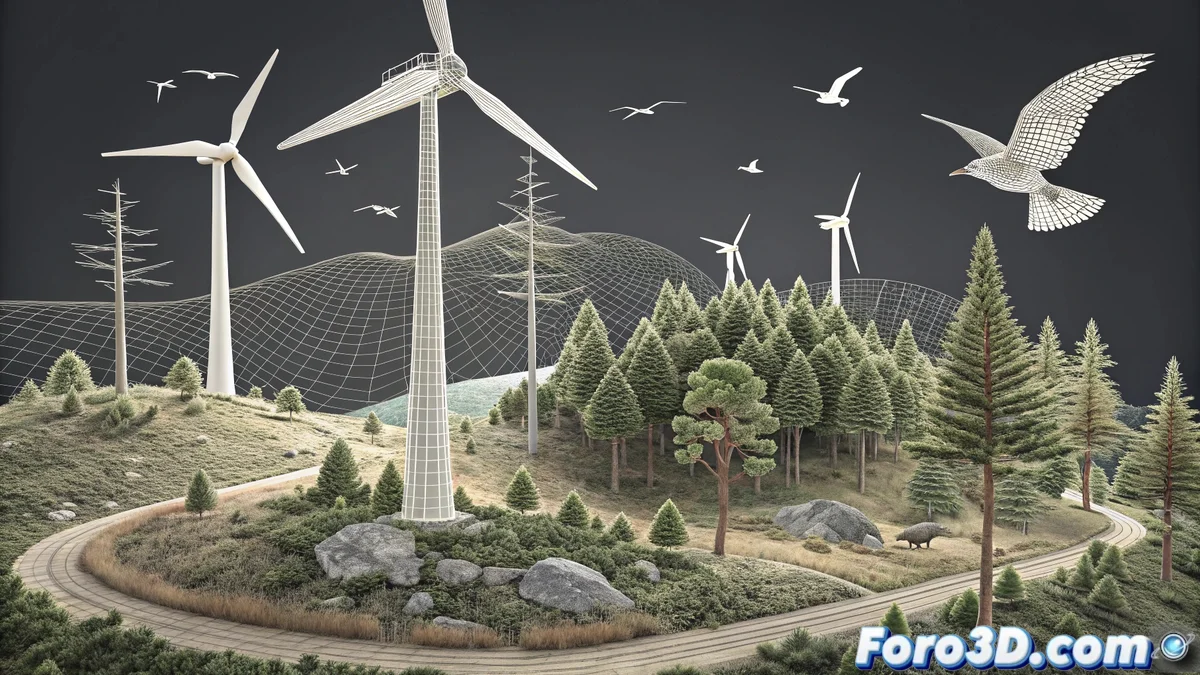
Local fauna—especially birds and bats—is represented with simplified models animated with basic rigs. 🦅 Flight paths are traced using NURBS curves, showing how migratory routes would intersect with the turbines. Optionally, particle effects are added to simulate air disturbances or flight deviations. This animation layer graphically illustrates one of the main reasons for the project's rejection.
Animation Techniques and Visual Narrative
- Turbine Rotation: Wind turbine blades are animated with cyclic motion, using constraints to maintain realistic rotation.
- Dynamic Cameras: Paths are programmed to show multiple perspectives: aerial view, ground level, and fauna angles.
- Information Layers: Graphical elements are overlaid to highlight conflict zones between infrastructure and environment.
Lighting and Rendering for Analysis
Lighting is set up for different conditions: daytime light to evaluate visual impact and twilight for studying effects on nocturnal fauna. 🌅 Rendering is optimized for clarity rather than photorealism, allowing emphasis on environmental analysis elements. In post-production, annotations and labels are added to explain the different impacts, creating an educational visual tool.
Export and Use of the Simulation
The final result is exported as an MP4 video or image sequence, maintaining versions with and without information layers. 📹 This simulation can serve both for environmental education and technical presentations, accessibly showing why some renewable projects require reconsideration. MotionBuilder's flexibility allows updating the visualization if the project evolves.
Thus, while technical reports detail impacts on paper, 3D animations make them visible to everyone… without having to wait for the windmills to be built to see their effects. Because in MotionBuilder, the only thing spinning out of control is the virtual turbines. 😉