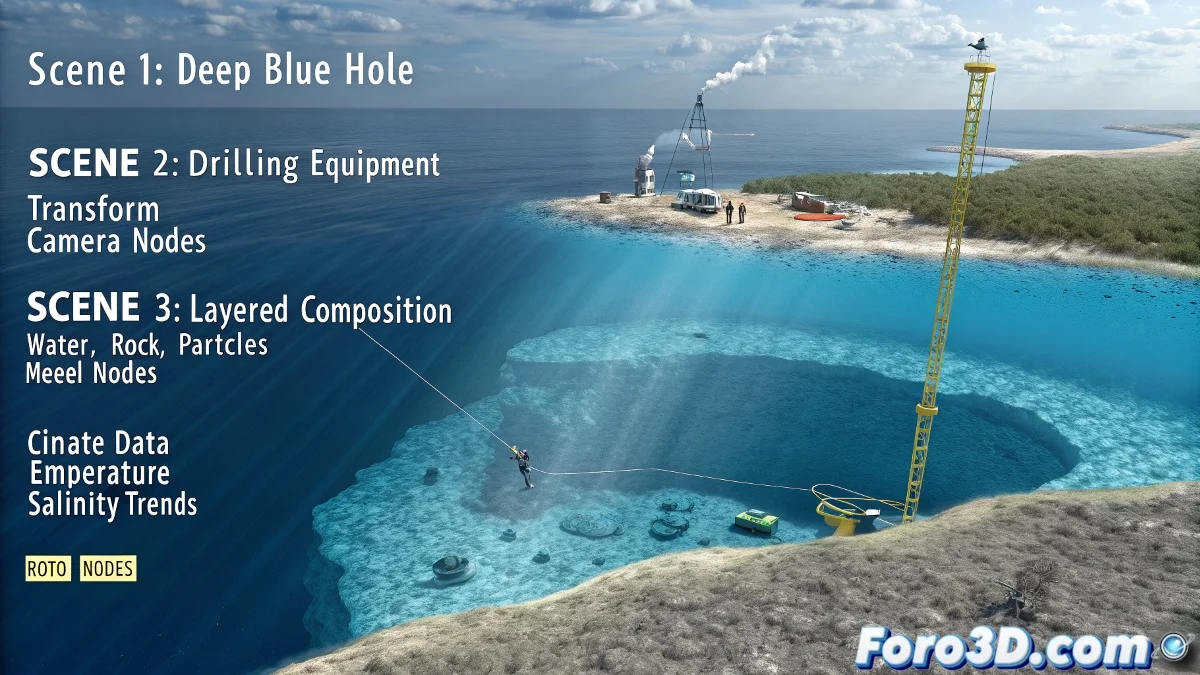
Diving Deep into the Climate Mystery with Nuke 🌊
A recent study has drilled into the Great Blue Hole, revealing concerning data on changes in temperature, salinity, and water chemical composition that reflect the impacts of climate change on sensitive marine ecosystems. This finding underscores the importance of monitoring critical zones to anticipate global environmental consequences. Nuke presents itself as the ideal tool for visualizing these discoveries, allowing the creation of visual compositions that combine 3D elements, volumetric effects, and scientific data into a compelling narrative.
Importing and Organizing 3D Layers
The process begins by importing 3D renders previously created in software like Maya or Blender:
- Water layer with transparency and refraction properties
- Hole geometry with limestone rock and coral textures
- Drilling equipment modeled with realistic mechanical details
- Background elements like marine life and geological formations
Each element is imported as an independent layer using Read Nodes, allowing individual control over color, depth, and transformations. 🔍
Composition and Advanced Visual Effects
Specialized nodes are used to integrate elements:
- Grade and ColorCorrect to match tones between layers
- Z-Depth to manage depth and realistic blurs
- RotoPaint to add suspended sediments and organic particles
- Particle Nodes to simulate bubbles and drilling debris
- Merge Nodes with blending modes like Plus and Screen for natural integration
This approach ensures that all elements coexist coherently in 3D space.
Compositing in Nuke is like being a visual surgeon; every cut must be precise but invisible.
Lighting and Underwater Atmosphere
The characteristic lighting of the depths is recreated:
- Exposure Nodes to simulate light attenuation with depth
- Volumetric Light Rays for light rays penetrating the water
- Gradient Nodes for transitions from deep blue to abyssal black
- Glow Nodes subtly around the drilling equipment
These effects create the characteristic immersion of the underwater environment.
Integration of Scientific Data and Animation
To communicate the climate findings:
- Tracker Nodes to anchor data graphics to moving elements
- Text Nodes with temperature and salinity information
- Transform Nodes animated to simulate the descent of the drilling equipment
- Camera Nodes with smooth movement through the scene
The animation can show the drilling process and sample collection.
Rendering and Final Output
Nuke allows rendering the final composition with:
- Write Nodes to export in formats like EXR or MP4
- Compression control and bitrate for quality-size balance
- Metadata management for embedded technical information
- Batch rendering for long animated sequences
The result is a visually impactful piece that educates about climate change.
While scientists analyze how to save the oceans, we analyze how to save renders that crashed midway through the composition. In the end, the real blue hole might be the one left in our free time after rendering. 😅