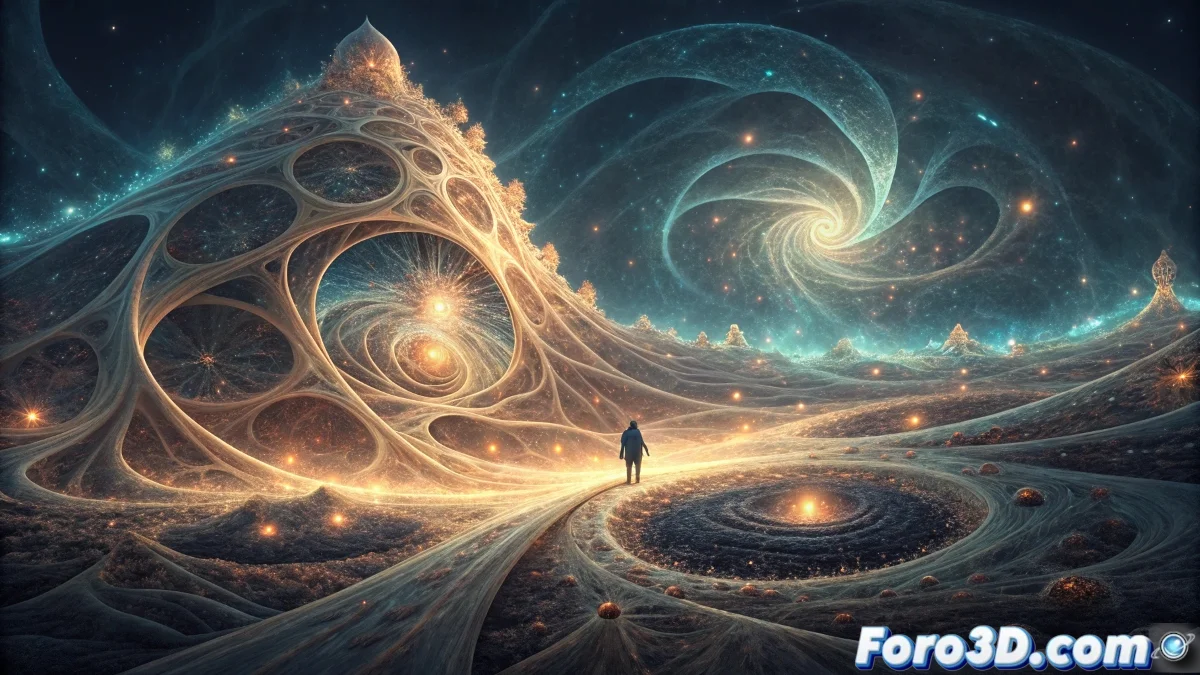
Visualizing Quantum Concepts with ZBrush
When facing radical quantum theories that redefine our understanding of reality, ZBrush emerges as the ideal tool to transform scientific abstractions into tangible visual representations. We begin by sculpting forms that question the very foundations of space and time, employing advanced techniques that allow visualizing universes where conventional rules do not apply 🌌.
Scientific Foundations for Abstract Modeling
Before starting any project in ZBrush, it is crucial to internalize the scientific principles behind these unconventional visions of quantum reality. We research theories that propose a cosmos without space as a container, without linear time, and without discrete particles, creating inspiration panels with references to complex fluids, energy fields, and fractal patterns that challenge human perception.
Key Research Elements:- Study of water vortices and light interference patterns as conceptual basis
- Analysis of fractal structures that repeat at different scales
- Investigation of natural phenomena that contradict traditional human intuition
The true magic happens when digital sculpting tools meet scientific concepts that challenge all conventional logic, creating bridges between mathematical abstraction and visual perception.
Advanced Quantum Modeling Techniques
We employ ZModeler with specialized deformers to create base meshes that we later transform using tools like Bend, Twist, and Inflate, seeking forms that simultaneously communicate movement and stillness. The implementation of NanoMesh allows us to distribute micro-structures that represent quantum events without resorting to visible particles, generating the illusion of a continuous and fluid reality.
Essential Tools and Techniques:- DynaMesh for fluid geometries without defined beginning or end
- Procedural textures and custom alphas that replace traditional particles
- MatCap shaders configured for dynamic response to ambient lighting
Integration of Quantum Principles into the Workflow
Sculpting techniques allow us to incorporate levels of detail that vary according to the scale of observation, faithfully reflecting the quantum principle that properties emerge only during interaction with the environment. We configure materials that respond dynamically to lighting changes, simulating how quantum properties manifest only in specific measurement contexts.
This creative approach suggests that if theoretical physicists incorporated ZBrush into their methodology, their publications might contain fewer equations and more impactful visual representations, though they would probably still be perplexed by technical mysteries like the inexplicable disappearance of subtools when switching between documents 🎨.