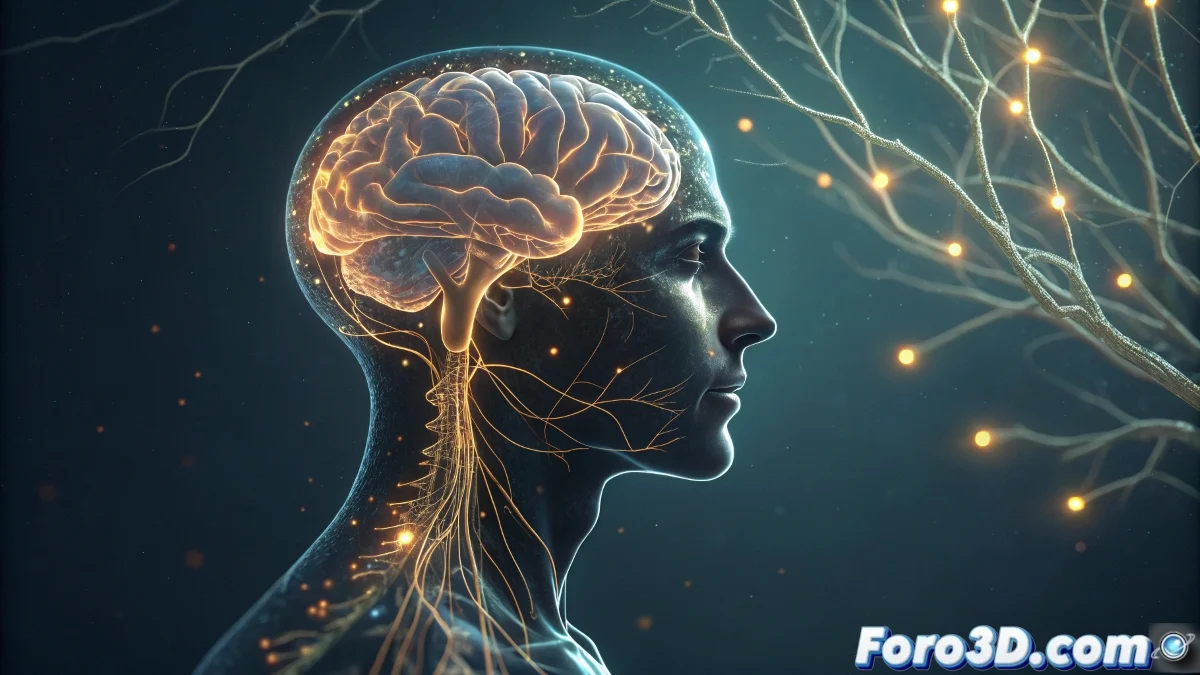
When Animation Explains the Complexity of the Brain
A recent neuroscience study has revealed how depression, schizophrenia, and bipolar disorder—combined with unhealthy habits—directly affect adult neurogenesis, the brain's ability to generate new neurons. 🧠⚡ In After Effects, we can transform these complex findings into understandable visualizations, showing how mental disorders impact brain plasticity and how potential therapies could restore these vital functions. This union between science and visual art democratizes neuroscientific knowledge for diverse audiences.
Scientific Project Setup
When starting After Effects, a 1920x1080p composition at 30 fps is created, ideal for medical-educational content. Organizing the Project panel is crucial: Scientific_Footage, Neuronal_Animations, Data_Graphics, and Explanatory_Audio keep assets orderly. 🗂️ Enabling GPU acceleration ensures smoothness when working with particles and complex effects that simulate biological processes. Saving as neurogenesis_study.aep preserves the structure for future iterations.
Visualizing neuroscientific processes in After Effects does not only illustrate data; it humanizes science, making the microscopic tangible and the abstract comprehensible, bridging the gap between laboratory and society.
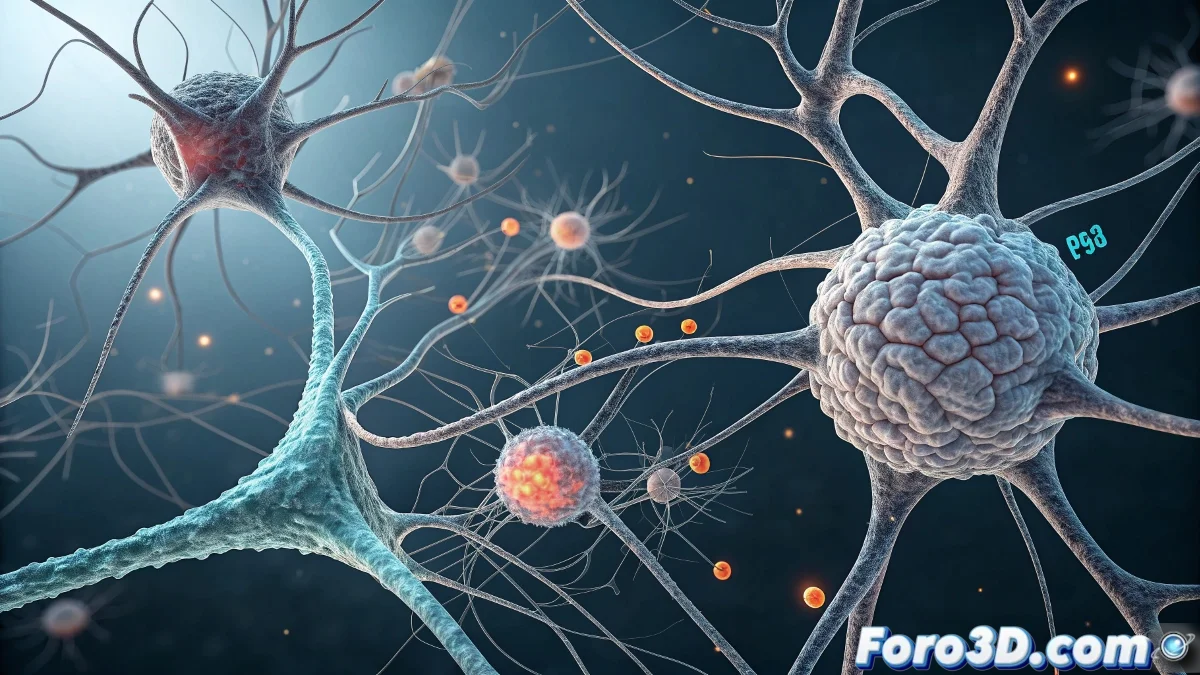
Creating Neurons and Visual Connections
Neurons are created using Shape Layers—circles for somas and paths with stroke for axons and dendrites. 🎨 The Trim Paths effect animates the growth of neuronal connections, while Puppet Pin Tools adds organic feel to the branches. To simulate neurogenesis, Trapcode Particular (or CC Particle World) is used, emitting particles from active somas, with life, size, and turbulence parameters that replicate real cellular behavior.
Representation of the Impact of Mental Disorders
- Visual Contrast: Healthy brain shows dense neuronal networks with warm colors (oranges/yellows) while affected brains show sparse networks with cool tones (blues/grays).
- Deterioration Metaphors: Particle animations that fade, connections that break, and progressive reduction of neuronal density.
- Scientific Abstraction: Stylized representation of biological processes without compromising medical accuracy—balance between comprehensibility and rigor.
Advanced Animation and Synchronization Techniques
Converting audio to keyframes allows synchronizing animations with explanatory narration. 🎧 Glow and light leak effects highlight areas of neuronal activity, while depth of field isolates main elements in 3D compositions. Transitions between states—healthy vs. affected—are achieved with morphing between precomps and opacity/scale adjustments with Easy Ease for smoothness.
Applications Beyond Visualization
These animations serve as educational tools in medical schools, materials for psychiatry congresses, and content for mental health awareness campaigns. 🏥 After Effects' ability to create versions with and without text makes them versatile for different contexts and audiences, from specialists to the general public.
Ethical Considerations and Scientific Rigor
All visualizations are developed in collaboration with neuroscientists to ensure accuracy. 🩺 Unproven causal claims are avoided, and patient data is anonymized when real medical images are used. Visual metaphors are chosen to clarify without oversimplifying complex biological mechanisms.
Thus, while science continues to decipher the mysteries of the brain, After Effects allows us to visualize these advances… although no render can fully capture the wonder of real neuroplasticity. Because in medical animation, the only thing that should deteriorate are stereotypes about mental health, not the neurons. 😉