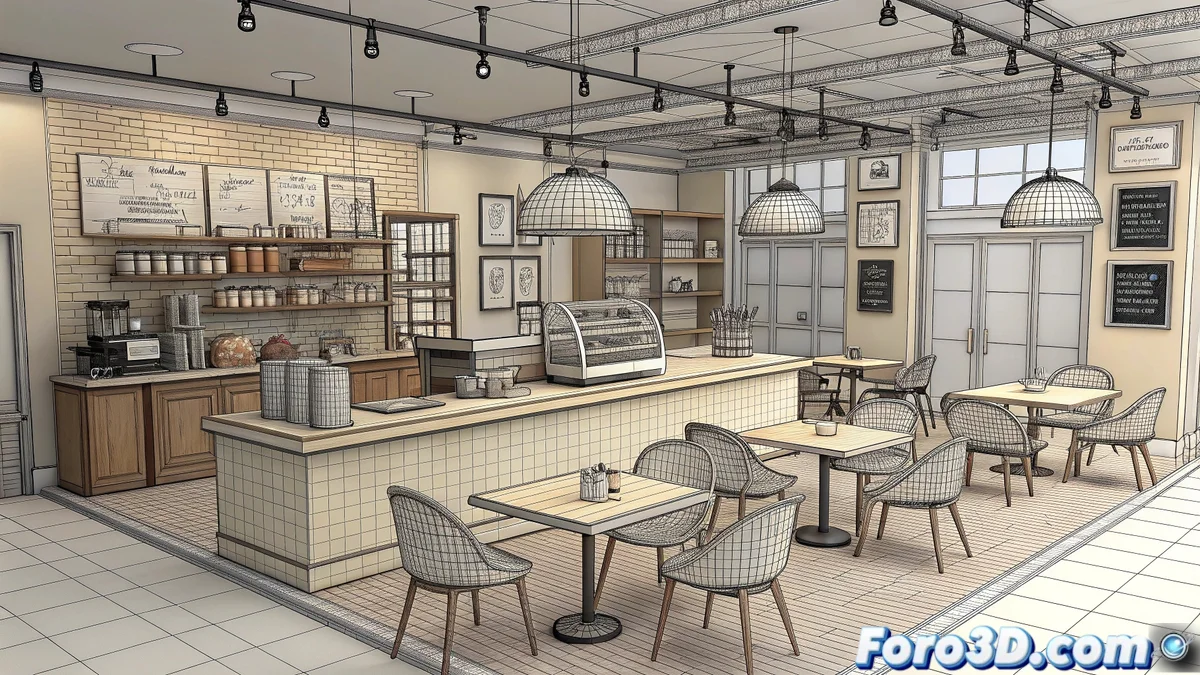
Representing Economic Tensions through 3D Modeling ☕
A recent study analyzes how economic inequality within friend groups affects personal relationships, revealing that differences in income, access to leisure, and shared resources can generate tensions even among close people. This research, traditionally presented with data and graphs, finds in Cinema 4D a powerful medium for its visualization, allowing the recreation of physical spaces where these social dynamics come to life through visual symbolism and scenic composition.
Modeling the Social Environment in Cinema 4D
The process begins by building a recognizable social space—a modern cafe, a coworking space, or an apartment—using basic primitives and polygonal modeling in Cinema 4D. Walls, tables, and chairs are created quickly, while the Subdivision Surface tool allows smoothing curves and adding realism to objects like cups, lamps, or electronic devices. The arrangement of the furniture not only defines the space but also suggests zones of comfort and exclusion within the group. 💸
Symbolic Distribution of Characters and Props
Through stylized character models, friends are placed at different tables or areas, reflecting their economic status through carefully chosen details. Props like high-end laptops versus obsolete devices, premium backpacks versus simple bags, or even clothing and body posture, visually communicate income differences. The relative position of the characters—some grouped closely, others isolated—accentuates the dynamics of inclusion and tension described in the study.
In social visualization, every object is a data point; every spatial arrangement, a visible statistic.
Lighting and Atmosphere to Reinforce the Narrative
Cinema 4D offers advanced lighting tools like Area Lights and Global Illumination to create warm and realistic environments. Light is directed strategically to highlight contrasts: characters with greater resources bathed in warm and direct light, while those in less favorable economic situations are placed in darker areas or with indirect lighting. This play of lights and shadows subliminally reinforces the central theme of inequality.
Visual Elements and Eye Guidance
Additional details in the scene help communicate the message without the need for explanatory text:
- Whiteboards or screens with integrated statistical graphs
- Books or magazines on economic topics on specific tables
- Mobile devices showing luxury apps versus discount apps
- Wallets and cards visible in pockets or on tables
The overall composition guides the viewer's gaze toward these elements, creating an autonomous visual narrative.
The Technical Irony Behind Social Representation
While the friends in the scene discuss income differences, 3D artists face our own inequality: the struggle against rebellious polygons, splines that refuse to close, and coffee cups that insist on passing through tables as if the laws of physics do not apply in the digital world. The real tension is not in incomes, but in achieving a final render that does not collapse due to a geometry error.
In the end, the only inequality that really hurts is the one between the time we invest in modeling and the result we get after hours of rendering. But hey, at least our economic tensions are virtual... for now. 😅