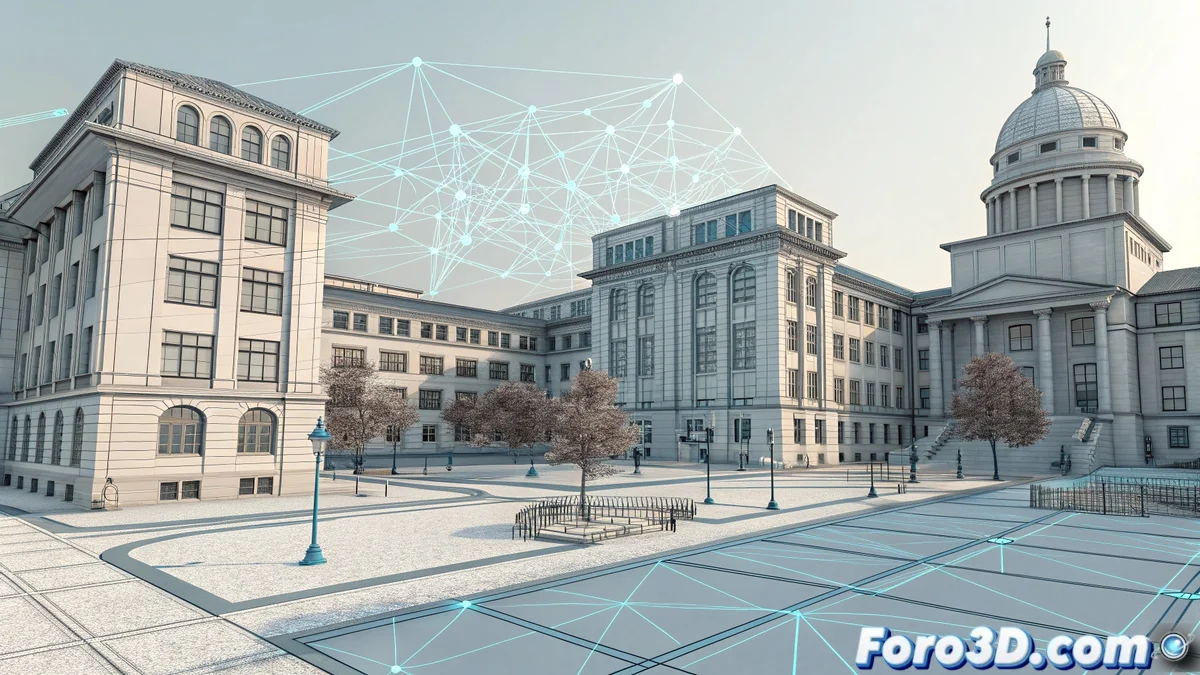
Transforming Digital Threats into Visual Art with 3ds Max 🔒
A recent report has revealed that 60% of Ibero-American universities have suffered cyberattacks in the last year, highlighting the growing vulnerability of educational institutions to digital crime. This abstract issue finds in 3ds Max a powerful channel for its visual representation, allowing cold data to be transformed into immersive experiences that communicate the urgency of cybersecurity through modeling, animation, and striking lighting effects.
Abstract Modeling of the University Network
The process begins by representing the university's digital infrastructure using basic primitives in 3ds Max. Interconnected Cylinders symbolize data networks, while Boxes organized in modular patterns represent servers and storage centers. To convey a sense of scale and complexity, instances and arrays are used to replicate these elements, creating a structure that suggests a vast and interconnected digital ecosystem. University buildings are simplified into pure geometric shapes, recognizable yet stylized, emphasizing their function as nodes within the network. 🌐
Visual Representation of Vulnerabilities
Security breaches are materialized through fractured and discontinuous geometries. By applying the ProBoolean modifier with subtraction operations, cracks and holes are created that pierce through server models and connections. These "digital wounds" are enhanced with emissive materials in red and orange tones, which appear to bleed data or energy. The contrast between the clean shapes of the network and these ruptures visually communicates the impact of the attacks.
Visualizing a cyberattack is like mapping a ghost: the invisible is traced through its effects.
Particle Systems to Symbolize the Attack
To represent the moment of the attack, Particle Systems are used to simulate malicious data flows. By configuring emitters with chaotic trajectories and assigning high-emissivity materials, beams of particles are created that collide with the university network, deforming it or generating new fractures. The integration of Space Warps like Wind or Vortex adds dynamism, suggesting the unpredictable and disruptive nature of digital threats.
Alert Lighting and Atmosphere
The scene is immersed in a dark and tense atmosphere, primarily lit by red and green alert lights—colors associated with danger and surveillance. Flickering lights with intensity animations create a sense of emergency, while fog volumes and lens flare effects add depth and drama. The use of Global Illumination ensures that light interacts credibly with emissive and reflective materials.
Scene Composition and Narrative
The camera is animated to traverse the network, initially focusing on its integrity and then progressively revealing the vulnerabilities. Close-ups on specific cracks highlight the damage, while wide shots show the extent of the problem. Additional elements such as:
- Floating texts with statistics from the report
- Sweep animations that simulate security scans
- Corrupted geometries with Noise modifiers
complete the visual narrative, transforming the scene into a graphic warning about digital fragility.
While universities seek security patches, we patch vertices and normals in 3ds Max. The irony is palpable: we represent digital fragility with tools that also crash unexpectedly. At least our cyberattacks are rendered... and fixed with a Ctrl+Z. 😅