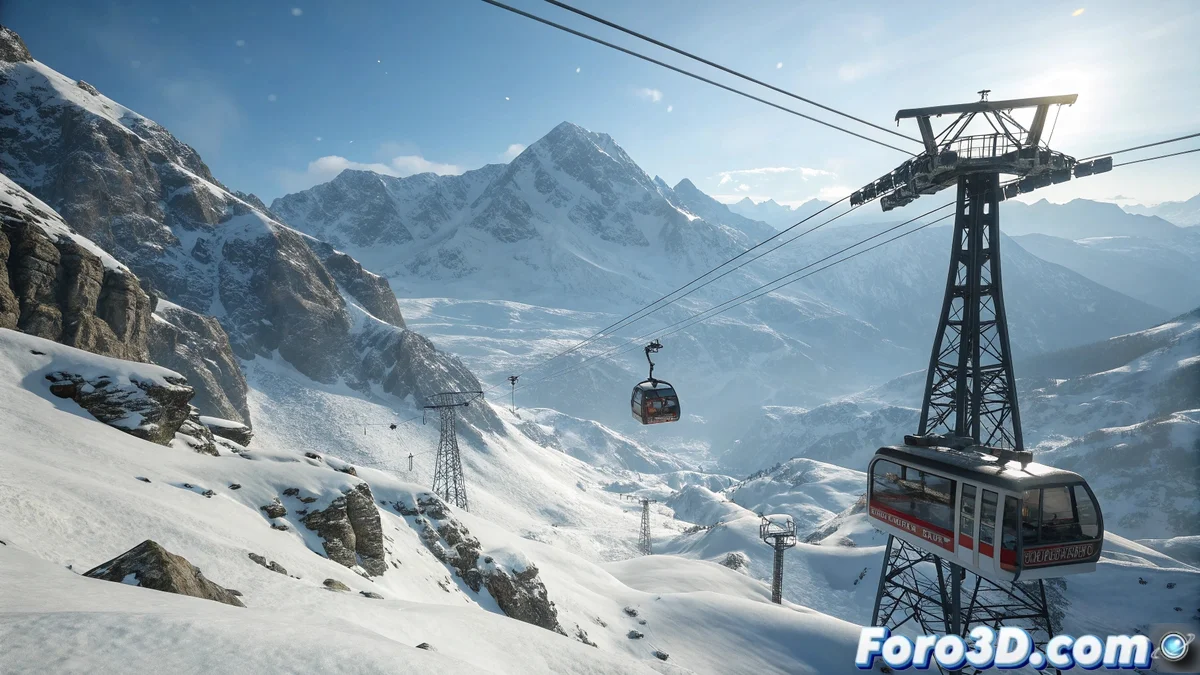
When Safety Meets Alpine Beauty
Maintaining cable cars in snowy mountainous environments represents a crucial engineering and safety challenge. 🏔️🚡 In Terragen, we can visualize these systems in their natural context, creating scenes that show not only the beauty of alpine landscapes but also the critical infrastructure that requires constant maintenance. From support towers to ice-covered cables, every element tells a story of technical precision in challenging environments.
Initial Project Setup
Upon opening Terragen, a new scene is created by setting the resolution to 4K to capture fine details of snow and structures. Organizing the node graph is essential: Terrain, Snow_Textures, Cable_Car_System, and Atmosphere are structured logically. Saving the project as telefericos_montana.ter preserves all settings… because in virtual alpine environments, as in real ones, preparation prevents problems.
Mountainous Terrain Generation
The terrain is created using procedural noise patterns that simulate realistic mountain formations, with jagged peaks and deep valleys. 🗻 Displacement layers are applied to add rock details under the snow, and erosion is adjusted to create credible slopes. Areas around cable car stations are slightly flattened to simulate preparation and maintenance zones. This base sets the stage for the transportation infrastructure.
Visualizing infrastructure in extreme environments not only shows scenic beauty; it reveals how human engineering adapts and withstands challenging natural conditions through meticulous design and maintenance.
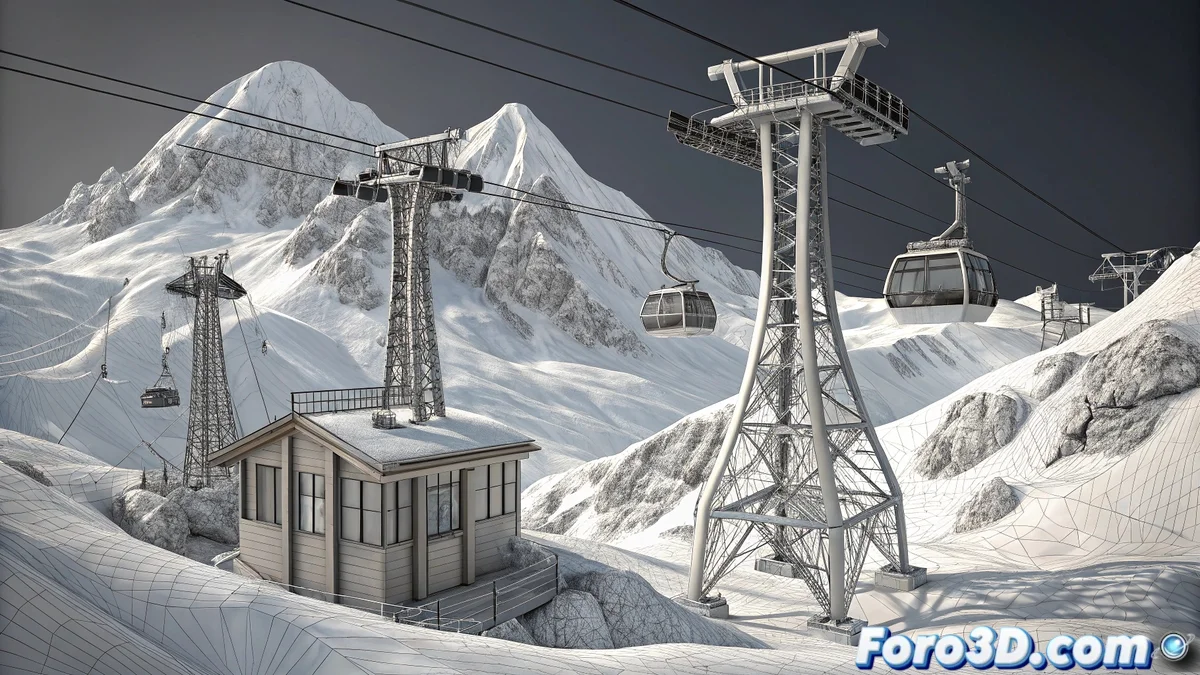
Cable Car System Implementation
Support towers are modeled as metallic structures with snow accumulation on horizontal surfaces, using custom shaders. ❄️ Cables are traced between towers using realistic catenary curves, with textures showing ice and variable snow buildup. Cabins are imported as 3D models or created with primitives, textured with contrasting colors for visibility in foggy conditions. This visual system communicates the complexity of operating at altitude.
Texturing and Environment Techniques
- Snow Textures: PBR layers with high roughness and subtle subsurface scattering are used to simulate fresh and compacted snow in different areas.
- Atmospheric Effects: Altitudinal fog is configured to densify in valleys and clear on peaks, adding depth and realism.
- Alpine Lighting: The sun angle is adjusted to create long shadows and highlights on ridges, typical of high latitudes and altitudes.
Rendering and Post-Processing
The scene is rendered with adaptive sampling to capture fine details of snow textures and structures. 📸 Cameras are positioned to show spectacular views of the entire system and technical close-ups of critical details—cable joints, fastening mechanisms, ice accumulation areas. In post-processing, levels are adjusted to emphasize the contrast between infrastructure and the natural environment.
Beyond Visualization
This scene can serve as a tool for maintenance planning, snow accumulation analysis, or staff training. 🛠️ Terragen's ability to simulate different weather conditions allows testing storm, frost, or reduced visibility scenarios—all without physical risks.
Thus, while real technicians battle ice and wind, we can explore these environments from digital warmth… where the only cold that exists is in the color palette. Because in Terragen, the only dangerous drop is in the frames per second. 😉