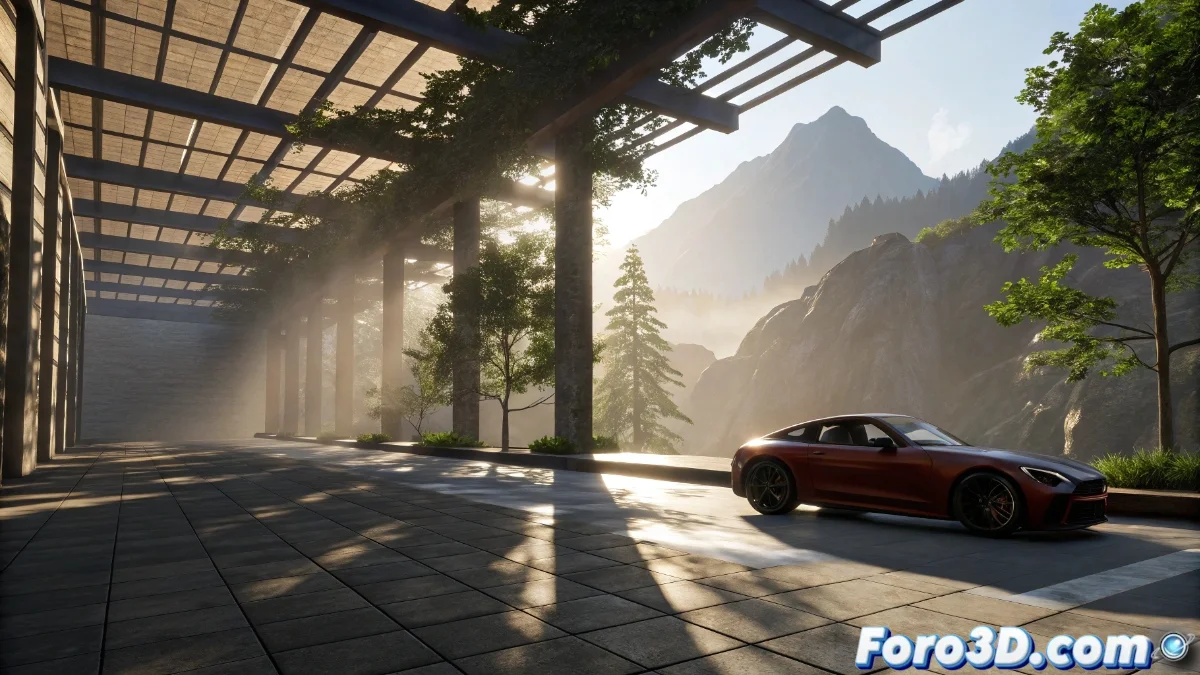
Virtual Shadow Maps: Revolution in Dynamic Shadows for Complex Scenes
Virtual Shadow Maps represent a fundamental technological leap for real-time shadow generation in massive-scale virtual environments. 🎮 This innovative system integrates seamlessly with Nanite, Unreal Engine's virtualized geometry system, providing ultra-high-resolution shadows even in scenarios of extreme complexity. The solution effectively resolves the classic shadow aliasing problem through virtual maps that regenerate only in necessary areas, optimizing performance without sacrificing visual quality. ✨
Operational Mechanics of Virtual Shadow Maps
The operation is based on dividing the shadow space into virtual pages that are only processed when visible from the camera's perspective. It employs a screen-space shading technique that calculates shadows directly from the scene geometry, overcoming the resolution limitations inherent in traditional methods. This architecture synchronizes natively with the Nanite pipeline, where geometry is streamed and rendered at ultra-high levels of detail. The end result is precise and defined shadows that maintain sharpness in close-ups, while secondary areas consume minimal resources. 🖥️
Main Technical Features:- Division of shadow space into on-demand rasterized virtual pages
- Direct shadow calculation from scene geometry via screen-space shading
- Full integration with Nanite's geometric streaming system
The combination of Virtual Shadow Maps with Nanite redefines the limits of dynamic lighting in large-scale virtual environments
Benefits Over Conventional Systems
The most notable advantages include the complete eradication of aliasing in close planes and the ability to handle scenes with millions of polygons without perceptible quality loss. The system scales dynamically according to environmental complexity and object proximity to the camera, distributing shadow detail where it is most crucial. Additionally, it drastically reduces memory consumption by avoiding the allocation of large static maps, using instead an efficient data structure that stores only the essentials. This approach allows developers to create expansive worlds with premium dynamic lighting without performance compromises. 🌐
Essential Comparative Advantages:- Complete elimination of aliasing in close camera planes
- Automatic scaling based on scene complexity and visual proximity
- Significant reduction in memory usage through optimized data structures
Reflections on Technological Evolution
Although it is extraordinary to have perfect shadows in colossal scenarios, there are times when one misses those days when shadows danced freely across the screen generating abstract patterns that could be interpreted as unintentional artistic expressions. This technological evolution confronts us with the eternal dilemma between technical precision and imperfect charm, reminding us that every advance brings both gains and losses in the visual experience. 🎨