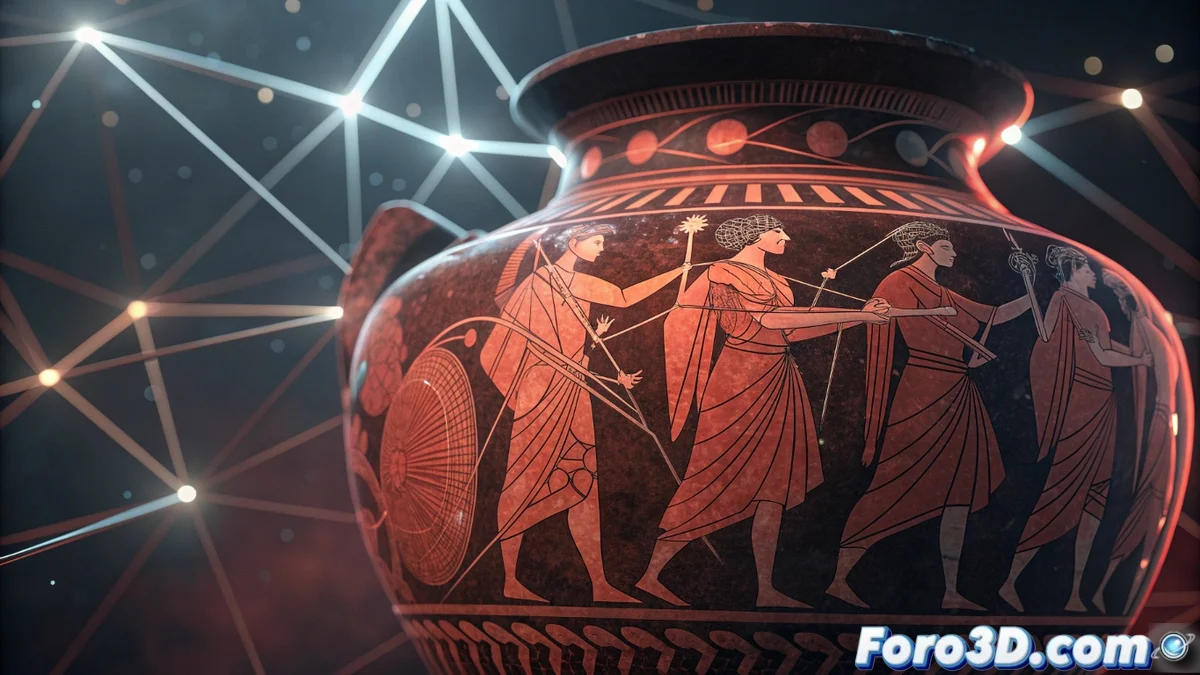
Forensic Virtual Reassembly of Archaeological Pottery Using 3D Scanning
Forensic archaeology has found a revolutionary ally in three-dimensional digitization technology. When the remains of an ancient vase, such as a Greek jar, arrive at the laboratory in hundreds of fragments, it is no longer necessary to risk its integrity with excessive physical handling. 🏺 The modern solution begins with the creation of a precise digital twin of each shard, a process that marks the start of a millimeter-accurate and non-invasive reconstruction.
The Digital Genesis: Fragment Capture with 3D Scanners
The first link in this technological chain is 3D data acquisition. Each pottery fragment is scanned independently using high-resolution devices like the Artec Space Spider or the NextEngine. These scanners faithfully capture the complex geometry and fracture edge surface texture, generating digital representations in the form of dense point clouds or polygonal meshes. The quality of this initial model is fundamental, as it constitutes the database on which all subsequent algorithms will work. A poor scan would compromise the entire virtual assembly process.
Equipment and Key Results in the Scanning Phase:- Structured light or laser scanners: Provide micrometric precision, essential for capturing details of broken edges.
- Point cloud or polygonal mesh: These are the resulting digital formats that act as the "geometric DNA" of each fragment.
- Calibration and multiple scans: Required to eliminate shadowed areas and ensure complete coverage of each piece.
3D digitization turns a physical problem of a million pieces into a computational challenge of a million polygons, preserving the original intact.
Refining the Digital Raw Material: Mesh Cleaning and Optimization
The raw data from scanning is rarely ready for analysis. It contains artifacts, noise, and superfluous geometry. This processing and preparation stage is performed in specialized software like PolyWorks, MeshLab, or CloudCompare. Here, technicians "clean" the models: they remove floating elements, smooth surfaces without altering critical edges, and reduce polygon density in unnecessary areas to optimize performance. The goal is to obtain clean and lightweight meshes where the fracture topography is perfectly clear, preparing the ground for matching algorithms to work with maximum efficiency. 🔧
Essential Tasks in Mesh Processing:- Noise and outlier removal: Elimination of points or polygons that do not correspond to the fragment's real surface.
- Intelligent decimation: Reduction of the number of polygons while keeping the fracture edge geometry intact.
- Hole filling and smoothing: Correction of small missing areas in the mesh without distorting its overall shape.
The Heart of the Process: Registration and Automatic Assembly Algorithms
The central and most fascinating phase of forensic virtual reassembly is executed by custom software that implements registration algorithms like the Iterative Closest Point (ICP). This program systematically compares the geometry of all digital fragments. It tests millions of orientations and relative positions, evaluating how broken surfaces fit together and calculating a matching "score." The algorithm iterates, adjusts, and fits the virtual pieces like an automatic three-dimensional puzzle, seeking the global configuration that reconstructs the original vase. 💻 The final result is a complete and reassembled 3D model, an invaluable asset that allows archaeologists to perform precise measurements, stress analysis, interactive visualizations, and plan physical restoration with absolute precision, or simply archive the artifact in its integral form for future generations.