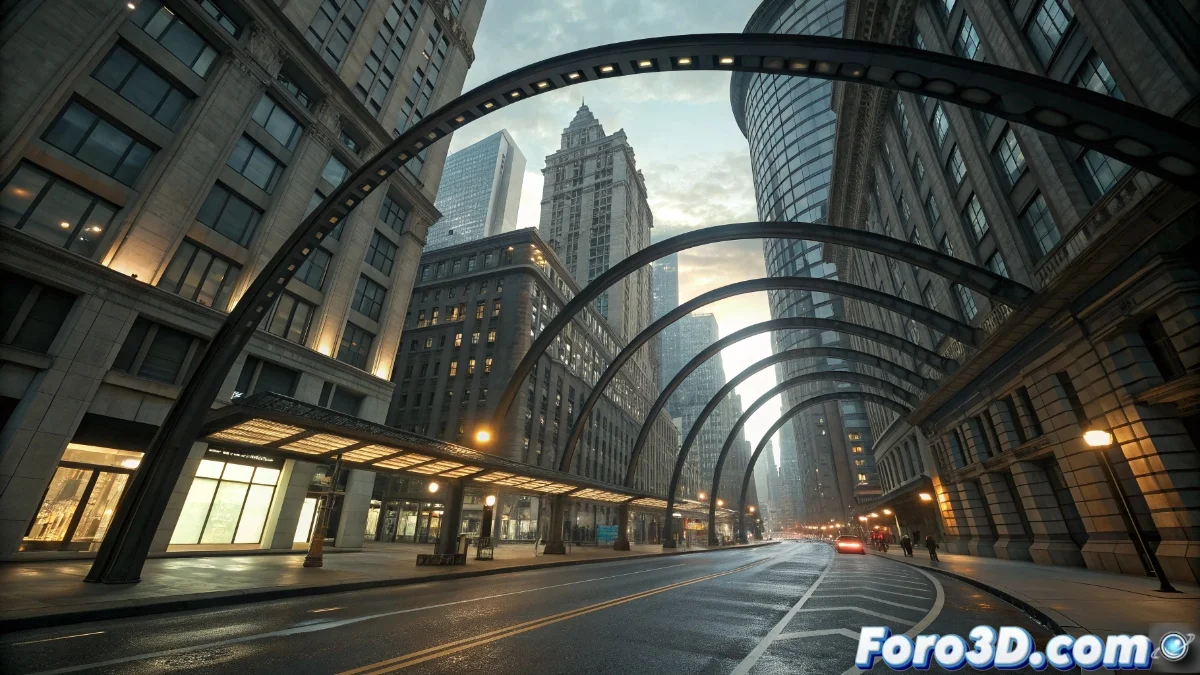
Curvilinear Perspective in Spatial Representation
The curvilinear perspective represents a significant evolution in visual representation systems, where traditionally straight lines become organic curves that converge toward various vanishing points. This methodology allows for encompassing scenes with extreme viewing angles, from 180° panoramas to complete 360° environments, replicating human perception in wide peripheral visions. 🎨
Mathematical Foundations of Curvature
The transformation of straight lines into arcs is not random but obeys precise geometric principles, where circular or elliptical trajectories guide each curve toward specific visual poles. Each vanishing point acts as an attraction center, generating harmonic deformations that preserve spatial logic. This approach is especially useful in panoramic architecture, extensive interiors, or urban landscapes, where straight lines would produce unaesthetic irregularities at the edges of the composition. 🧮
Key Aspects of Curvature:- Curves follow defined mathematical patterns, avoiding chaotic distortions
- Multiple vanishing points are distributed on the horizon, zenith, and nadir for three-dimensional control
- Spatial coherence is maintained through calculated and natural deformations
In curvilinear perspective, the straightest lines are usually perfect curves, especially when drawing spaces so vast that you can see your own heels without mirrors.
Applications in Illustration and Architecture
Digital illustrators and architects value this technique for visualizing immersive spaces, particularly with angles greater than 90°. The process begins with placing main vanishing points on the horizon, complemented by vertical points to handle curvature in tall structures or significant depths. Programs like Photoshop, Blender, or SketchUp include tools to generate these guides automatically, although many artists prefer manual tracing for absolute creative control. 🏙️
Featured Tools and Techniques:- Specialized software with built-in functions for curved guides
- Manual methods that allow customized adjustments and greater expressiveness
- Combination of horizontal and vertical points to master curvature in all directions
Conclusion on Curvilinear Perspective
Mastering curvilinear perspective involves understanding that the curved nature of lines in wide visions is essential for realistic representations. This technique not only enriches illustration and architecture but also faithfully reflects how the human eye experiences extensive spaces, making every composition immersive and coherent. 🌍