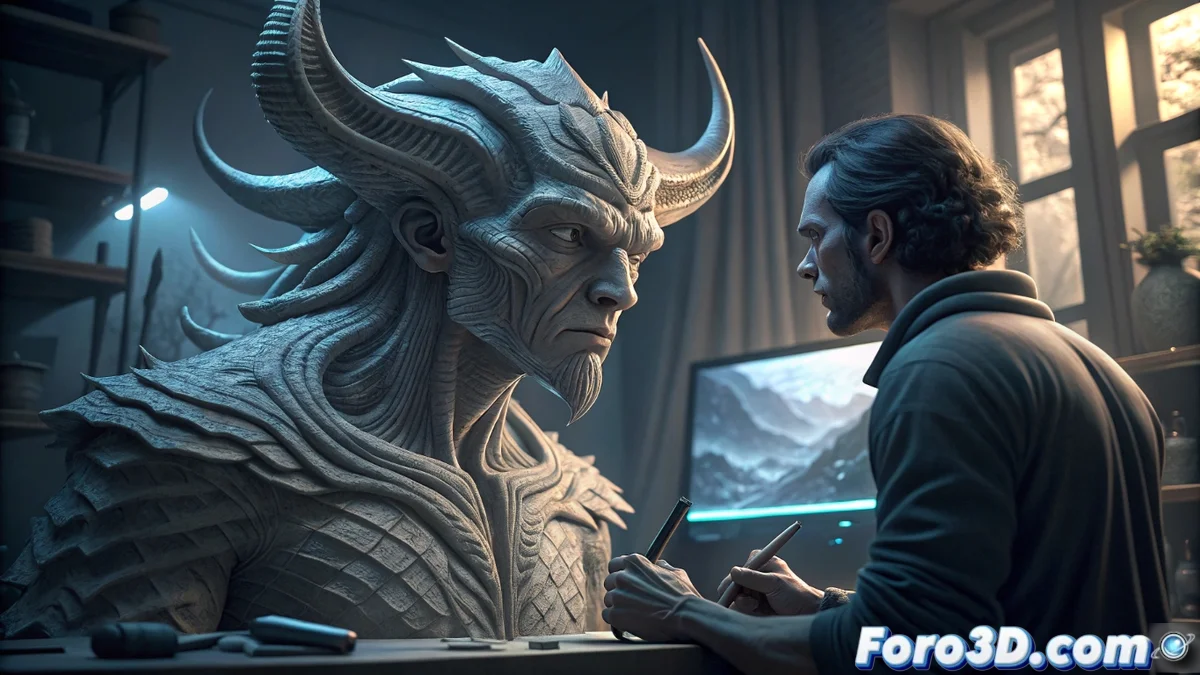
Vector Displacement Meshes: Revolutionizing Brushing in Digital Sculpting
3D modeling has taken a qualitative leap with the adoption of techniques such as the use of Vector Displacement Meshes (VDM). Unlike traditional displacement, this methodology allows manipulating geometry in any direction in three-dimensional space, freeing the artist from the restriction of moving the mesh solely along its normal. The result is an unprecedented ability to sculpt intricate organic elements with remarkable efficiency. 🎨
The Mechanism Behind the VDM Technique
This technology operates by processing three-dimensional vector data that encodes the direction and magnitude of the displacement. By interpreting this information, the brush applies multidimensional and dynamic deformations that integrate perfectly (seamless) into the production pipeline. One of its greatest virtues is the preservation of the topology and global structure of the mesh while adding high-fidelity details, which represents a monumental advantage for the digital artist.
Key Advantages of VDM Brushing:- Total Directional Freedom: Displacement is not confined to the surface normal, allowing sculpting at complex angles.
- Efficiency in a Single Stroke: Complete shapes, such as ears, twisted horns, or fabric folds, can be generated with a single precise stroke.
- Structural Precision: Fine details are added without distorting the base geometry of the mesh, maintaining the model's integrity.
VDM transforms brushing from a superficial sculpting tool into a powerful and predictable vector deformation system.
Practical Applications in the Industry
In real production environments, such as AAA video game development or animation feature films, VDMs have become a cornerstone. Artists use them to inject realism into specific elements: from porous skin texture and scars to the creation of anatomical or ornamental protrusions. This tool not only improves visual quality but also radically optimizes time, reducing the need for tedious manual touch-ups in later stages of the pipeline.
Common Use Cases with VDM:- Creation of Organic Assets: Ideal for wildlife, fantasy creatures, and natural elements with irregular shapes.
- Detailing of Clothing and Armor: Perfect for generating folds, dents, and complex ornaments on textile or metallic surfaces.
- Rapid Prototyping: Allows agile iteration and visualization of design variations during the conceptual phase.
The Unpredictable Side of the Technology
Despite its precision and power, the use of Vector Displacement Meshes can occasionally bring moments of controlled chaos. Under certain circumstances, the interaction between complex vectors and the mesh topology can make it seem like the mesh comes to life on its own, performing unexpected deformations in the viewport. These unforeseen "dances" serve as a humorous reminder that, even with the most sophisticated technology, an element of improvisation and manual adjustment remains part of the creative process. 💥