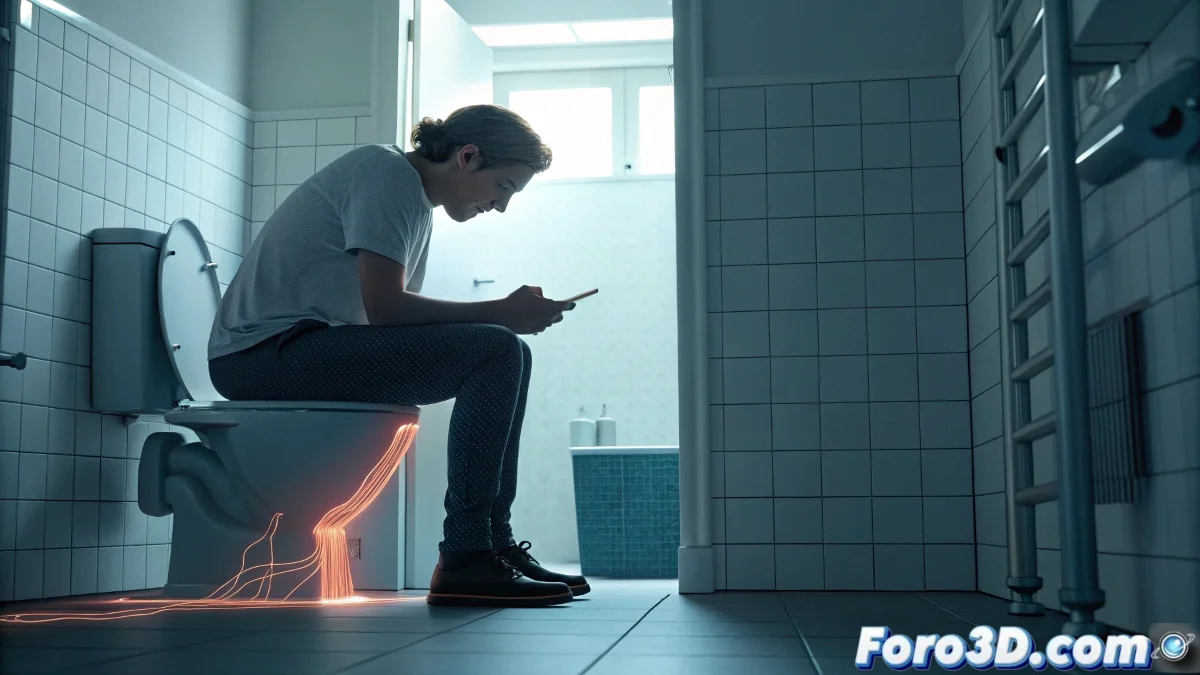
The Digital Connection You'd Rather Not Have
Proctologists from various institutions have confirmed what many suspected: using your smartphone on the royal throne significantly increases the risk of developing hemorrhoids. The problem isn't the device itself, but the extra time we spend sitting, completely distracted by social media and apps. What should be brief bathroom visits turn into prolonged sessions of digital entertainment with very real physical consequences.
The mechanics are simple but devastating: every extra minute seated increases pressure in the anal area, compromising blood circulation and progressively dilating hemorrhoidal vessels. The body's weight compresses these delicate vascular tissues, and when the posture is maintained for fifteen or twenty minutes instead of the recommended five, damage is practically guaranteed. Statistics show that phone users in the bathroom double their stay time.
The throne has become the new cinema armchair, with a much less pleasant ending
Preparing the Anatomical Simulation in Houdini
Representing this physiological process requires a scientific approach combined with visual sensitivity. Houdini offers ideal tools to simulate both blood hydrodynamics and soft tissue deformation. The project begins with research on pelvic anatomy and real hemodynamic parameters.
Setting the correct scales is fundamental: from large pressure volumes to microvessels that dilate progressively. The simulation must capture both the mechanical behavior of tissues and altered blood flow patterns, creating a visual narrative that educates without being explicitly graphic.
- Research on anal canal anatomy and hemorrhoidal plexus
- Setup of measurement units for realistic biological simulation
- Creation of base geometry based on medical references
- Establishment of node hierarchy for modular management
Modeling the Relevant Anatomy
The initial geometry focuses on key structures: the lower rectum, anal canal, and complex hemorrhoidal vascular system. Using procedural modeling tools, we create an anatomical base that will then be dynamically deformed. The topology is optimized for soft tissue simulations, with loop flows that respect the natural muscle direction.
Blood vessels are generated using VDB systems that are later converted into manageable geometry. This approach allows creating complex vascular networks with organic variation, avoiding the rigidity of traditional manual modeling. The result is anatomy that, although stylized, maintains scientific precision.
- Creation of base anal geometry with sculpting tools
- Generation of vascular network using VDB from Particles
- Application of controlled subdivision for organic smoothing
- Preparation of UVs for future medical textures
Simulation of Pressure and Tissue Deformation
The core of the visualization lies in simulating how prolonged pressure deforms tissues. Using Houdini's Finite Elements solver, we configure the anal tissue material properties: limited elasticity, high compressibility, and gradual shape memory. Constraints define how ligaments anchor the anatomy to virtual bone structures.
Pressure is applied as a growing volumetric force, simulating distributed body weight. We animate this parameter to show the difference between a normal five-minute session versus a prolonged twenty-minute one, with progressive deformations that accumulate over simulated time.
Fluid Dynamics for Compromised Circulation
Altered blood flow is simulated using FLIP fluids with viscosity adapted to blood properties. Emitters are strategically positioned in superior rectal arteries, while sinks capture venous drainage. Externally applied pressure dynamically modifies flow parameters, showing progressive congestion.
Using velocity and pressure fields, we visualize how characteristic swirls and stagnations of hemorrhoidal congestion form. The fluid coloration gradually changes from bright arterial red to dark venous red, indicating decreased tissue oxygenation.
- Setup of FLIP container with adaptive resolution
- Definition of arterial emitters and venous drains
- Animation of viscosity and pressure parameters
- Establishment of color fields based on velocity
Materials and Shaders for Educational Clarity
Materials are designed for a balance between biological realism and educational clarity. Tissues use subsurface scattering shaders to convey the translucent quality of anal mucosa, while blood vessels employ controlled emission to highlight flow patterns. High-pressure areas show artificial thermography via color ramps.
The material system is built procedurally, allowing adjustment of transparency and emphasis levels according to narrative needs. This approach facilitates creating multiple shots from different angles without fully rerendering.
- Development of mucosal tissue shader with SSS
- Creation of vascular materials with flow animation
- Implementation of pressure masks via color ramps
- Setup of AOV renders for compositing control
Animation and Visual Narrative
The animated sequence compares parallel scenarios: normal bathroom use versus prolonged session with phone. Cameras are positioned to show macro views of pelvic anatomy and micro views of individual dilating vessels. Animated text highlights elapsed times and pressure levels.
The editorial timing uses strategic pauses to emphasize key moments, such as the point where tissue deformation becomes irreversible. Graphical interface elements overlay to guide attention without distracting from the main simulation.
Render and Medical Postproduction
The final render uses a scientific setup that prioritizes clarity over pure aesthetics. Lights are positioned to eliminate volumetric ambiguities, while soft shadows define three-dimensional geometry. In compositing, anatomical annotations and time scales are added to contextualize observed changes.
Postprocessing effects include subtle glow on congested vessels and depth of field to direct focal attention. The result educates about the invisible consequences of an apparently innocent habit, using visual power to promote behavior change.
Sometimes the best animation is the one that convinces us to leave the phone out of the bathroom 🚽