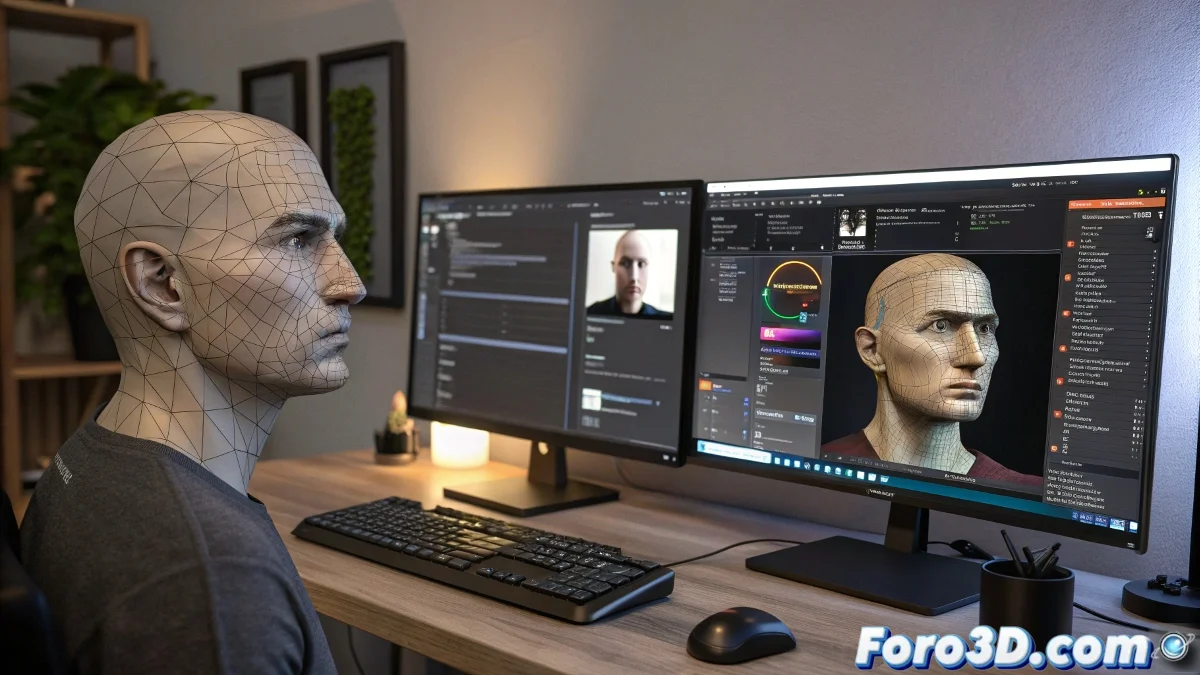
The Mathematical Magic Behind 3D Facial Expressions
If someone says 3D characters come to life by magic, they probably ignore that there's an army of mathematical expressions working behind the scenes. Expression controllers are those silent assistants that, with discrete equations, manage to make an eyebrow raise when the mouth opens, and make gestures seem more human than those of many Monday mornings 😴.
These controllers don't wear lab coats, but they use formulas to automate behaviors. This way, the animator doesn't have to move every digital muscle by hand, because that's what machines are for... and the artist's sanity, which appreciates every second saved.
The Perfect Team for Animating Without Drama
In tools like 3ds Max or Maya, these controllers often team up with objects called helpers. They are simple elements that act as invisible handles: they connect to parts of the face so the animator can move them more easily, like someone pulling a string and moving an entire puppet.
Thanks to this combination, moving one point is enough to make several facial elements react naturally. It's about efficiency and control, as if a small digital orchestra conductor guided virtual muscles with a single gesture 🎻.
Resources to Master Controllers Without Going Crazy
Learning to use them doesn't require being a mathematician, although it sometimes seems like an endless equation. Forums like Foro3D are full of tutorials, while platforms like YouTube offer guides from the basics to advanced tricks in Maya, Blender, or 3ds Max.
- Explore step-by-step tutorials with practical examples.
- Consult forums where users share useful expressions.
- Practice with simple scenes before animating complex faces.
- Try them in different software to understand their approaches.
A good expression controller is like a magician: if it does its job well, no one notices it's there.
When Logic Helps You Smile
Even though they sound like boring math, expression controllers allow for believable and detailed animations without sweating over every frame. Thanks to them, 3D characters can laugh, frown, or be surprised without the animator losing patience... or their coffee ☕.
And if you ever wonder why that animated smile looks so real, remember there's a formula behind it. Or two. Or twenty. But who's counting, right? 😂