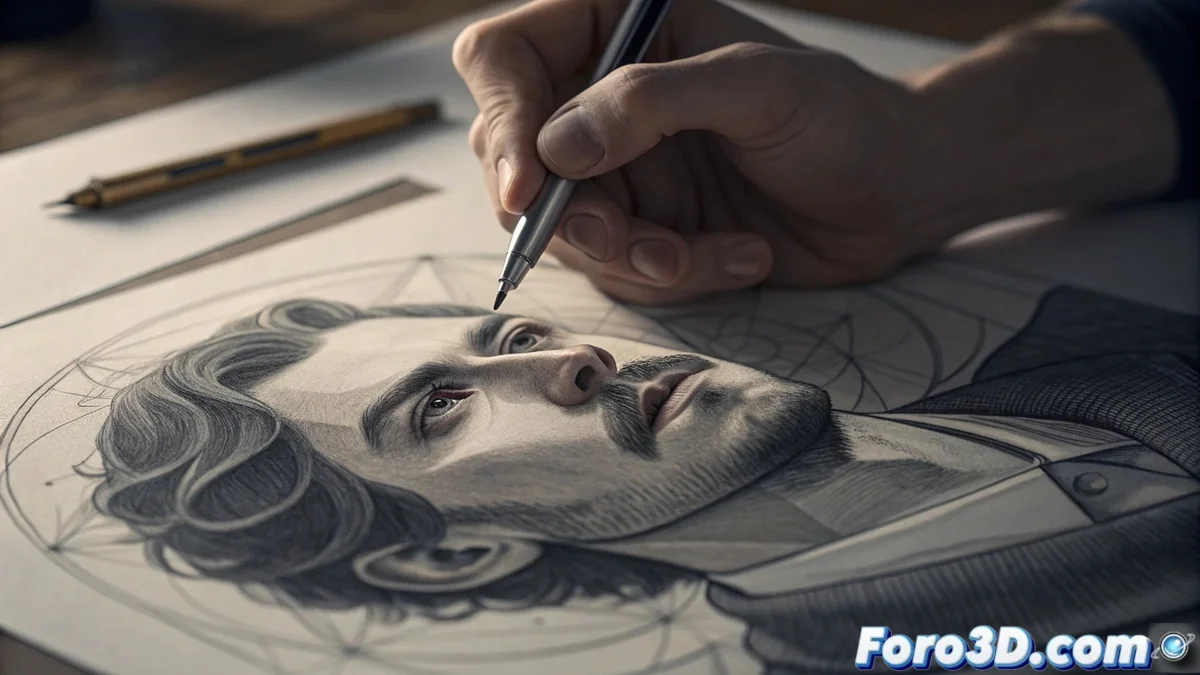
Inverted Drawing: Betty Edwards' Technique to Improve Artistic Perception
The inverted drawing technique is a revolutionary approach devised by Betty Edwards that allows artists to transcend mental symbols and focus on the pure forms of objects. By flipping reference images, our brain interrupts its tendency to recognize familiar elements and focuses exclusively on real contours, angles, and spatial relationships 🎨.
Fundamentals of the Upside-Down Drawing Method
This practice is based on deactivating the symbolic mode of the left hemisphere and enhancing the visual mode of the right hemisphere, which facilitates more objective and detailed observation. By not identifying components like eyes or mouths, the mind is freed from visual biases and concentrates on what actually exists in the composition.
Steps to apply the technique:- Select a clear line drawing, avoiding complex shading that could distract attention
- Place the reference upside down and begin drawing without trying to guess which part you are reproducing
- Resolutely resist the temptation to turn your work around until you have completely finished the exercise
When comparing results, most artists experience astonishing accuracy in their copying ability, demonstrating how this method optimizes perception.
Advantages of Practicing with Inverted Images
This exercise significantly develops the understanding of proportions and shapes, forcing the brain to analyze negative spaces and spatial relationships with greater precision. Beginners notice immediate improvements in their observation skills, as interferences from preconceived notions about the "correct" appearance of objects are eliminated.
Key benefits of inverted drawing:- Increases accuracy in capturing the real lines and angles of any composition
- Trains the mind to adopt an artistic gaze, focusing on abstract qualities
- Fosters a deeper connection with the fundamental visual elements of each image
Final Reflection on the Method
It is fascinating how, sometimes, it is necessary to trick our own brain to allow us to see what is really in front of us, instead of what we assume should be there. Betty Edwards' technique not only improves drawing skills but permanently transforms our way of interpreting the visual world ✨.