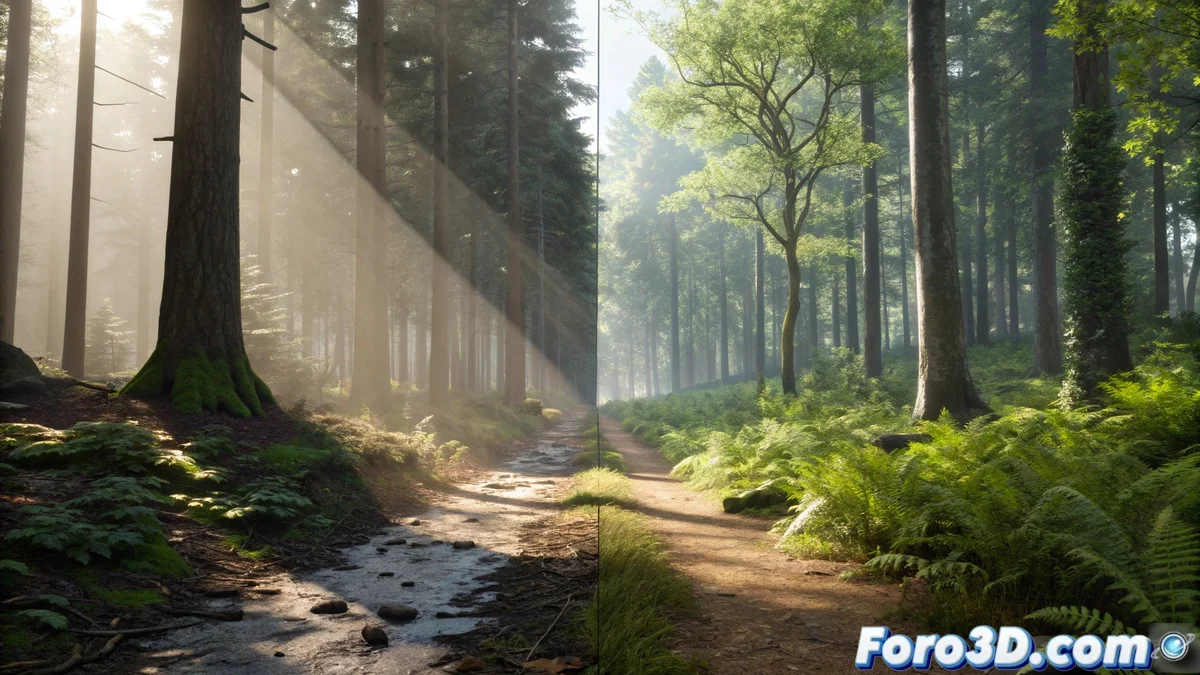
Unreal Engine vs Blender Eevee: Real-Time Rendering Approaches
In the world of real-time rendering, Unreal Engine and Blender Eevee embody opposing philosophies that satisfy distinct creative demands. While Unreal Engine bets on extreme photorealism through advanced technologies, Eevee prioritizes operational agility within an integrated ecosystem. 🎮
Technical Divergences in Lighting and Geometry Handling
The technological gap manifests primarily in the treatment of global illumination and complex geometry. Unreal Engine's Lumen system reproduces real light behavior with dynamic reflections and shadows, eliminating the need for baking. Nanite revolutionizes polygon handling by allowing the import of ultra-high-density models without compromising performance. In contrast, Eevee employs approximate methods like light probes and baked lighting that, although fast, require manual intervention to approach visual realism. 💡
Distinctive Advantages by Engine:- Unreal Engine: Dynamic lighting without precomputation + automatic LOD management with Nanite
- Blender Eevee: Unified workflow with the Blender ecosystem + instant preview
- Weak Points: Unreal requires powerful hardware / Eevee has limitations in advanced realism
Choosing between these engines is like choosing between a supercar and an urban bicycle: both are efficient vehicles, but designed for radically different circuits.
Implementation Scenarios and Production Strategies
The choice of engine often depends on the project context. AAA developers prefer Unreal Engine for immersive video games and VR experiences where realism is priority, leveraging its optimized pipeline for consoles and PC gaming. Blender Eevee dominates in pre-production phases, basic animation, and organic modeling, where its native integration with Sculpt, Texture, and UV greatly streamlines the workflow. For independent studios or rapid prototyping, Eevee drastically reduces render times, while Unreal offers cinematic quality in exchange for higher technical requirements. ⚙️
Recommended Use Cases:- Unreal Engine: Triple-A video games, virtual architecture, immersive simulations
- Blender Eevee: Independent 3D animation, asset preview, motion graphics
- Hybrid Workflow: Many artists use Eevee for blocking and Unreal for final renders
Conclusion: Complementarity Rather Than Competition
These tools represent complementary paradigms in the visual industry. Unreal Engine leads in projects where realism and interactivity are critical, while Blender Eevee empowers artists who value iterative speed and pipeline coherence. The final decision should be based on specific project requirements rather than absolute technical superiorities, as each engine excels in its natural domain of application. 🏆