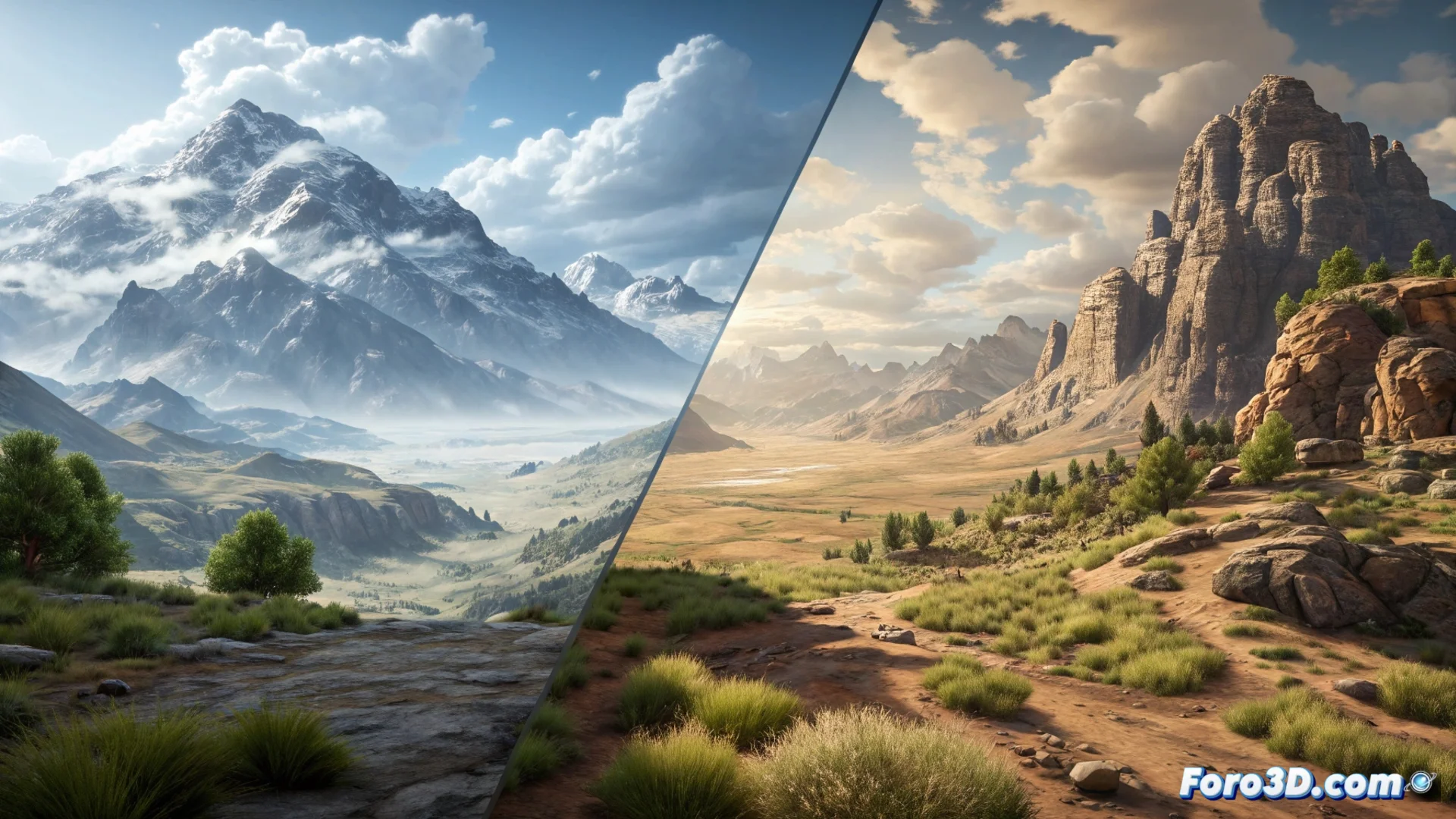
Unreal Engine and Decima: two philosophies of graphics engine development
In the video game industry, the choice of graphics engine defines the workflow and creative possibilities. Two paradigmatic examples are Unreal Engine and Decima, which represent almost opposite development models. One is born as a universal tool, the other is forged to solve very specific problems 🎮.
Unreal Engine: the accessible colossus
Created by Epic Games, Unreal Engine positions itself as a comprehensive suite for producing video games in any genre and for multiple platforms. Its business model allows free use until surpassing an income threshold, at which point royalties are applied. Developers can access its complete source code, vast documentation, and an asset marketplace.
Main features of Unreal Engine:- Generalist approach: Aims to serve indie projects, AAA, and beyond video games, such as in film or architecture.
- Visual tools: Includes systems like Blueprints for programming without writing code line by line.
- Real-time graphics: Focuses on delivering a visually powerful rendering system and an intuitive editor.
Unreal evolves with contributions from a huge community of developers worldwide.
Decima Engine: the author's tool
The Decima engine is a proprietary technology initially developed by Guerrilla Games for Horizon Zero Dawn and later shared with Kojima Productions for Death Stranding. It is not available for external licensing and is refined internally for very specific projects.
Decima engine's strengths:- Specialization in open worlds: Optimized for rendering vast, dense landscapes with enormous visual detail.
- Proprietary technology: Integrates advanced systems for handling large draw distances and highly elaborate atmospheric lighting.
- Custom development: Each feature responds to concrete needs of the games it powers, such as simulating how rain erodes the terrain.
Technical approach and opposing priorities
The fundamental difference lies in their purpose. Unreal Engine wants to be a solution for everyone, which sometimes means developers spend time adjusting basic aspects like compiling shaders. In contrast, Decima offers a already polished base for a specific type of experience, allowing its teams to focus efforts on refining environmental fidelity and scale from the very beginning 🌄.
While one grows collaboratively and publicly, the other is fine-tuned in a closed environment to achieve highly specialized excellence. Both paths are valid and demonstrate the diversity of approaches in video game technology development.