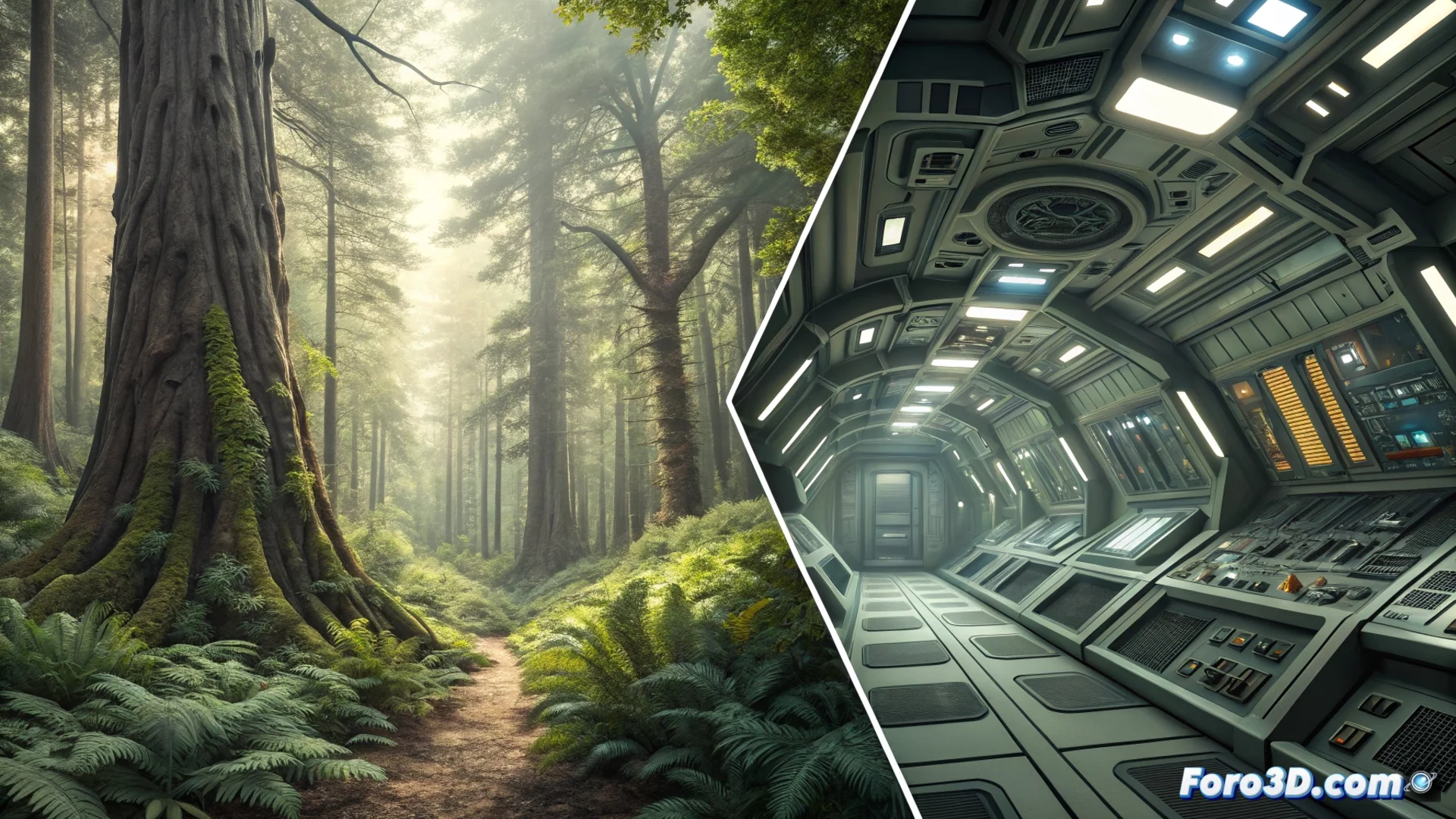
Unreal Engine 5 vs Creation Engine 2: Development Philosophies in Contrast
In the video game development landscape, two graphics engines stand out for their opposing paths: Epic Games' Unreal Engine 5 and Bethesda's Creation Engine 2. One is designed as a universal solution, while the other is tailored to specific needs. Both aim to create immersive virtual worlds, but their methods and fundamental priorities diverge notably 🎮.
The Multiplatform Approach of Unreal Engine 5
Unreal Engine 5 is conceived as a general-purpose engine, available for any external studio to use. Its business model is based on licenses, making it accessible to a wide range of developers. Its main technical goal is to achieve maximum visual realism, for which it integrates pioneering technologies.
Key Technical Features of UE5:- Nanite: A system that processes virtual geometry with microscopic detail, eliminating traditional polygon limits.
- Lumen: Provides dynamic global illumination and real-time reflections, changing how scenes are lit.
- World Partition: Manages massive open worlds smoothly, loading and unloading sections automatically.
- MetaHuman Creator: Facilitates creating digital characters with astonishing realism in little time.
The choice of engine often pits the priority for cinematic graphics against deep world simulation, a constant debate in the community.
Bethesda's Internal Tool: Creation Engine 2
On the other hand, Creation Engine 2 is born as an internal platform that Bethesda Game Studios adapts and refines exclusively for its own titles, such as Starfield. It is not commercialized. Its central philosophy is not just to render a world, but to simulate it, prioritizing systemic interactivity and persistence over absolute visual purity.
Fundamental Pillars of Creation Engine 2:- Persistent Objects System: Almost every item in the world is a physical object that the player can pick up, move, or use, creating a sense of a living world.
- Cell Simulation: Stably manages extensive environments through cells that load dynamically, an evolution of its open-world technology.
- Systems Interconnection: Its strength lies in how the game's different systems (physics, AI, objects) interact with each other to generate a coherent and reactive simulation.
Two Paths to the Same Goal
In summary, Unreal Engine 5 and Creation Engine 2 illustrate how open-world development can be approached from different angles. While UE5 pushes the limits of visual fidelity with tools for everyone, CE2 specializes in building deep interactive sandboxes for specific experiences. The decision between one and the other ultimately depends on what the developer wants to prioritize: a visually stunning canvas or complex systemic play. This divergence keeps innovation and technical debate alive 🔧.