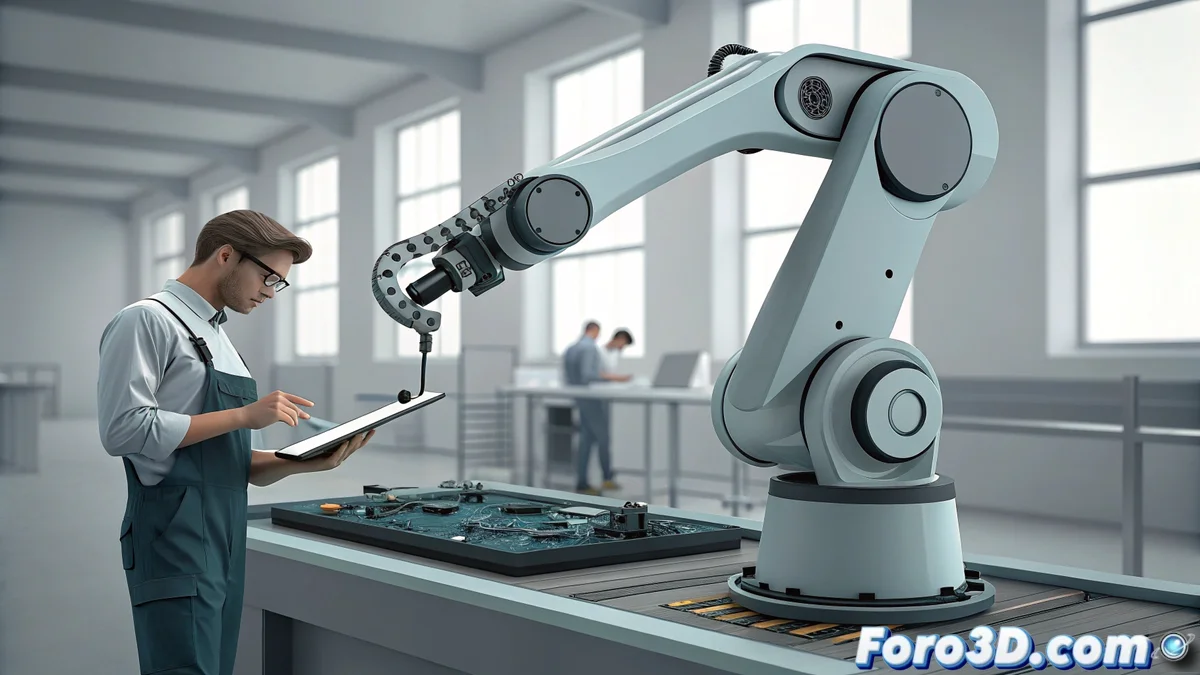
Universal Robots UR5 and UR10: Cobots that Transform Human-Machine Collaboration
The industry is advancing toward environments where humans and machines share space safely and efficiently. Collaborative robots or cobots, led by models like the UR5 and UR10 from Universal Robots, are fundamental in this change. These robotic arms are designed to operate side by side with people, eliminating the need for traditional protective cages and redefining how to automate. 🤖
Safety Integrated into the Design
The central philosophy of these cobots is based on an inherent safety architecture. They incorporate advanced force and torque sensors that constantly monitor their movement. If the robot detects unexpected contact, it can stop immediately or drastically reduce its speed. This capability allows them to be deployed in assembly lines or work cells where personnel operate in close proximity, opening the door to automating tasks that were previously unfeasible.
Key Safety Features:- Automatic stopping upon collision detection, thanks to sensors in each joint.
- Ability to configure reduced speed zones near operators.
- Design with rounded edges and no dangerous pinch points.
Their success lies in simplifying the concept of industrial robots, making automation seem less intimidating and more like a work companion.
Programming by Guiding the Arm by Hand
One of the biggest barriers to adopting traditional robotics is the complexity of programming. UR cobots break down this obstacle with an intuitive programming system. The user physically grabs the arm and manually guides it through the key points of the task. The movements are recorded in a simple graphical interface on a tablet, without needing to write a single line of code. This allows technicians or operators without robotics experience to set up applications in hours.
Common Applications that Can Be Configured:- Packing and palletizing products of different sizes.
- Screwing, gluing, or welding in predefined sequences.
- Loading and unloading machine tools like CNCs or presses.
- Performing basic quality inspections with attached sensors.
Flexibility to Adapt to Current Production
Their lightweight design and mounting options on pedestals, walls, or even mobile carts offer exceptional versatility. They can be easily relocated between different workstations or production lines, which is ideal for manufacturing short runs or frequently changing environments. The main difference between the UR5 and UR10 lies in their reach and payload capacity: the UR5 handles lighter loads with great precision, while the UR10 can manipulate heavier and bulkier components. Additionally, a wide ecosystem of accessories, such as pneumatic, electric grippers, or machine vision systems, multiplies their possible uses. ⚙️
Although they promise safe collaboration, it is crucial to emphasize that they are not a universal solution. A specific risk assessment must always be conducted for each application, as certain processes with sharp tools or high forces may require additional protective measures. Their true value lies in democratizing access to automation, especially for small and medium-sized enterprises seeking to be more agile and competitive without large investments in complex robotic infrastructure.