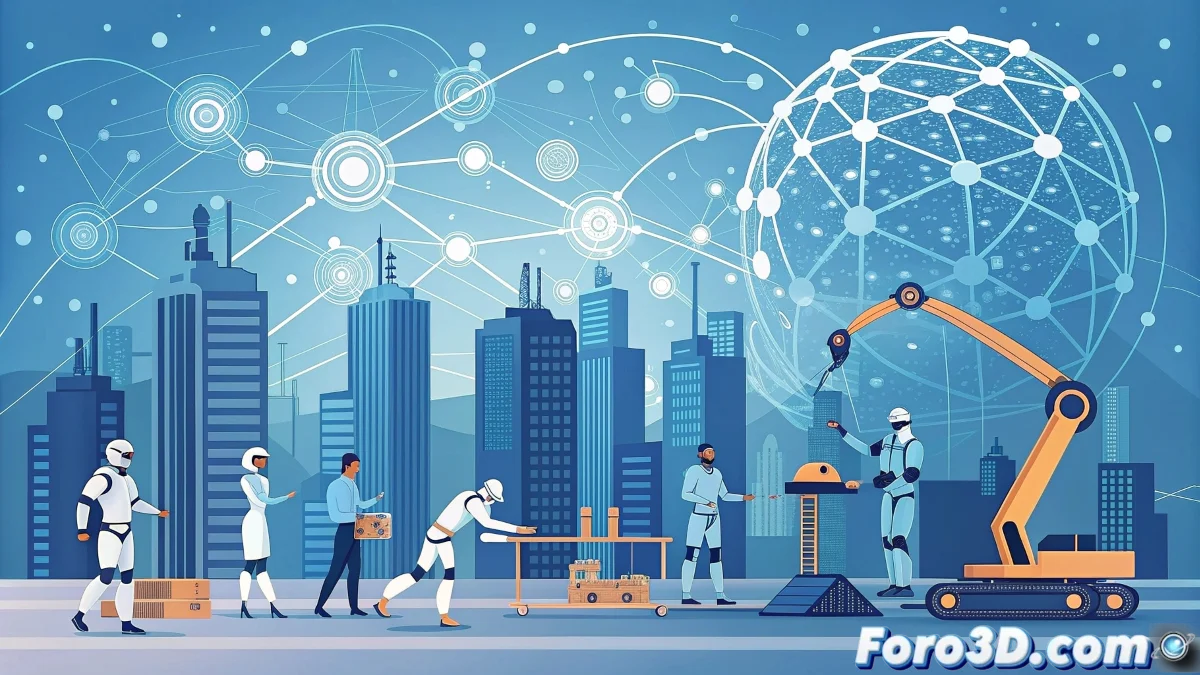
Understanding AI: Beyond Science Fiction
Artificial Intelligence has stopped being that abstract concept from movies to become your everyday ally. But what is it really? In simple terms, AI is the ability of machines to perform tasks that normally require human intelligence: understanding language, recognizing patterns, learning from experience, and making decisions. The fascinating thing is that you no longer need to be a coding expert to harness its power; tools like ChatGPT, Midjourney, and Stable Diffusion have democratized access, putting superhuman capabilities just one click away. 🚀
Demystifying AI: It's Not Magic, It's Applied Mathematics
Far from Hollywood's conscious robots, today's AI is based on neural networks that function like simplified virtual brains. These networks learn from massive amounts of data to find patterns and make predictions. When you use ChatGPT, you're interacting with a model that analyzed millions of books and web pages. When you generate images with DALL-E, the system understands relationships between visual and textual concepts. The magic is that it learns from examples, not programmed rules. 🧠
Types of AI You Use Without Knowing It:- Generative AI: creates new content (text, images, audio)
- Machine Learning: improves with experience without reprogramming
- Natural Language Processing: understands and generates human language
- Computer Vision: recognizes and analyzes images and videos
Game-Changing Tools: Your New Digital Assistant
The true value of AI lies in its practical application. ChatGPT can help you from writing emails to debugging code; Midjourney generates concept art in seconds; GitHub Copilot suggests lines of code like a programming partner. The revolutionary part is that these tools understand context and intent, not just specific commands. You can ask for "an image of a dragon in art nouveau style" or "rewrite this paragraph in a more professional tone" and get surprisingly good results. ✨
AI doesn't replace human intelligence, it amplifies it
Revolutionized Workflows: Real Cases
Imagine being able to automate repetitive tasks that consume your creative time. Designers using AI to generate mood boards in minutes, writers overcoming blocks with contextual suggestions, developers finding bugs in seconds. AI acts as a talent multiplier, allowing you to focus on what really matters: strategy, creativity, and decision-making. It's the end of the "blank page" and the beginning of human-machine collaboration. 💼 Practical applications by discipline:
- Art and design: concept generation, variations, styles
- Programming: autocompletion, debugging, documentation
- Writing: brainstorming, editing, multiple tones and styles
- Research: document summarization, data analysis
Ethics and Limits: Using AI Responsibly
Like any powerful tool, AI comes with important responsibilities. It's crucial to understand that these systems can make mistakes (hallucinations), perpetuate existing biases in training data, and raise issues of originality and copyright. The most effective AI is the one you use as a assistant, not a replacement for your judgment. Verify the information, edit the results, and keep your unique voice in the creative process. Human oversight remains essential. ⚖️
Getting Started Today: Your First Day with AI
The entry barrier is incredibly low. You can start with free ChatGPT, try Midjourney via Discord, or explore Stable Diffusion online without installation. The learning curve is gentle: start with simple prompts ("write a tweet about...") and gradually advance to more complex instructions ("generate a script for a 3-minute video about..."). The secret is learning to communicate effectively with AI through clear and specific prompts. 📝
Understanding AI doesn't require a PhD in computer science, but curiosity and willingness to experiment. This technology is redefining what's possible in every industry and creative discipline. It's not about machines replacing us, but how we can collaborate with them to achieve results that were previously impossible. The future is not human versus machine, it's human with machine, and that future started yesterday. 🌟