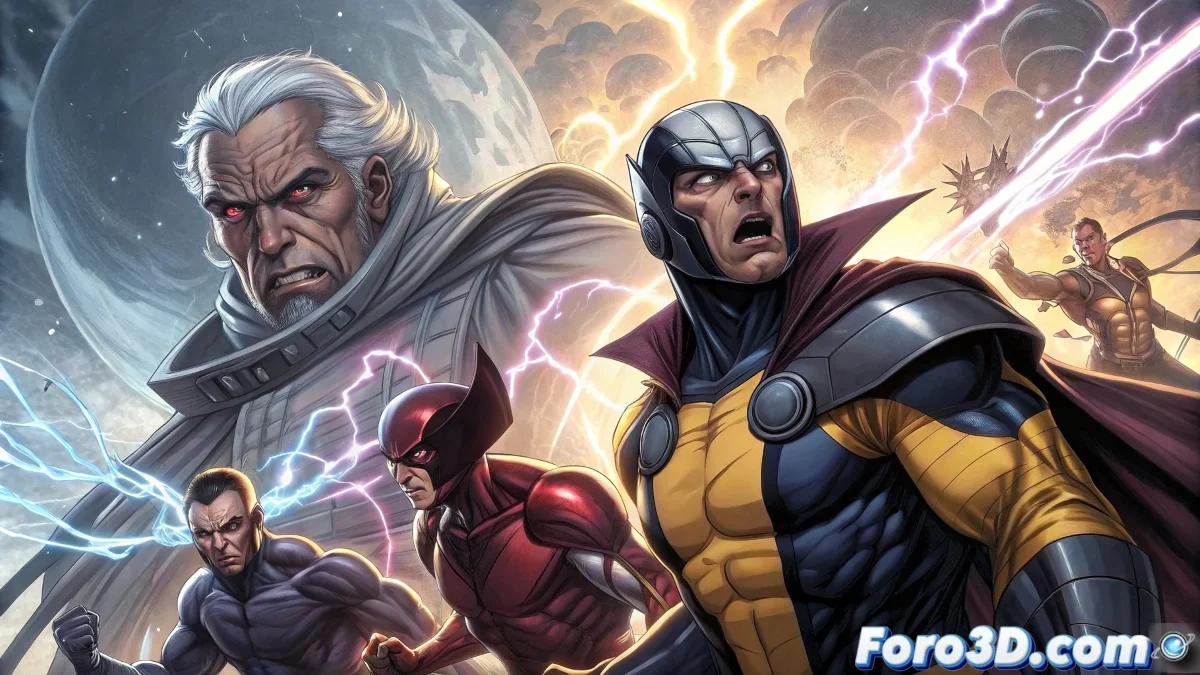
Unbreakable X-Men: when the cosmos knocks on Krakoa's door
Marvel Comics has launched the new storyline The Age of Revelation in the Unbreakable X-Men series, taking the universe's most resilient mutants to face an existential cosmic threat. This story represents the first truly interstellar challenge for the mutants since the establishment of the nation of Krakoa, testing whether their fragile utopia can survive enemies operating on a cosmic scale. Writer Jonathan Hickman and artist Pepe Larraz weave a narrative that questions the place of mutants in Marvel's broader cosmos, raising questions about evolution, destiny, and the price of survival. 🌌
The fragility of the "unbreakable"
What makes this arc particularly interesting is the central irony: the Unbreakable X-Men—mutants specifically selected for their resilience and survival abilities—face a threat that cannot be defeated through brute force or supernatural durability. The cosmic entity known as The Revelator does not attack bodies, but minds and realities, exposing fundamental truths that the mutants have been avoiding since the dawn of Krakoa. This philosophical approach to conflict recalls the best moments of the Claremont era, where physical battles were often secondary to ideological conflicts.
Analysis of the new mutant status quo
The Age of Revelation arrives at a crucial moment for Marvel's mutant universe, with Krakoa consolidating as a global power but facing growing internal and external tensions. This arc serves as the ultimate test of whether mutant society can survive threats that go beyond traditional earthly conflicts.
The nature of the cosmic threat
The Revelator is not a traditional invader but a conceptual force that exists outside conventional space-time. Its main power is forced revelation, the ability to make individuals and societies face truths they have suppressed or ignored. For the X-Men, this means confronting the inherent contradictions of Krakoa: can a nation founded on principles of unity and progress reconcile with its pacts with malevolent entities, its state secrets, and the price paid for immortality?
Unique aspects of the threat:- non-physical but conceptual enemy
- attack through psychological truths
- affects reality itself
- challenges Krakoa's laws
Composition of the Unbreakable team
The team selected for this mission represents the best of mutant resilience: Colossus with his organic steel form, Wolverine with his healing factor, Rogue with her ability to absorb and resist powers, and new members like Darwin, whose evolutionary adaptation power makes him theoretically invincible. The dramatic irony lies in the fact that their physical powers may be irrelevant against an enemy that operates on the metaphysical plane, forcing them to find new ways to fight that do not rely on their legendary durability.
Sometimes the truth is the most unbreakable threat of all, especially when you've built an empire on half-truths.
Impact on Krakoa's ecosystem
The arc promises lasting consequences for the mutant nation, regardless of the conflict's outcome. The revelations forced by the cosmic entity have the potential to destabilize the Silent Council, expose the Quiet Council's secrets, and challenge the faith that ordinary mutants have placed in their leaders. In a particularly interesting twist, the threat seems to have a connection to the Cerebro Phenomena, suggesting that the mutants' psychic powers may have attracted unwanted attention from higher dimensions.
Possible consequences:- revelation of council secrets
- loss of faith in mutant leadership
- change in fundamental laws
- new interstellar alliances
Art and visual narrative
Pepe Larraz elevates the concept with art that combines the epic scale of cosmic space with the intimacy of personal drama. His designs for The Revelator avoid the classic cosmic monster appearance in favor of an abstract and dreamlike presence that manifests differently for each character. The action sequences are particularly innovative, representing metaphysical battles as explosions of concept and color rather than traditional physical combat. The handling of facial expressions perfectly conveys the trauma of facing deeply buried truths. 🎨
Highlighted artistic elements:- abstract villain design
- visual representation of concepts
- cosmic scale versus personal drama
- evocative color palette
In the end, The Age of Revelation could be the mirror the X-Men need, though they would probably prefer to keep seeing their idealized reflection in Krakoa's tranquil waters. 🌊