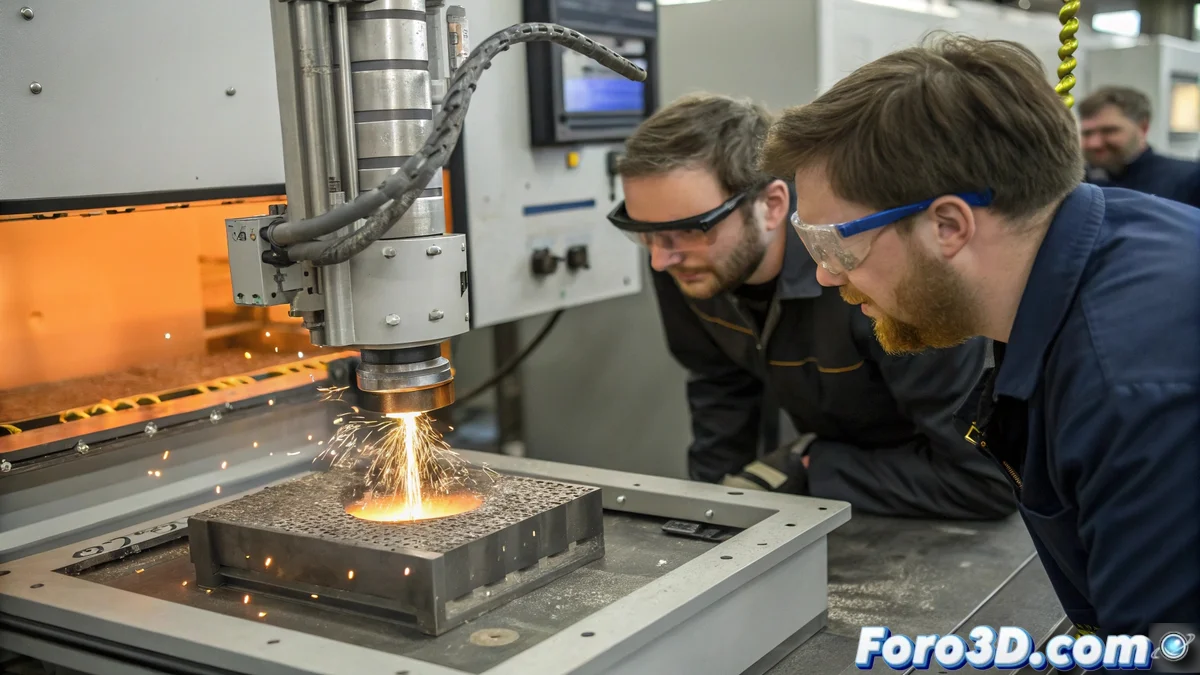
When Ultrasound Gives Rhythm to Metal 3D Printing
A surprising innovation is transforming the landscape of metal 3D printing: the application of ultrasound during the manufacturing process. 🔬 Researchers have demonstrated that this technique can significantly improve the material's microstructure, refining the grains and increasing the mechanical strength of the produced parts. This advance promises to reduce internal defects and improve material uniformity in complex components, marking a before and after in metal additive manufacturing.
The secret lies in how ultrasonic vibrations interact with the metal during its solidification. 💥 In processes like powder bed fusion, these vibrations trigger additional crystal nucleation, generating smaller and more uniform grains that increase fatigue resistance and improve the hardness of the final component. Ultrasound also helps eliminate gas bubbles and reduce porosity during solidification, resulting in parts with lower risk of mechanical failures.
A symphony of vibrations that transforms the metallic microstructure.
Technical Benefits that Resonate in the Industry
This technology offers significant advantages for applications where structural integrity is a priority. 🛩️ The ability to produce parts with lower porosity and finer grain is particularly crucial for aerospace and medical sectors, where components must withstand extreme conditions and meet the highest safety standards. The technique can be applied to various metals and alloys, opening new possibilities for additive manufacturing of critical parts.
The most notable improvements include:
- Grain refinement for more uniform microstructures
- Porosity reduction and elimination of gas bubbles
- Increased strength mechanical and fatigue resistance
- Greater consistency in material properties
The Resonant Future of Additive Manufacturing
The integration of ultrasound systems into industrial 3D printers could mark a significant step toward the serial production of high-performance components. 🏭 This technology not only improves part quality but also could reduce the need for costly and time-consuming post-processing. Its scalability potential makes this innovation particularly attractive for manufacturers seeking to combine the geometric complexity of 3D printing with the structural reliability of traditional manufacturing methods.
With so much ultrasonic vibration, 3D printer operators might end up dancing to the rhythm of the solidifying metal… even though their grains have never been so fine and well-structured! 💃 A technological irony where the vibrations that improve materials could also boost morale on the production line, proving that sometimes the most serious advances come with an unexpectedly rhythmic side.