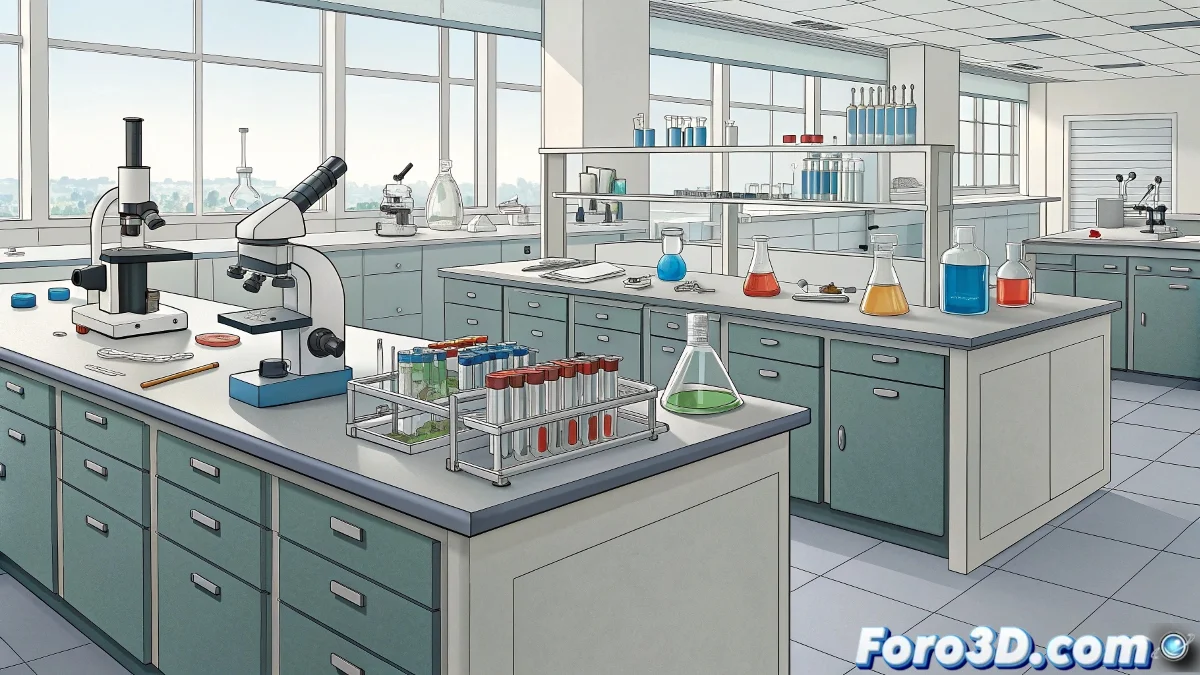
How to Recreate Medical Research Labs in 3D with Realism
Discover professional techniques for modeling, texturing, and animating medical laboratory environments with full detail, creating credible and lively scientific scenes.
"A good 3D lab doesn't just show equipment... it tells the story of research" — Medical digital artist
1. Architectural Design of the Laboratory
Key Elements to Model:
| Area | Essential Components | Recommended Technique |
|---|---|---|
| Workbenches | Microscopes, centrifuges, pipettes | Kitbashing with modular assets |
| Culture Area | Petri dishes, incubators, samples | Instance scattering |
| Storage | Refrigerators, shelves with reagents | Array modifiers |
2. Animation of Scientific Processes
Advanced Techniques:
- Liquid Simulation:
- Mixtures in test tubes
- Flow in microfluidic devices
- Person-Object Interaction:
- Sample manipulation
- Microscope use
- Particle Systems:
- Smoke from reactions
- Bubbles in solutions
3. Realistic Scientific Materials
Key Configurations:
- Laboratory Glass:
- Transmission: 0.95-1.0
- IOR: 1.5
- Stainless Steel:
- Roughness: 0.1-0.3
- Metallic reflections
- Colored Liquids:
- Volumetric absorption
- Color density
4. Technical Lighting
For Credible Environments:
- Cool Light:
- Fluorescent tubes
- 5000-6500K
- Focal Points:
- Microscope lamps
- Safety cabinet lights
- Special Effects:
- Equipment screens
- LED indicators
Medical Realism Checklist
- ✅ Anatomical Precision: Exact scientific models
- ✅ Real Protocols: Correct workflows
- ✅ Sample Variety: Cultures, reagents, tissues
- ✅ Documentation: Readable labels and records
On foro3d you'll find free packs of medical equipment. Because science needs art and art feeds on science. 🧪
Common Problem Solutions
- Unrealistic Liquids: Adjust IOR and absorption
- Static Equipment: Add subtle animations
- Lack of Life: Include organic elements
- Heavy Render: Optimize glassware geometry
As researchers say: "The devil is in the details... and so is the truth". Now go and create labs that inspire new discoveries. 🔬