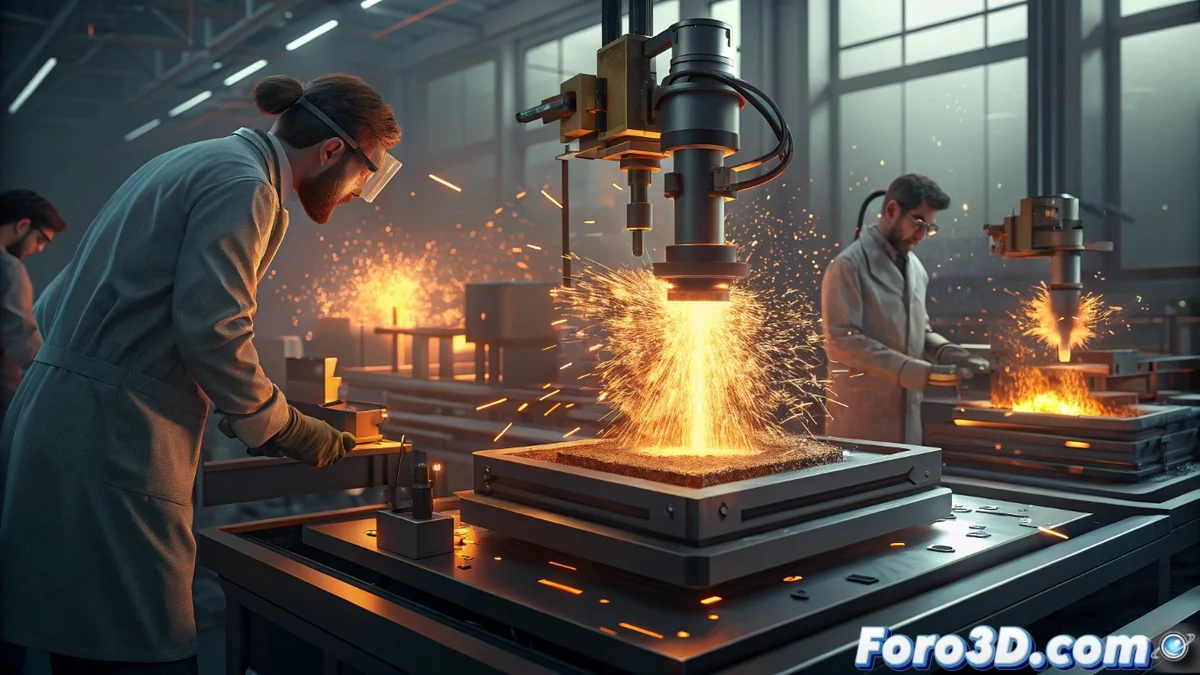
UCL Researchers Discover New Spatter Mechanisms in Metal 3D Printing
A team from the prestigious University College London (UCL) has made a crucial discovery for metal additive manufacturing. Their research has unraveled two fundamental mechanisms behind spatter formation, a persistent problem that compromises the integrity and precision of 3D printed parts. This finding promises to revolutionize quality control in this technological field. 🔬
Unveiling the Secrets of Laser-Material Interaction
The study focused on analyzing with unprecedented detail the complex dynamics that occur when a high-energy laser beam impacts the metal powder bed. Using advanced visualization techniques, scientists were able to observe and categorize spatter patterns that were previously unpredictable. This deep understanding is the first step toward developing effective mitigation strategies.
The two key mechanisms identified:- Explosive Vaporization Mechanism: Related to the sudden and violent vaporization of components from the molten material, which projects particles at high velocity.
- Fusion Pressure Mechanism: Originating from the pressure forces generated in the fusion crater, expelling droplets of liquid metal to the surroundings.
- Practical Implication: Knowing these origins allows engineers to adjust parameters such as laser power, scan speed, or chamber atmosphere to suppress these unwanted effects.
Understanding the 'why' of spatter gives us the tools to dictate the 'how' of a clean and efficient printing process.
Transformative Impact on Industry
The ability to predict and minimize spatter is not just a technical improvement; it is a catalyst for the adoption of metal 3D printing in critical applications. Precision and repeatability are decisive factors in sectors where a microscopic defect can have serious consequences.
Areas of direct application:- Aerospace and Automotive Sector: Manufacturing of structural and engine components with superior material integrity, reducing weight and increasing reliability.
- Medical Industry: Production of customized implants and prostheses with perfectly defined surfaces and optimized mechanical properties, crucial for biocompatibility.
- Economic Advantages: Significant reduction in costs associated with post-processing, material waste, and scrap rates, optimizing the entire production chain.
From Defect to Controlled Opportunity
This advance turns a quality enemy into a manageable phenomenon. Far from being a mere undesirable artifact, the study of spatter now stands as a diagnostic tool to calibrate manufacturing processes. With a touch of humor, we could say that metal 3D printing is learning to tame its most "artistic" and rebellious side to achieve levels of absolute industrial precision. The future of high-end additive manufacturing is, without a doubt, cleaner and brighter. ✨