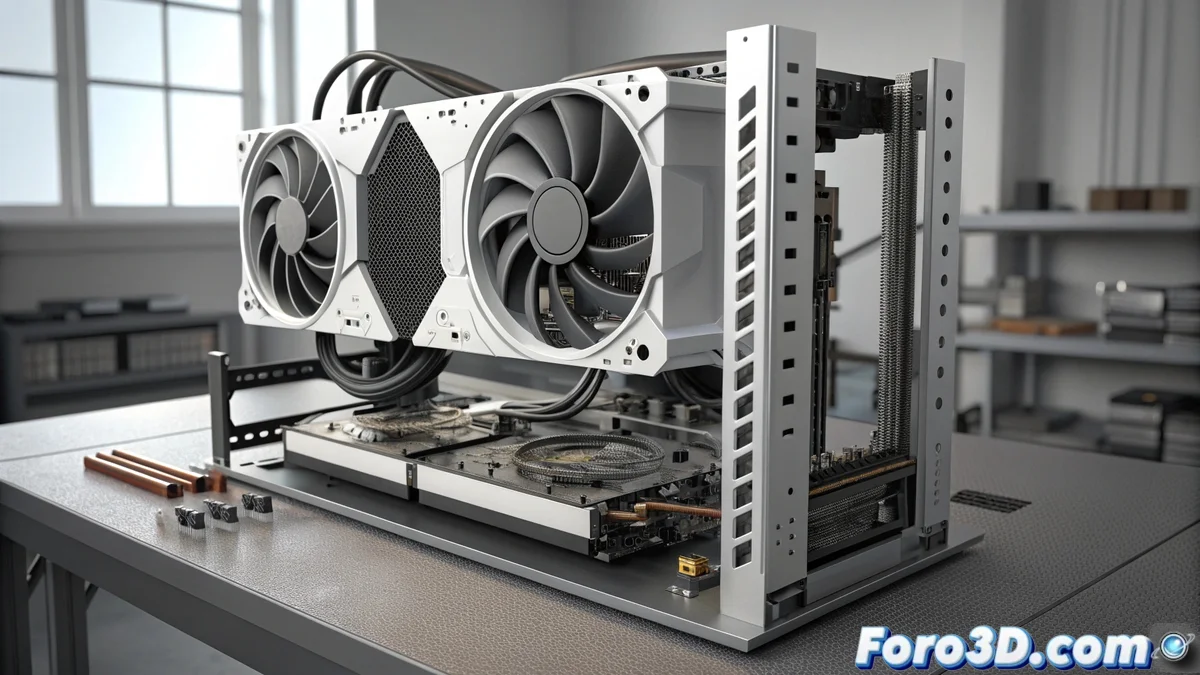
TrashBench Modifies an RTX 2060 with CPU Coolers
The modding community witnessed a new experiment from the enthusiast known as TrashBench. This time, he transformed an Asus GeForce RTX 2060 Dual graphics card by equipping it with two huge heatsinks designed for processors. The central goal was to test limits and explore paths different from those set by manufacturers for cooling components. 🛠️
Adapting and Mounting the Heatsinks
To achieve this mounting, it was necessary to completely disassemble the graphics card's original cooling system. Then, the two large CPU heatsinks were attached directly to the GPU core and the memory modules. This process required fabricating custom mounting brackets, as standard mounts do not work. The result is a much more voluminous hardware profile than Asus's initial design.
Key Steps in the Process:- Remove the original fan and aluminum heatsink from the RTX 2060.
- Apply new thermal paste to the GPU and memory chips.
- Fabricate or adapt metal brackets to secure the CPU heatsinks to the card's PCB.
- Mechanically secure the massive assembly to avoid damage from vibration or weight.
The project serves more as an exercise in technical creativity than as a guide for replication.
Evaluating Practical Results
Although it demonstrates notable technical skill, the utility of this mounting in a daily-use system is limited. The CPU heatsinks are designed to dissipate heat from a single concentrated source, not from the various components of a graphics card, such as the voltage regulators (VRM). Additionally, the enormous size of the assembly makes it difficult to install in most computer cases.
Important Considerations:- Passive cooling for the VRMs may be insufficient under high load.
- The space it occupies inside the chassis is excessive, incompatible with many configurations.
- It demonstrates that the GPU core can be effectively cooled with solutions not intended for it.
An Exercise in Technical Ingenuity
The final result looks so massive that the graphics card seems to dominate the inside of the PC. More than seeking a practical improvement, TrashBench wanted to challenge the established and show that hardware limits often lie in the modder's imagination. This project reinforces the idea that the community values experimentation and innovation above mere utility. 💡