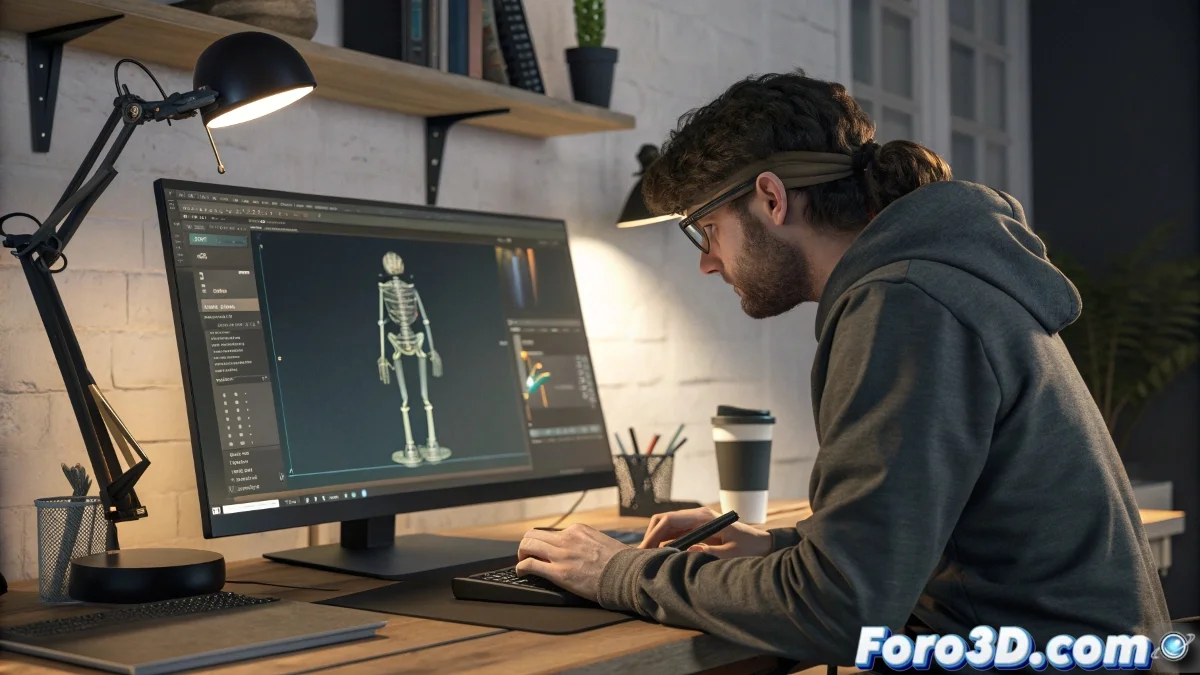
The Journey from Basic to Professional Rigging
Transitioning from a basic bone system to a professional rig is like switching from riding a bike with training wheels to piloting a fighter jet 🚀. Those first attempts where the character deforms like poorly kneaded playdough are a rite of passage that every animator experiences. The good news is that there is a clear path to evolve from those chaotic deformations to clean and controlled movements.
The Heart of the Problem: Weight Painting
"Melting playdough" deformations almost always originate from incorrect weight assignment to vertices. Each vertex needs to know exactly which bones should influence it and in what proportion to move coherently.
- Balanced Influence: Proper distribution between adjacent bones
- Smooth Transitions: Weight gradients in joint areas
- Normalized Weights: Total sum of influences equal to 1 per vertex
- Critical Areas: Special attention to shoulders, hips, and face
Good weight painting is like good makeup: it's not noticeable when done well, but looks terrible when it fails.
Elements of a Professional Rig
Advanced rigs incorporate systems that transform the animation experience from technical to intuitive.
- Visual Controllers: NURBS curves and intuitive shapes for manipulation
- IK/FK Systems: Switching between inverse and forward kinematics
- Space Switching: Switching between coordinate spaces as needed
- Facial Rigging: Dedicated systems for expressions and phonemes
- Custom Attributes: Custom controls for complex behaviors
The 12 Fundamental Principles of Animation
Beyond the technical rig, animation quality depends on applying principles proven by decades of industry practice.
- Squash & Stretch: Give weight and flexibility to objects
- Anticipation: Prepare the viewer for the action
- Staging: Present the idea clearly
- Straight Ahead vs Pose to Pose: Two complementary approaches
- Follow Through: Natural termination of actions
- Slow In & Slow Out: Realistic acceleration and deceleration
- Arcs: Natural movement trajectories
- Secondary Action: Movements that support the main action
- Timing: The heart of rhythm and comedy
- Exaggeration: Enhanced reality for visual impact
- Solid Drawing: Volume and weight in 3D forms
- Appeal: Visual appeal and character charisma
Progressive Exercises to Gain Fluency
Structured practice builds solid foundations without overwhelming the learner.
- Bouncing Ball: Basic timing, squash, and stretch
- Pendulum: Arcs and slow in/out
- Basic Walk: Locomotion cycles and weight
- Facial Expressions: Simple acting and emotional communication
- Object Interaction: Weight, anticipation, and follow through
Advantages of Using Predefined Rigs
Rigs shared by the community offer a valuable shortcut for learning.
- Focus on Animation: No technical rigging distractions
- Industry Standards: Exposure to professional systems from the start
- Troubleshooting: Learn from solutions implemented by experts
- Inspiration: See what's possible with a good rig
Community Resources and Next Steps
The animation community offers abundant resources to support growth.
And when your first animations still look like poses from a drunk puppeteer, remember: even Pixar animators started by making bouncing balls 🎾. The path of the master animator is paved with thousands of awkward frames that eventually turn into magic.