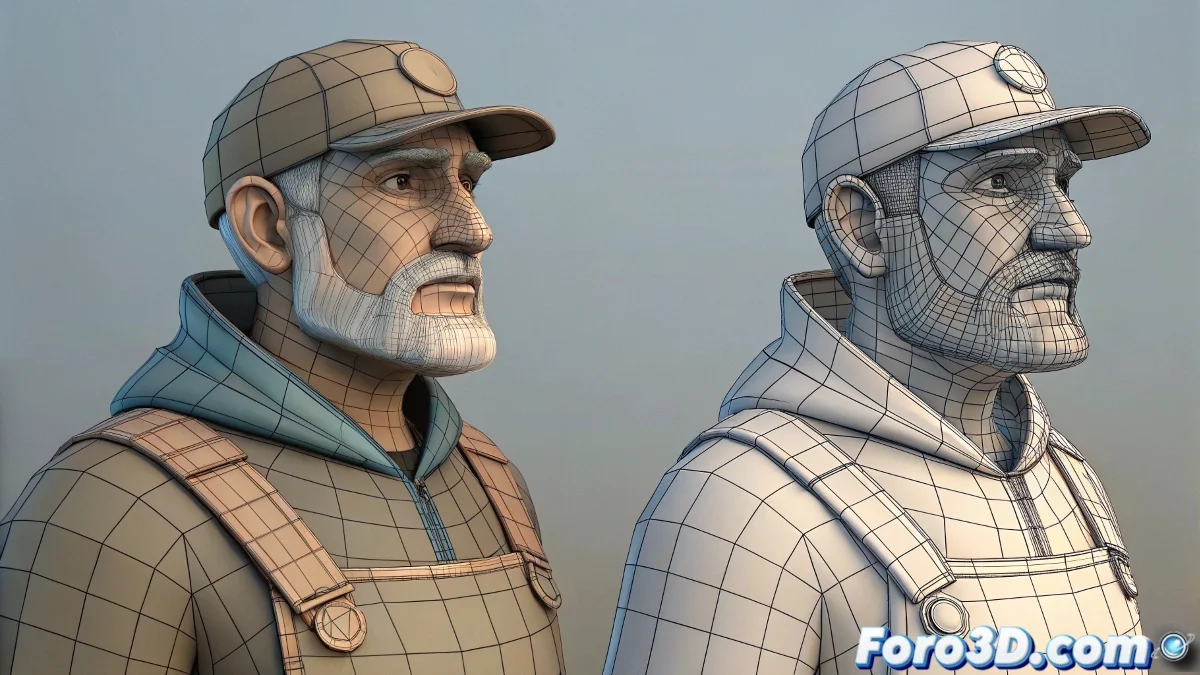
The Challenge of Non-Conventional Meshes in Weight Painting
Working with meshes of large polygons and irregular topology in weight painting is like trying to paint a mural with an industrial roller 🎨. While subdivided meshes offer a perfect pixel canvas for precise details, meshes with large polygons present unique challenges that require specific technical approaches to achieve clean deformations.
The Critical Importance of Uniform Topology
The effectiveness of weight painting is directly related to the density and uniformity of the mesh. Vertices act as storage points for influence data, and their distribution directly affects the quality of the deformation.
- Vertex Density: More vertices allow smoother transitions
- Uniform Distribution: Consistent spacing for predictable deformation
- Edge Loop Flow: Topology that follows natural deformation lines
- Critical Areas: Higher density in joints and bending zones
A well-topologized mesh is like good watercolor paper: it absorbs weight colors uniformly and predictably.
Subdivision Techniques for Optimal Weight Painting
Strategic subdivision transforms problematic meshes into ideal surfaces for precise weight painting.
- HyperNURBS: Smooth subdivision that maintains the original shape
- Subdivision Surface: Controlled increase in polygon density
- Adaptive Subdivision: Higher density only where needed
- Manual Creation: Strategic insertion of edge loops in critical areas
Weight Transfer Between Models
When subdivision is not possible, weight transfer offers a powerful alternative.
- Weight Transfer Tool: Native tool for copying weights between models
- Vertex Matching: Matching algorithms for similar models
- Tolerance Adjustment: Control of precision in the transfer
- Partial Transfer: Copy only specific weights from problematic areas
Workflow for Complex Meshes
Handling irregular meshes requires a systematic approach that maximizes results while minimizing issues.
- Evaluate the existing mesh and identify problematic areas
- Decide between subdivision or weight transfer
- Perform the chosen operation with appropriate settings
- Verify and adjust the resulting weights
- Test with test animations to validate deformations
Maintaining Deformations After Subdivision
Subdivision alters the mesh structure, requiring subsequent adjustments to preserve the deformation.
- Weight Recalculation: Automatic redistribution tools
- Manual Smoothing: Fine adjustment of weights after subdivision
- Volume Preservation: Adjustment to maintain proportions during deformation
- Exhaustive Testing: Verification with multiple poses and movements
Advanced Tools for Difficult Cases
For particularly challenging situations, advanced techniques provide additional solutions.
- Projection Painting: Weight painting based on 3D projection
- Motion-Based Weighting: Weight assignment based on test motion
- Custom Scripting: Automation of repetitive weight painting processes
- Machine Learning Tools: Emerging weight prediction tools
Optimization for Performance
The balance between deformation quality and performance is crucial in real production.
And when your deformations still look more like abstract origami than organic animation, you can always argue that it's a vanguard geometric animation style 🔷. After all, in the rigging world, sometimes technical "limitations" turn into unexpected creative opportunities.