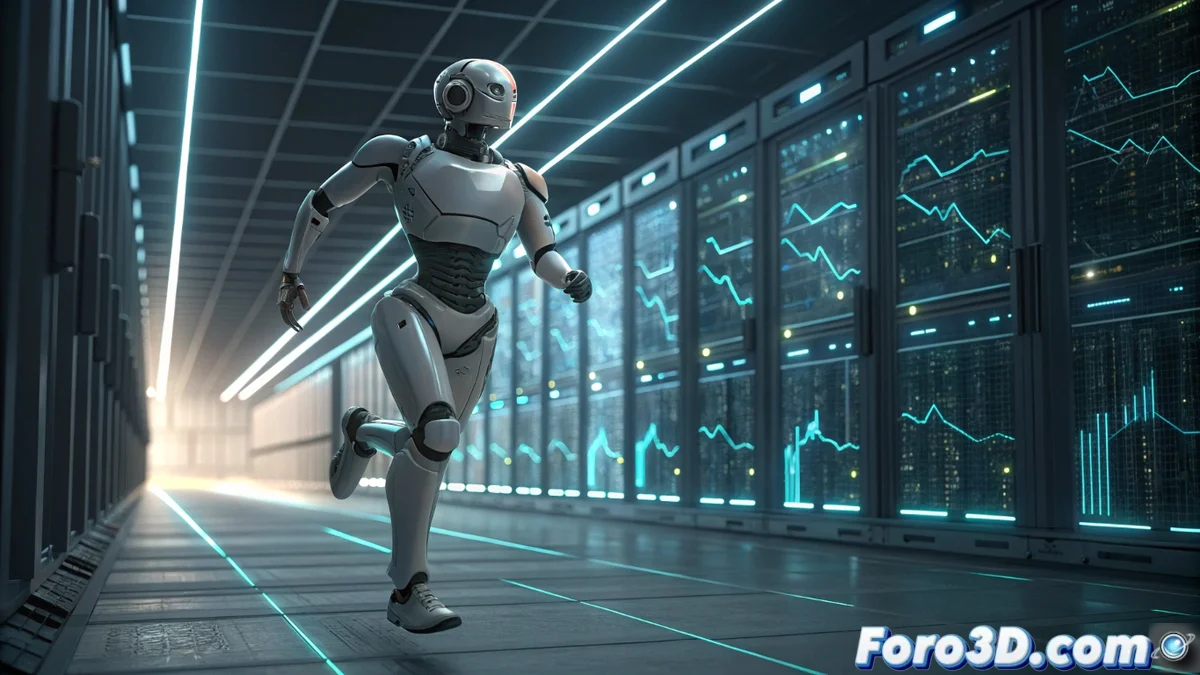
Training Humanoid Character Locomotion with RL in 15 Minutes
A new practical approach achieves training control policies for bipedal characters using reinforcement learning in record time. This method leverages the power of a single RTX 4090 GPU to complete the process in a quarter of an hour, a significant advance over traditional waits of days. 🚀
The Technical Foundation: Parallelizing and Optimizing
The core of this speed lies in executing a massively parallel simulation. The physics engine is optimized to run directly on the GPU, executing thousands of environments simultaneously to collect experience data at an unprecedented rate. To handle this scale, specific adjustments are applied to avoid numerical instabilities, such as modifying the simulation timestep. The use of off-policy algorithm variants like FastSAC and FastTD3 allows efficient reuse of old data, maximizing what the neural network learns in each cycle. The policy is trained by directly observing the character's state and its environment.
Keys to Stability and Speed:- GPU Simulation: Moving the physics to the graphics card allows parallelizing thousands of instances.
- Fast Algorithms: Employing FastSAC or FastTD3 to reuse past experiences and learn more with less new data.
- Minimal Rewards: Designing simple but effective reward signals that guide the desired behavior without overloading the learning.
The real challenge is no longer waiting days for the AI to train, but having the character's assets ready before the simulation finishes.
Robustness and Use in Animation Pipelines
The system is not only fast, but learns robust and adaptable controls. During training, strong domain randomization is applied, meaning the character practices with variable dynamics, uneven terrain, and external pushes. This diverse exposure teaches it to recover balance and move in unpredictable conditions. A direct application is training a full-body controller to follow reference human motion captures, bridging the gap between mocap data and realistic physical simulation.
Applications for the foro3d.com Community:- Procedural Animation: Integrate these controllers into pipelines to automatically generate physically credible movements.
- Preview Tool: Use the system in advanced rigging stages to quickly test how a character would move with a given skeleton.
- Research and Development: Opens discussions on how to apply these AI techniques to solve complex animation and real-time simulation problems.
A New Paradigm in Digital Animation
This methodology represents a shift in how character animation can be conceived and produced. By reducing training time from days to minutes, it becomes an interactive and practical tool. The main barrier shifts from computational power or waiting, to the artistic and technical preparation of the models. For animators and developers, it means being able to iterate and test complex locomotor behaviors with unprecedented agility, seamlessly integrating artificial intelligence into the creative workflow. 🤖