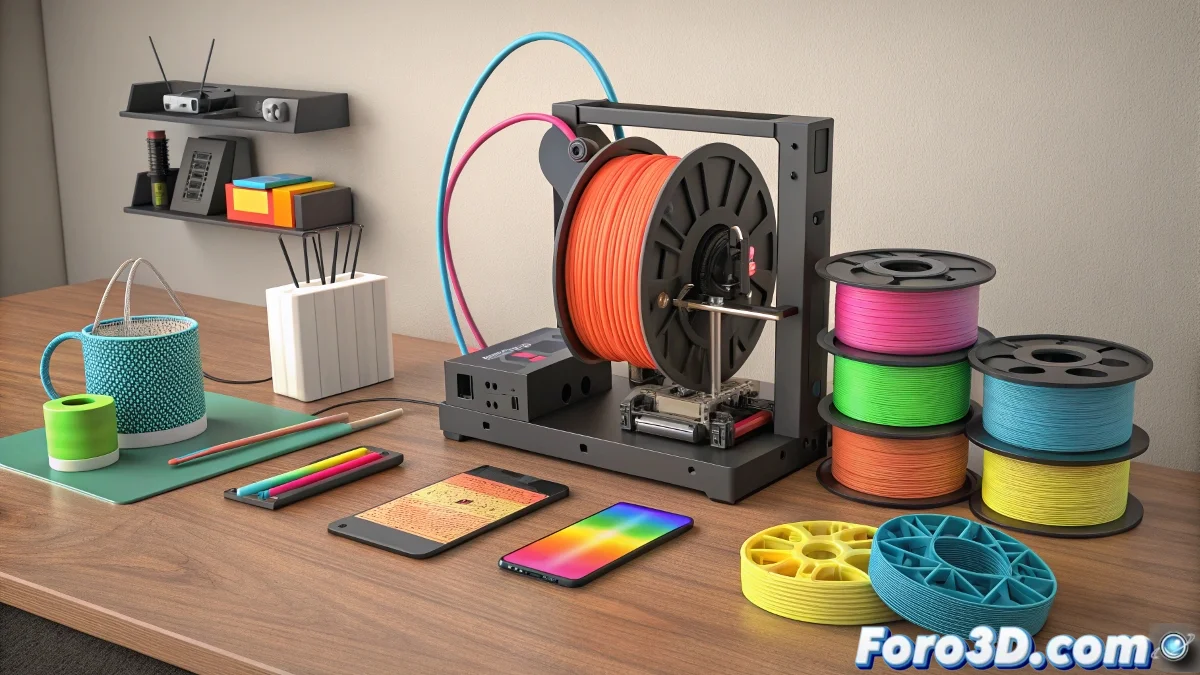
The Flexible World of 3D Printing
When the rigidity of traditional filaments becomes limiting, TPU emerges as the solution that expands the boundaries of what's possible in 3D printing. This thermoplastic polyurethane introduces elasticity to the repertoire of materials, allowing the creation of parts that bend, compress, and recover their original shape. Its arrival in the domestic market has democratized the manufacturing of components that previously required complex industrial production methods.
The magic of TPU lies in its chemical structure that combines rigid and flexible segments, giving it that unique characteristic of controlled flexibility. Unlike rigid filaments that break under tension, TPU stretches significantly before reaching its breaking point. This property opens up a range of applications impossible with conventional materials, from shock-absorbing components to custom wearables.
Unique Properties of Flexible Filament
- Elasticity and stretch capacity exceeding 500% in some formulations
- Excellent resistance to abrasion and frictional wear
- Superior absorption of impacts and vibrations compared to rigid materials
- Resistance to oils, greases, and many common chemicals
The Art of Printing with Flexibility
Mastering printing with TPU requires adapting the technique and settings to the particularities of the flexible material. The main difficulty lies in preventing the filament from buckling or curling inside the extruder, a problem known as buckling. For this reason, printers with direct drive systems perform notably better than those with Bowden extruders, as the filament path to the hotend is significantly reduced.
TPU transforms the 3D printer into a machine capable of creating parts that move, flex, and adapt
The ideal setup for TPU involves moderate printing speeds and conservative retractions. Temperatures between 210°C and 230°C usually work well, while a heated bed between 40°C and 60°C ensures good initial adhesion. Fan cooling can vary depending on the specific TPU model, although it is generally recommended to use little or no cooling to promote layer adhesion.
Applications Where TPU is Indispensable
- Shock-absorbing components for drones, robots, and mechanisms
- Custom cases and protectors for electronic devices
- Joints, seals, and flexible fastening elements
- Custom footwear, insoles, and orthopedic products
The versatility of TPU has conquered fields as diverse as engineering, medicine, fashion, and product design. Its ability to combine with other materials in multi-material assemblies further expands its creative and technical potential. From functional prototypes to end products, TPU demonstrates that flexibility can be as valuable as rigidity in the world of design. 🌀
Printing with TPU is like learning to dance: it requires a slow rhythm, smooth movements, and a lot of practice, but the result can be truly elegant. 💃
You can see this product and similar ones in the: store