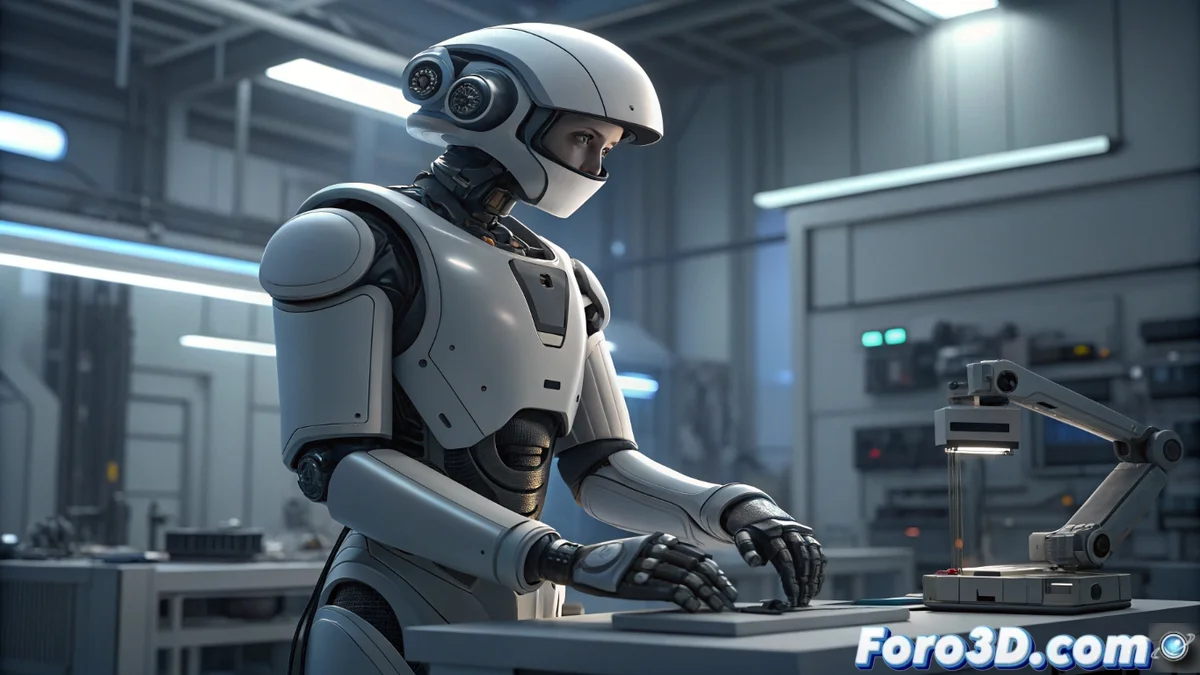
Toyota T-HR3: The Remote-Controlled Avatar Robot with Haptic Feedback
The automotive company Toyota has unveiled its latest innovation in robotics: the T-HR3, a third-generation humanoid designed as a physical avatar. This system allows a human operator to control the robot remotely with near-perfect synchronization, thanks to the integration of advanced motion sensors and data gloves that capture every gesture. The magic lies in its ability to send force feedback to the user, creating a sensory bridge between both. 🤖✨
Master-Slave Control System Architecture
The T-HR3's operation is based on a sophisticated master-slave system. The operator equips themselves with a harness and devices that capture in real time their body movements, from fingers to torso. This data is transmitted to the robot, which replicates it in a remote environment with impressive fidelity. The key innovation is tactile or haptic feedback: when the robot touches an object, the operator feels its resistance, texture, or pressure through the gloves, closing the interaction loop.
Key system components:- Master exoskeleton: Captures the operator's full body movement, including displacements and rotations.
- Haptic data gloves: Record fine hand and finger movements and return tactile sensations to the user.
- Control and transmission unit: Processes all movement and force information for real-time operation with no perceptible latency.
This technology is not just about imitating movements, but about transmitting sensations, literally extending the human sense of touch through a mechanical avatar.
Revolutionary Fields of Application
The implications of the T-HR3 go beyond the laboratory, promising to revolutionize multiple industries. Its design makes it ideal for extending human capabilities to scenarios where physical presence would be dangerous or impossible. The operator can handle complex tasks from a safe location, fusing human dexterity with robotic endurance in a completely new way.
Potential impact areas:- Medical assistance and remote surgery: Allows specialists to perform assessments or precision procedures remotely.
- Exploration and rescue: Access to high-risk environments such as disaster zones, nuclear plants, or deep space.
- Entertainment and telepresence: Creation of immersive experiences or physical interaction in events remotely.
A Reflection on Our Robotic Future
While Toyota's T-HR3 is presented as a tool to free us from "dirty" or dangerous work", an ironic reflection arises about its future role. Beyond its practical applications, one can imagine a scenario where this robotic double, designed to help us, ends up occupying a space in our daily lives in unexpected ways. This technology fuses remote control and physical interaction in such an intimate way that it inevitably makes us question the boundaries between the operator and their avatar, and the future of human-machine collaboration. 🛋️⚡