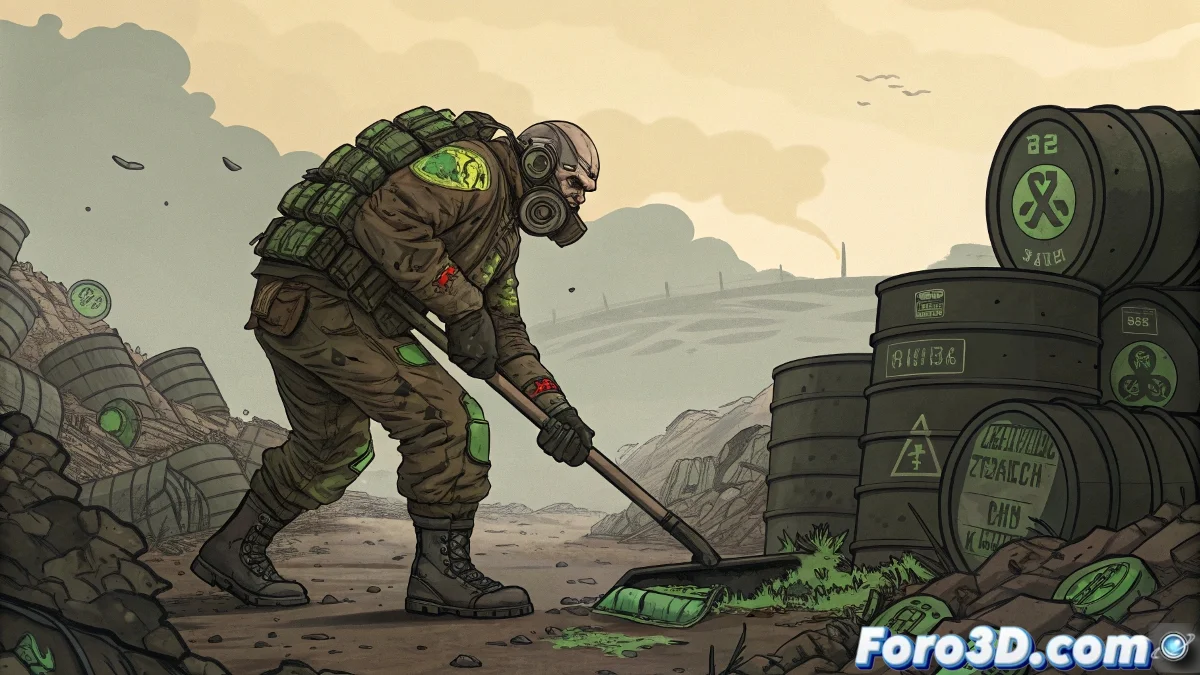
When trash becomes art: the visual legacy of Toxic Dump Planet
In a universe where toxic waste is the landscape and mutant creatures the inhabitants, Tom Illustrateur's comic has become the visual bible of beautifully repulsive. For 2D and 3D artists, this world is a creative gym where you train muscles you didn't know you had. 🎨☢️
Visual lessons for digital artists
1. The poetics of corrosion:
Every page teaches that rust can be as expressive as a human face. Study how textures:
- Degrade non-uniformly
- Create visual narrative (which areas rust first?)
- Interact with imaginary chemical leaks
2. Creatures that tell stories:
The mutants are not random monsters. Each:
- Body deformation reveals adaptation to the environment
- Grafted mechanical element suggests a survival story
- Pose and movement reflect the toxic ecosystem
3. Retina-burning palette:
Acid greens, radioactive oranges, and poisonous purples combine with:
- Dirty earths to anchor the scene
- Worn metallic grays
- Focal points with almost fluorescent colors
From comic to 3D modeling: transition guide
Step 1: Extract key moodboards
Select 3-5 representative panels and analyze:
- Figure-environment relationship
- Visual hierarchy (what stands out and why)
- Color transitions
Step 2: Interpret in 3D
Convert 2D elements into three-dimensional assets:
- Model structures with organic deformations
- Use dirty booleans for broken mechanical parts
- Add secondary geometry (cables, rivets, patches)
Step 3: Texturing with soul
In Substance Painter or Blender:
- Create corrosion layers with smart masks
- Add chemical leaks with sub-surface effects
- Generate accumulated dirt in contact areas
Community challenge for foro3d.com
1. "72 toxic hours":
Create a piece inspired by the comic using:
- At least 3 corroded materials
- 1 believable mutant creature
- Restrictive color palette (only greens, oranges, and blacks)
2. Brush exchange:
Share your custom brushes for:
- Accelerated oxidation effects
- Chemical stains
- Peeling paint
3. Collaborative tutorial:
Among several users, develop a complete guide for:
- 2D illustration in Toxic Dump style
- 3D modeling pipeline for contaminated environments
- Shaders for toxic substances in UE5/Blender
Inspiration beyond the comic
When you run out of direct references, mix these sources:
- Photographs of abandoned industrial zones
- Documentaries about Chernobyl
- Works by HR Giger and Zdzisław Beksiński
- The game "Stray" for neon lights in decay
Remember: in the world of Toxic Dump Planet, beauty didn't die - it just mutated. And your art can do the same. So dip your digital brushes in those toxic greens and prove that even the apocalypse can have good design... even if it stings to breathe. 😷🎨
Now, if you'll excuse me, I'm going to disinfect my graphics tablet after so much contaminating concept. But I promise the final result will be worth it (and possibly require a mask).