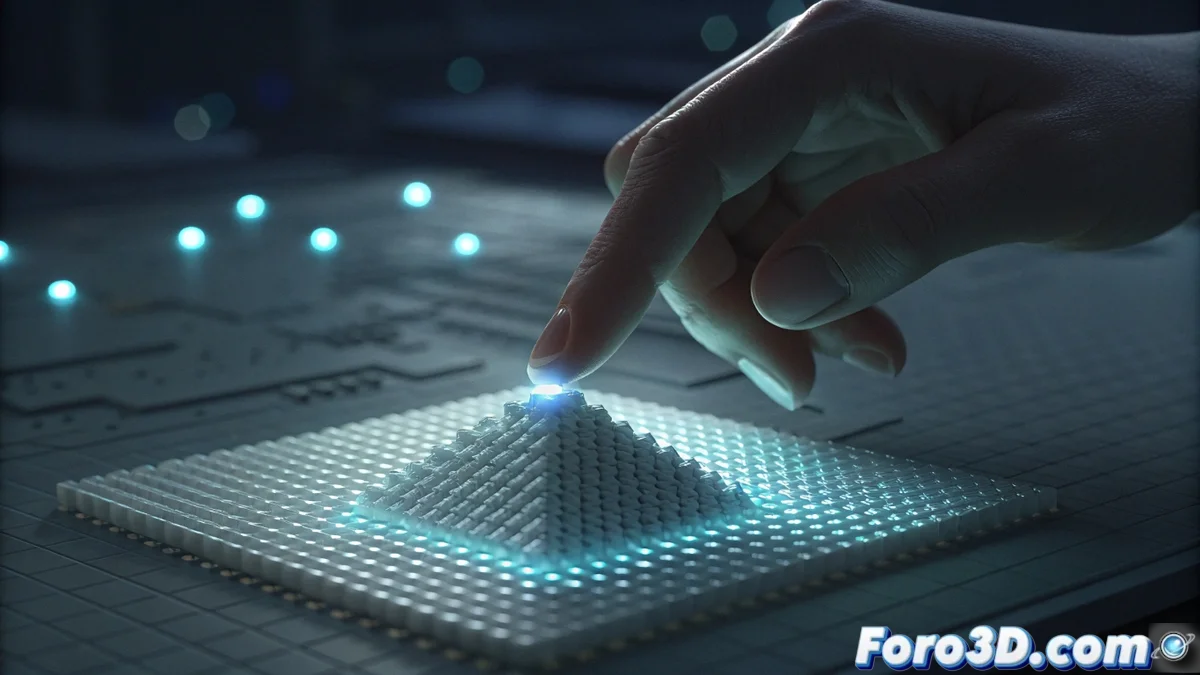
Touchable Screens: Mechanical Pixels that Create Relief with Light
A team from the University of California, Santa Barbara has created a system that transforms how we perceive digital images. The technology generates physical reliefs that can be felt directly with the fingers, eliminating the need to use gloves or wearable devices to achieve haptic interaction. This advance brings the sense of touch closer to purely digital visualization environments 🖐️.
The Principle: Pixels that Respond to Light
The basis of this system is optotactile surfaces. These are composed of a matrix of mechanical pixels just a few millimeters in size. Each one functions as an independent actuator that deforms in a controlled manner upon receiving a light pulse. By organizing these modules and precisely controlling which areas to illuminate, the surface can form dynamic relief patterns that change in real time.
Key Features of the Technology:- Fast Response: The pixels rise almost instantly when stimulated by the light beam, allowing for changing textures to be generated.
- Direct Interaction: Users can explore the generated shapes and reliefs by touching the screen directly with their fingers.
- Tangible Resolution: Currently, the pixels are millimeter-sized, which limits the complexity of the shapes that can be represented.
This technology brings haptic interaction to digital visualization environments without the need for gloves or wearable devices.
Where This Innovation Can Be Applied
The possible applications of this tactile interface are very diverse and open new possibilities in several fields. Its ability to represent physical shapes remotely is its main advantage.
Potential Areas of Application:- Teleoperation and Robotics: An operator could perceive the shape and texture of an object manipulated by a robotic arm kilometers away, improving control and precision.
- Accessibility: It offers a new way for people with visual impairments to access graphical information, maps, or diagrams through touch.
- Entertainment and Video Games: It creates more immersive experiences where players not only see but can also feel elements of the virtual environment.
The Future of Digital Touch
This development marks a significant step forward, but the technology must evolve to achieve higher resolutions and more detailed reliefs. Imagining a future where you can "touch" a text message or a notification adds a completely new layer of meaning to digital communication. For now, as the researchers point out, the "dots on the i's" would be quite large, but the path to fully integrating touch into our screens is already open 🚀.