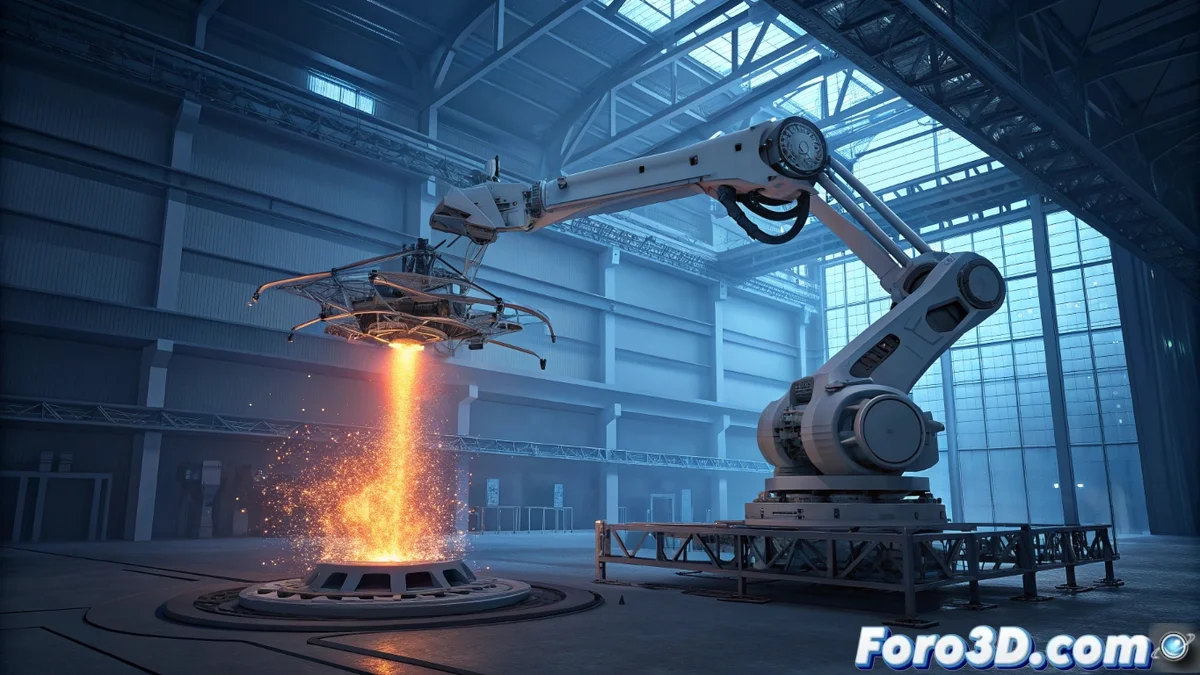
Titomic Manufactures Drone Bodies with Metal 3D Printing
The Australian company Titomic has implemented an innovative additive manufacturing method they call kinetic fusion. This system enables the production of large-format metal parts at speeds far superior to conventional techniques, opening new possibilities in sectors such as defense and aeronautics. 🚀
The Mechanism of Kinetic Fusion
The process is based on an industrial robot that controls a specialized print head. This head uses highly pressurized compressed gas to accelerate titanium powder to supersonic speeds. The particles are directed against a substrate or mold, where the impact energy generates the necessary heat for the material to consolidate layer by layer, without the need for an external heat source like a laser.
Key Features of the Process:- Impact Consolidation: The heat to fuse the metal comes from the kinetic energy of the particles upon impact.
- Dense Microstructure: The result is a titanium part with uniform density and mechanical properties.
- Geometric Freedom: It allows integrating complex shapes that would be very costly or impossible to machine.
The technique eliminates weak points from joints, creating a drone body that is inherently more robust.
Advantages in Tactical Drone Manufacturing
By applying this method, Titomic can produce the complete fuselage of a tactical drone in a single printing operation. This approach revolutionizes the design and manufacturing of these unmanned aerial vehicles.
Main Benefits of the Monolithic Design:- Uniform Mechanical Strength: By avoiding bolted joints or welds, potential failure points are eliminated.
- Weight Reduction: The integral structure is lighter by dispensing with additional fastening elements.
- Simplified Assembly: The main body requires fewer auxiliary components, speeding up final production.
Impact on the Future of Manufacturing
Titomic's kinetic fusion represents a significant advancement in metal 3D printing, especially for large-sized parts. Its ability to rapidly produce complex and resistant structural components positions this technology as a powerful alternative to traditional subtractive manufacturing methods. The tactical drone case is just one example of its potential to transform how high-performance industrial products are designed and built. ⚙️