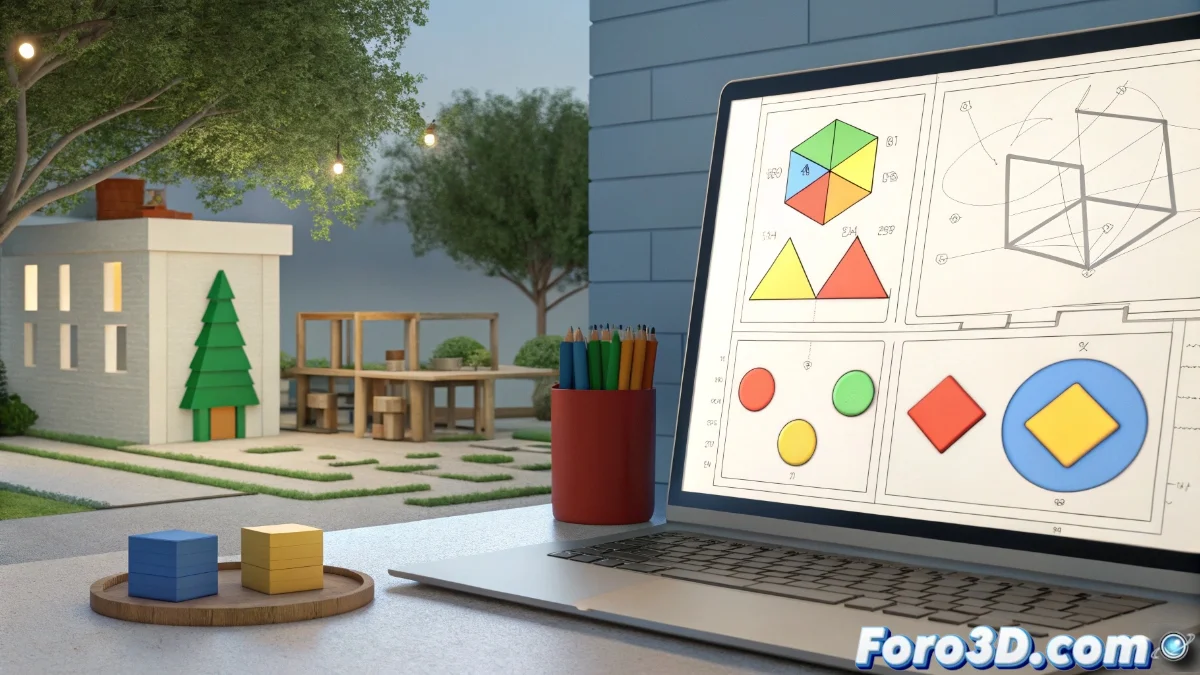
Tinkercad vs SolveSpace: 3D Modeling Philosophies for Different Users
In the universe of three-dimensional design, these two tools embody radically opposed approaches. Tinkercad bets on immediacy and accessibility, while SolveSpace prioritizes mathematical control and precision. 🎯
Divergent Approaches in 3D Creation
The essence of Tinkercad lies in its system of combinable geometric primitives through elementary Boolean operations. Its drag-and-drop interface eliminates barriers for newcomers and academic environments. In contrast, SolveSpace implements a full parametric environment where each element depends on dimensional and geometric constraints, requiring technical understanding but delivering millimeter precision. 🔧
Differentiating Features:- Tinkercad: Almost flat learning curve, ideal for first experiences with basic volumetry
- SolveSpace: 2D sketching with subsequent extrusion/rotation, perfect for exact dimensional adjustments
- Interface: Colorful and playful versus technical and minimalist
While Tinkercad democratizes 3D modeling, SolveSpace professionalizes lightweight mechanical design without overwhelming complexities.
Specific Application Cases
The workflows reflect this fundamental dichotomy. Tinkercad shines in rapid prototyping and organic modeling where immediacy takes precedence over technical rigor. SolveSpace finds its niche in mechanical parts, engineering projects, and situations where tolerances and parametric modifications are critical. 📐
Ideal Usage Environments:- Classrooms and basic workshops: Tinkercad facilitates initial immersion in 3D design
- Technical offices: SolveSpace ensures dimensional coherence in iterative reviews
- Hybrid projects: Combination of both tools for different development phases
Final Reflection on Design Philosophies
The duality between these platforms illustrates how three-dimensional modeling can be approached from complementary perspectives. Where Tinkercad sees a cylinder as an elemental shape, SolveSpace interprets it as a set of mathematical relationships governed by constraints. This paradigmatic difference demonstrates that in the CAD ecosystem, even seemingly simple solutions can hide profound professional considerations. 🚀