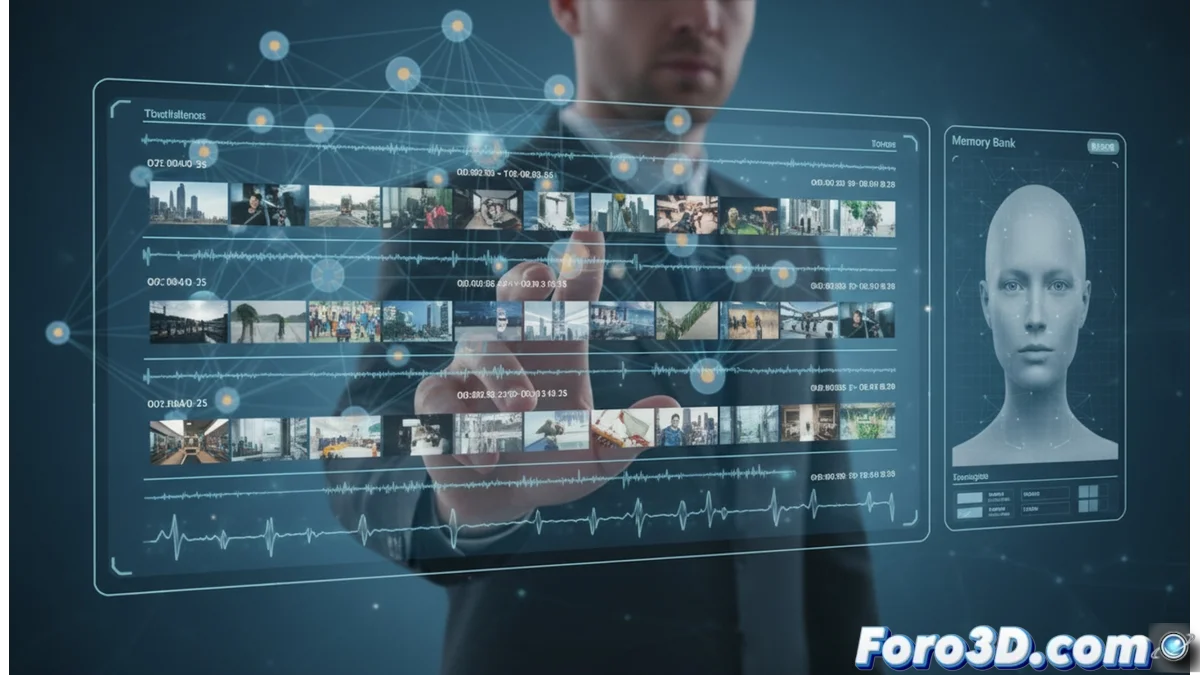
TimeLens Establishes a Solid Foundation for Localizing Events in Video
Understanding what happens and when in a video is a core capability for artificial intelligence. While multimodal language models excel in many tasks, optimizing them to pinpoint specific moments with precision had not been thoroughly explored. The TimeLens work presents a systematic investigation to build these models with robust capability, focusing on two pillars: data quality and algorithm design. 🎯
Addressing the Foundations: Training and Evaluation Data
The study first identifies serious issues in existing reference datasets for temporal localization. To address this, it introduces TimeLens-Bench, which contains versions of three popular datasets, meticulously re-annotated with strict criteria. The analysis shows drastic changes in how models are ranked using these new standards, confirming that previous evaluations were unreliable. It also tackles noise in training data through an automatic re-annotation process, generating TimeLens-100K, a large-scale, high-quality dataset. 📊
Key Contributions in Data:- TimeLens-Bench: A new benchmark with clean and consistent annotations for fair evaluation.
- TimeLens-100K: A massive cleaned training dataset, created automatically to reduce noise.
- Critical Finding: Previous model rankings change significantly, demonstrating the need for this solid foundation.
"Sometimes, the key to progress is not inventing something new, but cleaning the workbench well and ensuring the rules of the game are fair and clear for everyone."
Designing Effective and Efficient Algorithms
Building on this reliable data foundation, algorithmic design principles are explored in depth. This yields a series of practical and effective ideas that guide how to build better models. The approach does not seek a revolutionary method, but rather clear recipes and principles that work. ⚙️
Algorithmic Principles Explored:- Interleaved Time Encoding: Integrate temporal information within the text sequence, rather than treating it separately.
- Reinforcement Learning without Explicit Reasoning: Use a reward-based training paradigm that can be directly verified.
- Careful Training Recipes: Design specific methodologies to train models for this particular task.
The Result: Models with State-of-the-Art Performance
The combination of high-quality data and solid design principles culminates in the TimeLens models. This family of multimodal language models achieves state-of-the-art performance in temporal localization among open-source models. Its performance is so remarkable that it even surpasses some proprietary models, demonstrating the effectiveness of addressing the fundamentals. This work not only presents powerful models but also establishes a clear standard and methodology for the research community to investigate and develop on a reliable foundation. 🏆