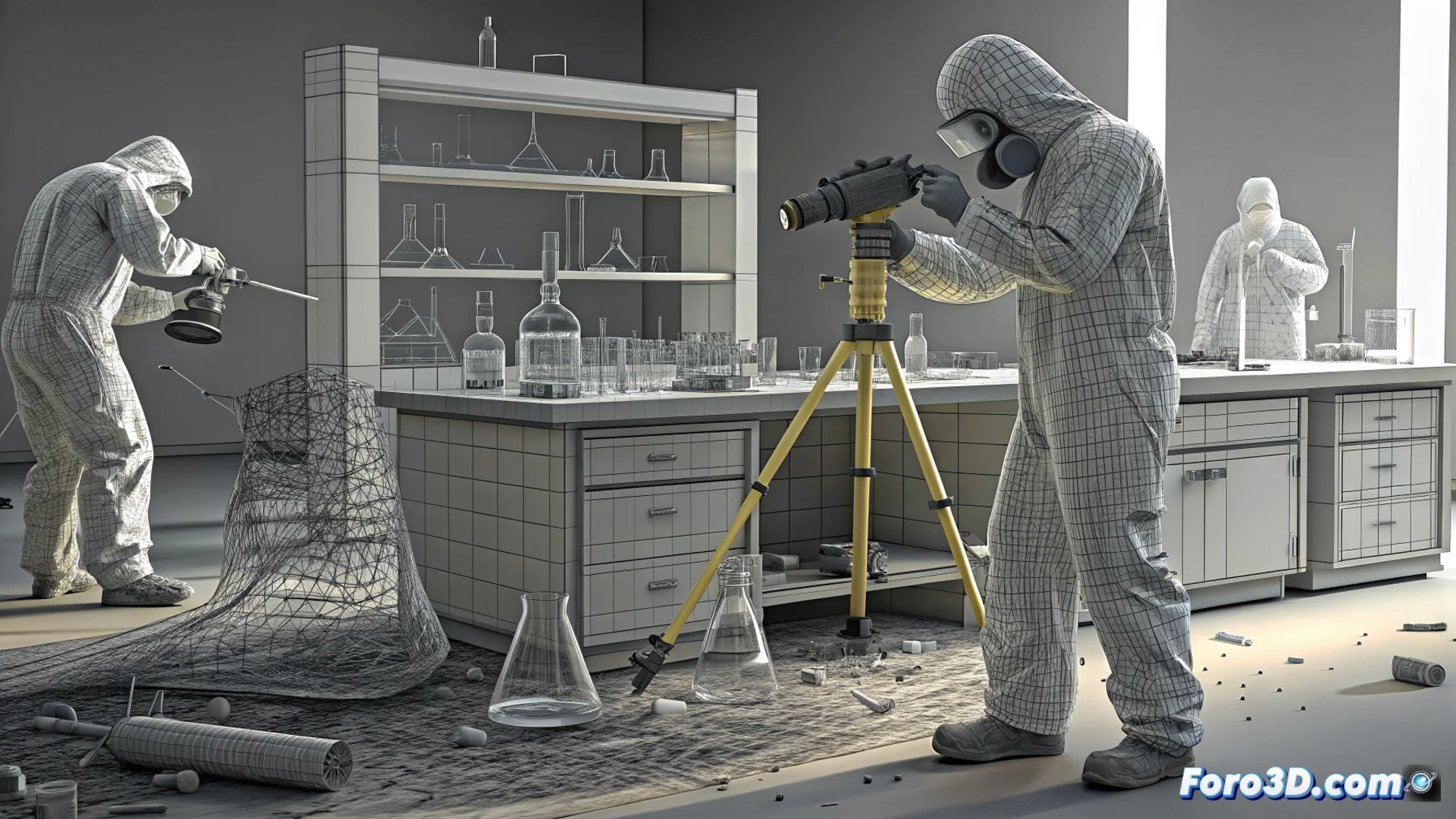
Reconstruct a Chemical Laboratory After an Explosion Using 3D Scanning
After a destructive event in a chemical laboratory, forensic experts apply cutting-edge technology to understand what happened. They don't just observe the debris; they digitally reconstruct it from scratch to find answers. 🔍
Document the Scene with Millions of Light Points
The first step involves high-precision 3D laser scanning. Technicians project beams of light onto every scattered fragment, from broken glassware to twisted metal structures. This system captures the exact geometry and position of all the remains, generating a massive and detailed point cloud. Specialized software then processes this data to form a three-dimensional mesh true to reality.
Key Data Capture Process:- Laser scanners measure the location and damage of each recovered object.
- A point cloud is generated that defines the geometry of the debris.
- The software converts these points into a manipulable 3D model.
The technology allows digitally reversing the effect of the blast wave and seeing how everything was before.
From Physical Chaos to Digital Order to Discover the Cause
With the complete digital model, investigators can manipulate the elements. They can regroup parts of a reactor or an extraction hood in their original position. The main goal is to determine the exact point where the fire started. To achieve this, they overlay additional layers of information on the model, such as the types of chemicals present or possible sources of a spark.
Analysis to Locate the Origin:- Different ignition scenarios are simulated in the virtual environment.
- The simulated damage pattern is compared with the one scanned in reality.
- Identifying the epicenter helps establish whether equipment failed, there was human error, or an unforeseen chemical reaction occurred.
A Vital Result for Future Safety
This meticulous work of 3D forensic reconstruction goes beyond determining culprits. Its conclusions are essential for preventing similar accidents in the future, improving protocols and laboratory designs. Sometimes, the most persuasive lesson comes from ordering the most absolute chaos. 🧪