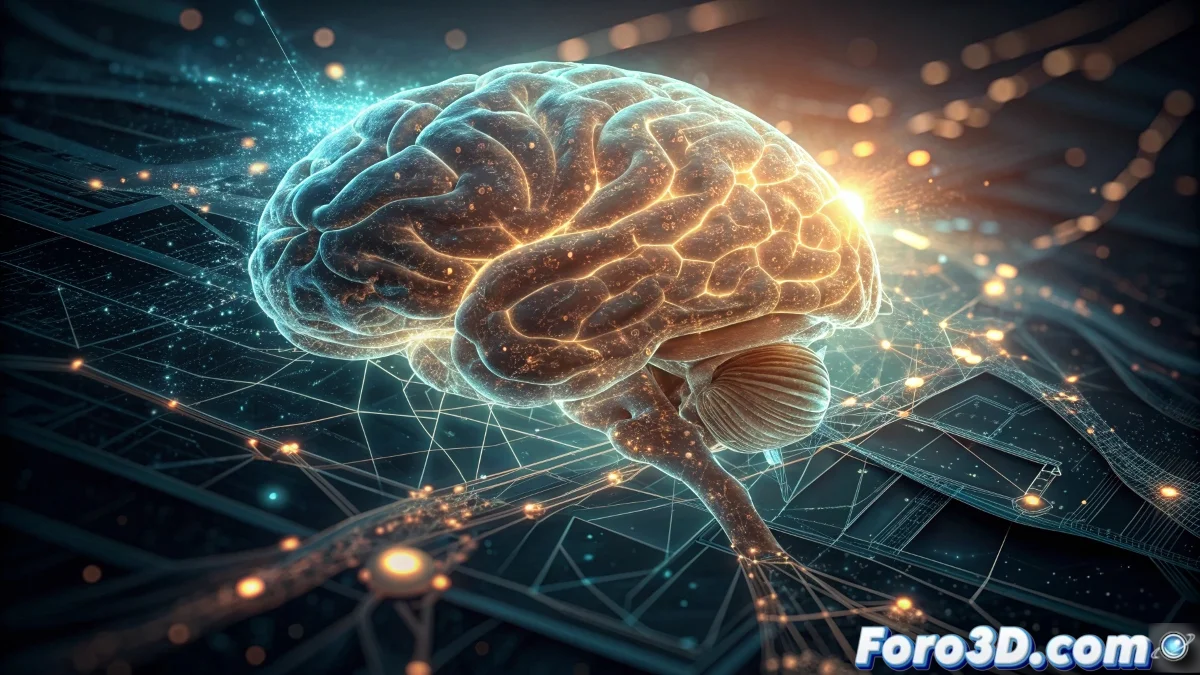
When Artificial Intelligence Maps the Complexity of the Human Mind
An international team of scientists has managed to create the most accurate map of the human brain to date, using artificial intelligence algorithms to process and analyze massive amounts of neuronal data. This achievement represents a quantum leap in our ability to understand the organization and connectivity of the body's most complex organ, revealing patterns and structures that had remained invisible to traditional research methods. The map not only shows macrostructures of the brain but descends to the level of individual neuronal circuits, creating an unprecedented three-dimensional representation.
What distinguishes this project is how it combines cutting-edge imaging techniques with advanced machine learning algorithms capable of detecting subtle patterns in datasets exceeding the petabyte of information. Where the human eye would see only noise and chaotic complexity, AI has identified hierarchical organizations, specific connectivity networks, and architectural principles that govern how the brain is structured and functions. This level of detail allows, for the first time, studying not only which brain regions exist, but exactly how they interconnect and communicate.
Revolutionary Features of the New Map
- Cellular resolution showing individual neurons and their connections
- Complete cartography of all cortical and subcortical regions
- Connectivity analysis revealing specific neural networks
- Multimodal integration of structural and functional data
The Methodology Behind Brain Mapping
The process began with the acquisition of ultra-high-resolution magnetic resonance images combined with electron microscopy of complete brain sections. The true innovation came with the development of AI algorithms capable of automatically aligning and segmenting these images, identifying each neuron, axon, dendrite, and synapse throughout the brain. Deep learning systems were trained with manually annotated data by neuroscientists, progressively learning to recognize neural structures with precision surpassing human capability.
The human brain contains more connections than stars in the Milky Way - now we are starting to map them
One of the most significant challenges was developing algorithms capable of tracing neural connectivity across vast distances in the brain. Using principles of tractography enhanced with graph neural networks, researchers were able to reconstruct the long and tortuous paths that axons follow to connect distant brain regions. This mapping of the brain's "information highway" reveals how different specialized systems coordinate to produce complex behaviors and cognitive functions.
Immediate Medical Applications
- Precise neurological surgery with maximum preservation of functions
- Early diagnosis of neurodegenerative diseases
- Development of more efficient brain-machine interfaces
- Understanding of psychiatric disorders at the neural circuit level
For fundamental neuroscience, this map represents the equivalent of the Human Genome Project for the brain. Just as genome mapping transformed biology and medicine, this complete brain atlas will provide the essential reference framework for decades of future research. Scientists can now pose questions about how specific connections are altered in neurological diseases, how circuits develop during learning, and what makes brain connectivity unique in individuals with exceptional talents or abilities.
Those working in artificial intelligence also benefit greatly, as the map provides the most detailed blueprint available of an extraordinarily efficient information processing system. Artificial neural network architectures could be inspired by the organization discovered in the biological brain, leading to advances in energy efficiency and learning capabilities that bring AI closer to natural intelligence.
This brain map is not the end of the journey, but the beginning of a new era in which we will be able to explore the human mind with a precision and depth that until recently belonged to the realm of science fiction 🧠