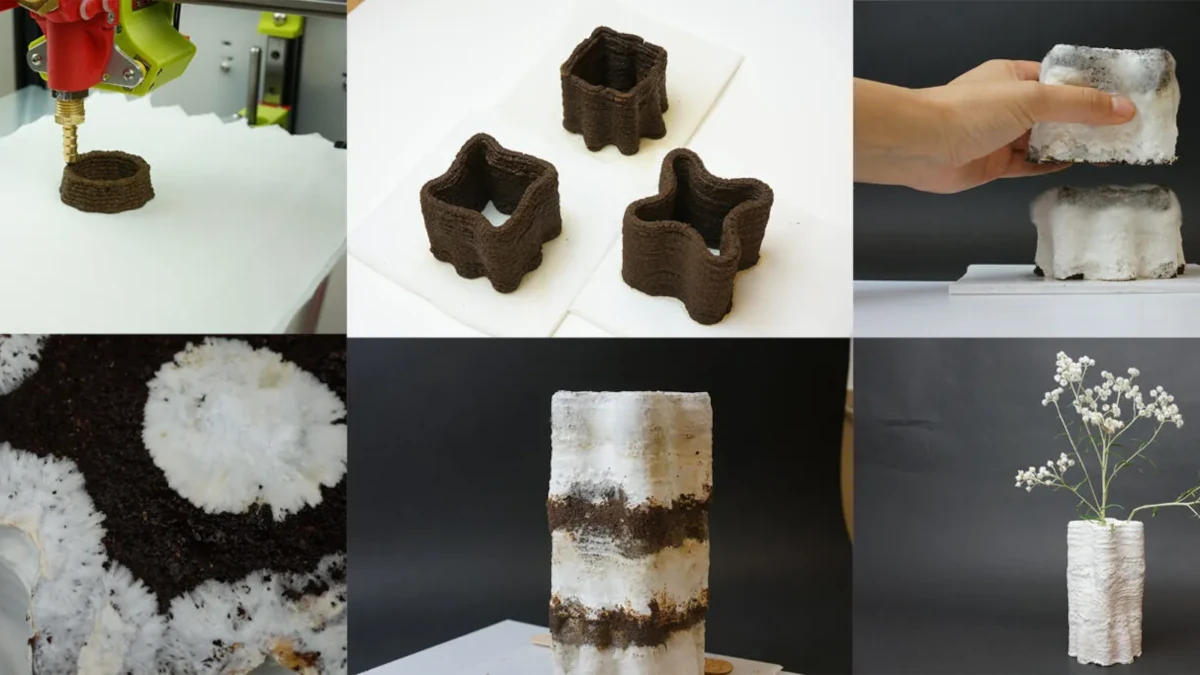
A team of researchers from the University of Washington has developed an innovative 3D printing technique that transforms coffee waste into a compostable packaging material. This advancement, published in the journal 3D Printing and Additive Manufacturing, offers an eco-friendly alternative to polystyrene foam packaging.
A New Material from Coffee and Mycelium
To manufacture this bioplastic, the scientists created a paste called Mycofluid, which combines:
- Used coffee grounds.
- Brown rice flour.
- Spores from the Reishi mushroom.
- Xanthan gum.
- Water.
After the 3D printing process, the pieces are left to rest for ten days to allow the mycelium, the network of fungal filaments, to grow, forming a protective layer around the material.
Properties Comparable to Conventional Packaging
Tests conducted demonstrated that this material offers:
- Similar strength to polystyrene foam.
- A water absorption rate of 7% after one hour of exposure.
- A higher density than expanded polystyrene, but with a weight comparable to cardboard or charcoal.
Thanks to these characteristics, this bioplastic is emerging as a viable and sustainable alternative for the packaging industry.
Applications for Customized Packaging
According to the researchers, this material could be useful for small businesses that need customized packaging solutions, especially for fragile products like glass or ceramics. Its ability to adapt to different shapes makes it an attractive option for sustainable shipping.
Reducing the Environmental Impact of Discarded Coffee
In the United States, more than 1.1 billion pounds of coffee waste are generated annually, representing a significant source of waste. This new method allows for the reuse of these leftovers to reduce plastic pollution.
"Although it currently requires a uniform type of coffee for its manufacture, the researchers are already exploring the use of other food waste for future applications."
Towards More Sustainable Industrial Packaging
3D printing combined with mycelium has proven to be an effective alternative for manufacturing biodegradable packaging. With the potential to replace polluting materials and utilize organic waste, this technology could become a key solution for reducing the environmental footprint of industrial packaging.